GOWIN FabricPilot Connects AI Assistants to FPGA Design and Hardware Debug
- Published
- Author
- Akanksha Gaur
- Reads
- 842
FabricPilot links MCP capable AI clients with GOWIN EDA for project setup, implementation analysis, programming and hardware waveform comparison.
FabricPilot brings AI assistants into the working FPGA design environment: GOWIN Semiconductor Corporation’s GOWIN EDA toolchain. Its practical distinction is that an AI client can interact with development tools and project data, rather than only generating code or answering questions from text. GOWIN says the software uses the Model Context Protocol (MCP) to connect compatible AI clients to its design environment.

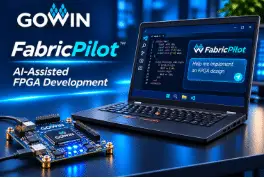
That connection spans several stages of FPGA work. Engineers can use natural language commands to set up projects, run development processes, inspect analysis results and look up technical documentation. The stated toolset includes 47 integrated tools across eight FPGA development functions, covering project management and design setup as well as synthesis, place and route, timing analysis and documentation lookup.

Control reaches into the design flow
FPGA development involves repeated exchanges between design files, implementation software and analysis reports. FabricPilot is intended to let engineers initiate and inspect these steps through an AI client that can call into GOWIN EDA. For example, a user can request a project setup or process run, then ask to inspect the resulting analysis. The value is in reducing the manual movement between commands, windows and reference documents; the engineering decisions still depend on reviewing the design and its results.

Synthesis translates a hardware description into a representation that can be mapped to the target device. Place and route assigns logic and interconnect within the FPGA’s resources, while timing analysis checks whether paths meet the design’s timing requirements. Bringing those stages under a conversational interface could make routine setup and report retrieval quicker, especially when a workflow requires repeated tool calls. It does not, by itself, establish that a design is functionally correct or meets timing. Those conclusions still need to come from the implementation evidence and the engineer’s review.
FabricPilot also supports local indexing of technical documentation. This gives an AI client a way to search material held within the development environment while responding to design questions. The company describes local execution and offline installation as supported options, with design files, execution history and indexed documentation kept in that environment. That setup may suit teams whose development machines operate without network access, though the available information does not specify supported operating systems, FPGA families, AI clients or installation requirements.

From implementation to physical hardware
The software’s workflow extends beyond creating and analysing a project. GOWIN says FabricPilot works with GOWIN Programmer for hardware programming and with GOWIN Analyser Oscilloscope (GAO) for debugging. It can also compare simulation waveforms with signals captured from FPGA hardware. That comparison connects expected behaviour in simulation with what the implemented device produces, giving engineers a way to examine differences across the design and test stages.

Waveform comparison can help focus debugging: engineers can inspect where simulated and observed signals diverge, then trace the discrepancy through the design and implementation. The product description does not provide measurement accuracy, supported acquisition settings or details of how comparisons are displayed, so it does not establish how much of that analysis is automated. The reported capability is the ability to compare the two signal sets within a workflow that also includes the vendor’s programming and analysis tools.
For teams already using GOWIN’s environment, connecting project operations, implementation reports and hardware debug through MCP could reduce repetitive interface work. The likely benefit is strongest in tasks with clear inputs and outputs, such as launching a known process or finding a relevant report. Designers will still need to specify constraints, judge timing and functional results, and decide whether changes are appropriate for the target device and application.
Local operation and traceability
GOWIN lists execution history, implementation reports and generated files as ways to trace activity. Telemetry is not enabled by default, according to the company. The application also checks sensitive actions so that engineers retain control over operations that could affect their work. Those measures address workflow visibility and user oversight; they do not replace a team’s own review of design changes or verification process.
The combination of offline installation and local project data is relevant for restricted development environments, where files and documentation may need to remain on the engineering system. The product description does not state what information, if any, moves between an AI client and other services when a networked setup is used. Teams assessing the tool will need to check configuration and data handling against their own environment.
FabricPilot is aimed at engineers developing FPGA based applications. Its defining feature is the bridge between an AI assistant and active design, implementation and debugging tools. The practical test will be whether that bridge makes routine work more efficient while keeping commands, generated files and analysis results reviewable. GOWIN’s product information is available at GOWIN Semiconductor.