ScioSense UFM-G01 Uses Ultrasonic Sensing for Residential Gas Meters
- Published
- Author
- Saba Aafreen
- Reads
- 966
ScioSense’s UFM-G01 measures gas flow at 16 to 7200 litres per hour, with up to ±1.5% accuracy and pressure loss below 150 Pa.
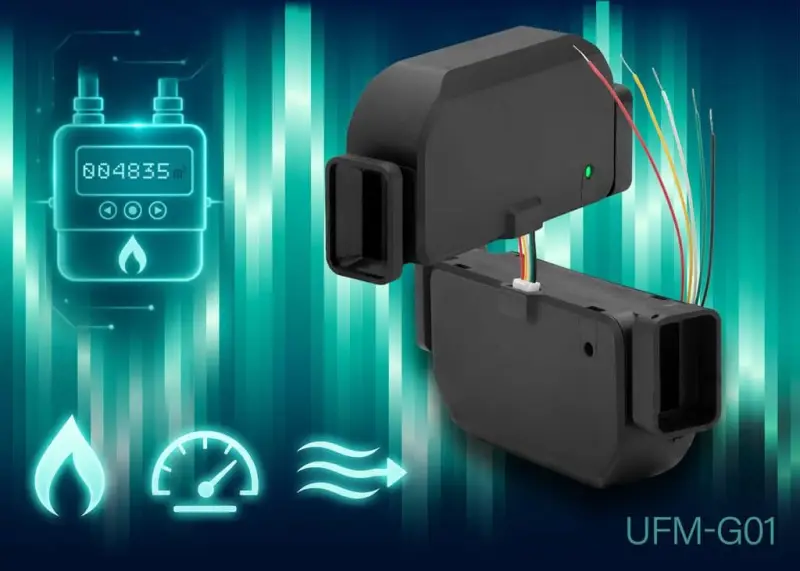
ScioSense’s UFM-G01 takes a different approach to residential gas measurement: it estimates flow from ultrasonic pulse timing instead of relying on thermal or mechanical sensing. For G4-class meters, the design targets two practical concerns at once—pressure loss through the meter and power use in battery-operated equipment.

Flow measurement from pulse timing
Two ultrasonic transducers sit inside the module’s pipe. They send pulses through the gas, and the difference in travel time provides the basis for calculating volumetric flow. Because this method has minimal contact between the sensing technology and the gas stream, ScioSense says the module can limit pressure loss while measuring flow.

The stated flow range is 16 to 7200 litres per hour, with accuracy of up to ±1.5%. Pressure loss is specified at less than 150 Pa. Those figures give meter designers a useful initial view of the measurement envelope, though the supplied specifications do not state test conditions, repeatability, or how accuracy varies across the full flow range.

That distinction matters when comparing a measurement module with a complete meter. The module’s figures describe its stated capability; system performance will also depend on the surrounding pipe geometry, installation and host implementation. ScioSense does not provide further detail here on those integration factors.
Integrated sensing and embedded interface
The UFM-G01 combines flow measurement with pressure and temperature sensors. It can report transient and cumulative flow, gas temperature, gas pressure and speed of sound. The pressure measurement range is 260 to 1260 hPa, and the operating temperature range is -20°C to +50°C.

The module supports air and methane (CH4). That makes gas compatibility a design parameter to check early: the stated support covers those two gases, while the available information does not specify performance with other mixtures or describe calibration requirements for a particular installation.

For equipment designers, the integrated measurements could reduce the need to source separate sensors for these quantities. The module communicates with a host device over UART, and ScioSense describes the design as plug-and-play. That provides a defined digital link, but the supplied details do not identify the UART settings, data format or host-side software requirements.
Power budget and service life
Battery operation is a central part of the product brief. The module runs from 3.2 V to 5.5 V and has typical energy consumption of 262 mAh per year. Its pulse frequency can be adjusted in software to reduce power consumption further. ScioSense does not give a specific reduction figure, so the achievable saving will need to be evaluated against the application’s measurement and update requirements.
The company also specifies a service life of up to 15 years. That is a design target rather than a complete account of field life: no qualification profile, environmental test conditions or maintenance assumptions are provided with the stated figure. For meter makers, it is a useful indication of the intended product lifetime, but system validation remains part of the design work.
Where the module may fit
ScioSense positions the UFM-G01 for G4-class residential gas meters, as well as small commercial gas distribution systems, gas burners, boilers and low-flow gas leakage detection. The low pressure-loss specification and battery-focused power profile are relevant to compact systems where flow restriction and service intervals affect product choices.
ScioSense says it can customise the module for customer requirements. Andreas Blocherer, the company’s Senior Product and Marketing Manager, described its price point as competitive, but no price was disclosed. Buyers will therefore need to assess cost, interface details and application-specific performance directly with the supplier.
The UFM-G01’s strongest engineering case rests on its combination of ultrasonic flow sensing, integrated pressure and temperature measurement, and a stated annual energy use suited to battery-powered designs. For teams evaluating it, the next checks are how the module performs across their actual flow profile, gas composition and host interface, and whether its lifetime and power figures match the meter’s operating requirements.
Further product information is available from ScioSense’s UFM-G01 product page.