AMD Versal TR SoCs Add Backside Tamper Detection and Post-Quantum Cryptography
- Published
- Author
- Saba Aafreen
- Reads
- 308
AMD’s Versal TR devices pair backside tamper sensing with adaptive SoC computing, key storage and post-quantum cryptography. Sampling is planned for 2027.

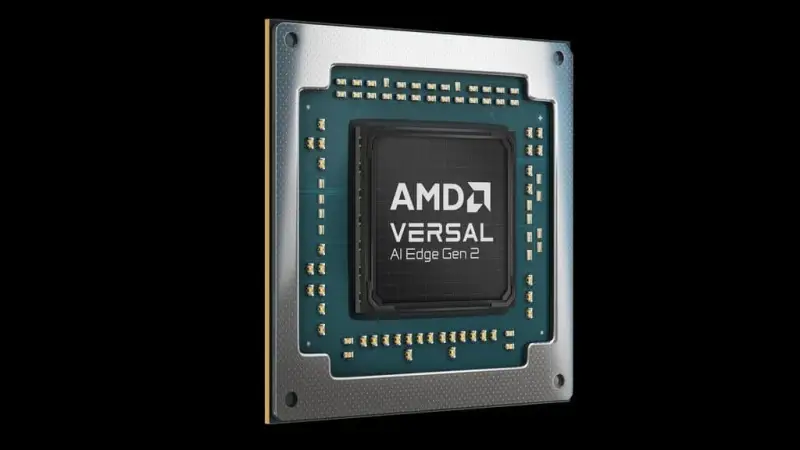
The AMD Versal TR family puts physical tamper sensing into an adaptive system-on-chip package, addressing an attack surface that conventional protection focused on the chip’s front side can leave exposed. Announced in November 2026, the devices combine a sensor die bonded to the compute die with programmable logic, Arm CPUs and AI Engines. AMD is targeting security-sensitive embedded systems, including data centre networking, fintech and industrial infrastructure.

Protection built into the package
The central design choice is a dedicated protection die bonded to the main compute die using 3D active-on-active technology. Its sensors cover the silicon backside, where physical access can create an avenue for probing or tampering. AMD says the system detects such activity and prevents booting if the protection die is tampered with or removed.
That boot response matters because a sensor only helps if the device can act on what it detects. Here, the protection die is part of the package’s security architecture, and its presence is tied to the ability to start the system. The design aims to make interference with the backside detectable before normal operation begins.

AMD positions the integrated approach as an alternative to assembling a custom protection scheme from separate components, mechanical enclosures and application-specific ICs. Folding sensing into the package could reduce board-level parts and space demands for designers. The trade-off is that platform architects will need to assess the device’s integrated protection against their own enclosure, board and system requirements; the available product details don’t specify sensor coverage thresholds or attack test conditions.
Security extends into boot and key handling
The Versal TR security features also cover cryptographic operations and device secrets. Hardware acceleration supports the post-quantum algorithms ML-DSA and SLH-DSA. Hybrid boot flows can support multiple signature algorithms, while an improved application security unit key vault provides a protected place for key material. A memory element aging sensor adds another hardware signal to the security toolkit.

Glitch detection has also been expanded. Alongside improvements to the existing architecture, the devices add a detector intended to identify simultaneous glitches across two voltage rails. That feature is relevant to fault-based attacks that try to disturb normal operation through brief electrical transients. AMD has not provided detection limits or test results in the product details, so those figures will matter to teams evaluating the protection for a specific design.
Taken together, these functions address different points in a system’s operation: backside sensing watches the package, boot checks govern whether execution starts, and cryptographic hardware supports authentication and key protection. They don’t remove the need for system-level security design, but they bring several protections into the silicon platform rather than requiring every project to assemble them from scratch.
Compute resources and migration options
Security is only part of the proposition. The devices combine Arm CPUs, AI Engines, programmable logic, hard IP and connectivity, with AMD specifying up to 229,000 DMIPS of scalar performance, 369 INT8 TOPS and 543,000 lookup tables (LUTs). Those figures describe the family’s stated capabilities; the product information doesn’t identify which individual model reaches each maximum or give workload conditions for the performance numbers.
AMD lists three parts: 2VE3358TR, 2VE3558TR and 2VE3858TR. Footprint-compatible standard counterparts are available, according to the company. This gives developers a possible migration path to a tamper-resistant variant without rerunning synthesis or place-and-route. For an established design, that could reduce some implementation work, though teams will still need to verify that the chosen device meets their security, timing and system requirements.

Kirk Saban, AMD’s Corporate Vice President of Product, Software and Solutions for AMD Embedded, said the devices bring physical attack protection together with high-performance computing to simplify development of security-critical systems. The practical value will depend on how the integrated safeguards behave in customers’ designs and how the parts fit their qualification schedules.
Availability timeline
AMD expects the first Versal TR devices to enter sampling in the second half of 2027, with production planned for the first half of 2028. That schedule leaves design teams time to compare the TR parts with their standard counterparts and determine whether the package-level sensing, boot controls and cryptographic features match their threat model.
For engineers, the main change is architectural: backside tamper sensing becomes part of an adaptive SoC offering that also supplies programmable compute and AI acceleration. The next useful details will be device-specific performance data, sensor and glitch-detection test conditions, and the design guidance available as samples approach.
AMD’s product information is available from its company site.