ScaffoldForge Generates Bone Scaffold Designs in 12 Seconds, but Needs Physical Testing
- Published
- Author
- Aura Moreno
- Reads
- 632
ScaffoldForge designs bone scaffold geometries from target properties in about 12 seconds. Its results remain simulated, and unfamiliar anatomy exposes data limits.
ScaffoldForge compresses a slow scaffold design process into a roughly 12-second generation step. The model creates a 3D geometry from requested structural properties, while conventional topology optimization takes about 8,400 seconds per design. That speed could make it easier to explore patient-specific options, but the reported results are computer simulations: no ScaffoldForge design has yet been printed or tested in a laboratory.
The work, by Yaohua Zhang, Hongyue Zhang, and Huaqing Yang, is described in a study published in PLOS One. Its target is the difficult balance in bone scaffold design. Open, porous structures can support blood vessel growth and transport nutrients, while reducing the material available to carry load. A scaffold must also fit the defect and be printable.
From target measurements to a 3D grid
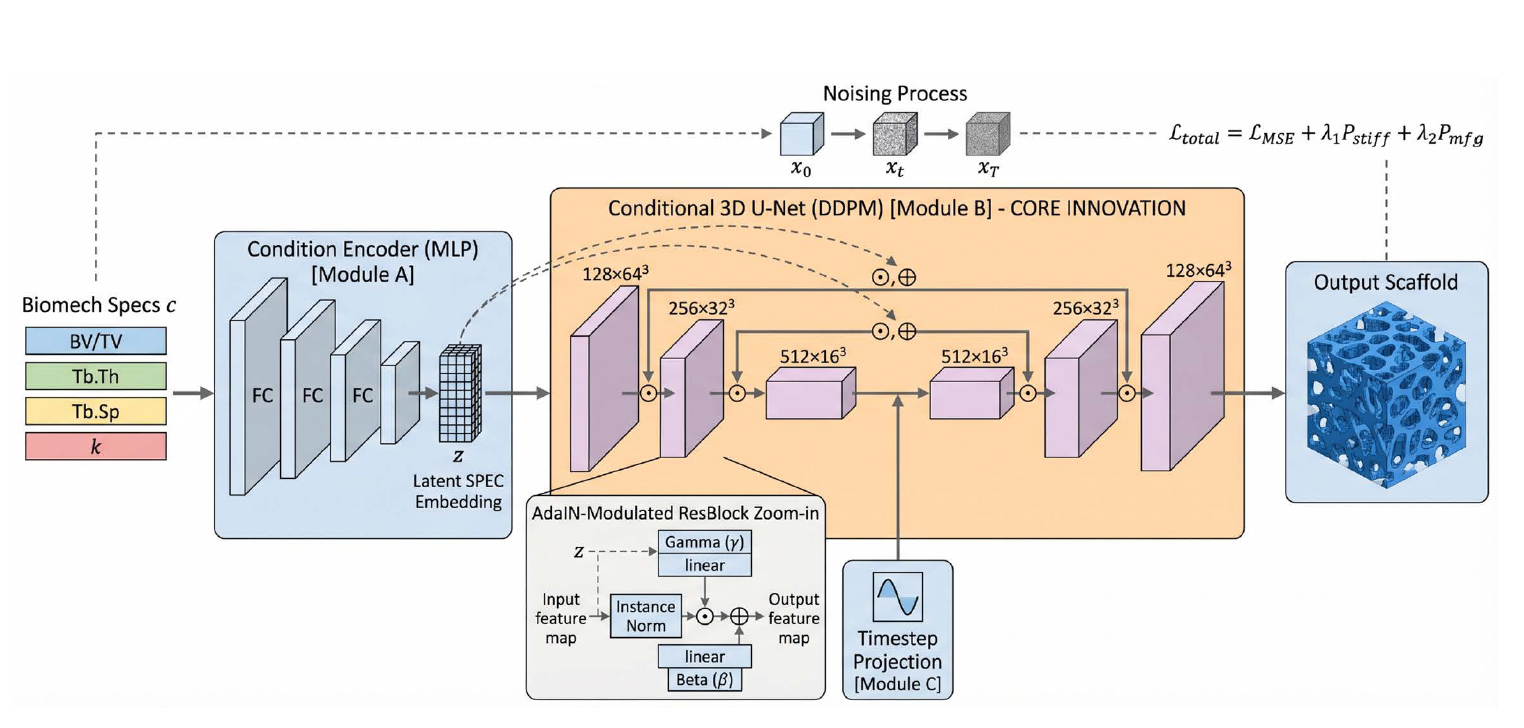
ScaffoldForge takes eight standardized measurements of trabecular bone architecture. They describe solid volume, strut thickness and spacing, connectivity, whether the structure has rod or plate forms, directional alignment, and fluid permeability. A diffusion model starts with random noise and refines it through 1,000 steps into a 64-by-64-by-64 voxel grid intended to match those targets.
The team built design constraints into training. The model is penalized when a scaffold falls below a load-bearing compressive strength level, contains overhangs that would need additive manufacturing support structures, or has permeability too low for nutrients to reach cells. These penalties are empirical rules rather than physical equations. Two previously trained neural networks estimate strength and permeability.
That distinction matters: the model is being steered by learned estimates of performance, not by a full physical simulation inside each generation step. The researchers’ approach is intended to reduce repeated optimization and checking. They still expect each generated design to need a simulation for validation.

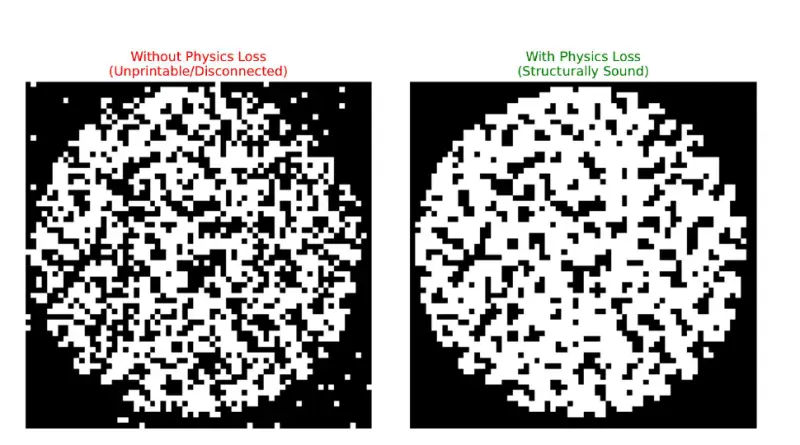
Training data is a constraint. The team assembled 250 scaffolds: 200 generated by software and 50 real structures with experimentally measured mechanical data. When the penalties were removed, generated results included disconnected clusters and floating material, geometries the researchers describe as unprintable. In a comparison of 500 generated designs against the training set, the model produced new geometries rather than simply reproducing training examples.
Speed and strength in simulation
On a single NVIDIA A100 GPU, ScaffoldForge generated a design about 700 times faster than topology optimization. A concurrent diffusion approach, TriTopo-LGDM, took 340 seconds. The comparison included eight other methods, among them evolutionary algorithms and Bayesian optimization.
ScaffoldForge’s estimated compressive strength was 56.6 MPa, 8.2% higher than topology optimization and 6.6% higher than TriTopo-LGDM. Across five training runs, the average strength gain over TriTopo-LGDM was 3.5 MPa (p = 0.043). Topology optimization produced slightly more permeable scaffolds. The authors attribute that difference to ScaffoldForge’s preference for stiffness while maintaining permeability above the level associated with blood vessel growth.
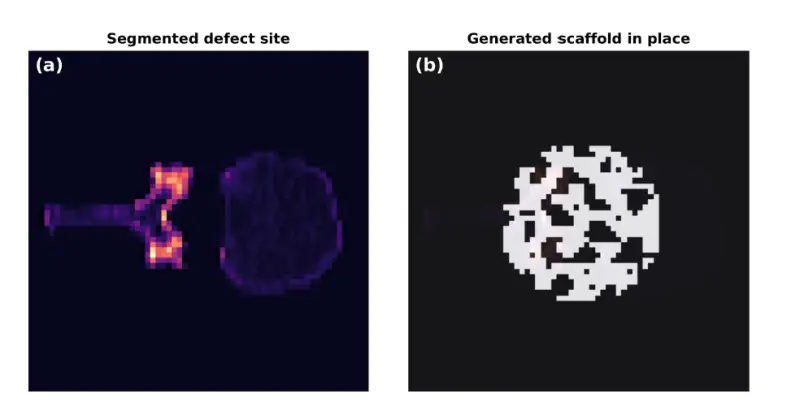
The researchers also tested a workflow using patient CT scans. It identifies a defect, generates a scaffold, then trims the geometry to the defect boundary. In 20 cases from a public spine CT dataset, the fit error remained within the 1 mm tolerance used for implants. This shows geometric fit in the tested pipeline; it does not establish how a printed scaffold would perform in use.
Unfamiliar anatomy exposes the data gap
Accuracy fell on bone shapes absent from training. For vertebral anatomy in an external dataset, error in matching target measurements was 65% higher than on the main test set. Expanding training from 250 to 2,050 scaffolds barely changed results on familiar geometries, but cut error on unfamiliar anatomy by about 27%. The team interprets this as evidence that more varied data, rather than a redesigned model, is the main need for handling new patients.
The software-generated training structures matched real bone within half a standard deviation on all seven shape measurements, but only two of seven met a stricter threshold. The researchers estimate that a stronger comparison would need about 100 real micro-CT scans, twice the number available to the study. A neural network classifier could still tell generated scaffolds from real bone, although less readily than it could distinguish the synthetic training data. With the expanded dataset, that difference was no longer statistically significant. The authors argue that closing the remaining gap requires more real scans.
Resolution also limits what the model can represent. Its grid captures features down to roughly 0.5 mm, coarser than natural trabecular bone’s 50 µm scale. Assessment for clinical use was outside the study’s scope, and the speed advantage applies only to design, not fabrication, testing, or assessment. The team’s immediate next step is to fabricate selected designs and compare mechanical tests with simulation predictions. Code, data generation tools, and trained models are available on GitHub.
ScaffoldForge’s practical contribution is a faster way to propose geometries against several competing targets. Whether those proposals translate into reliable implants depends on the work still ahead: testing printed parts, improving coverage of real bone anatomy, and checking predictions against measured performance.