Electric Drives: Components, Control Types, Advantages and Applications
- Published
- Author
- Komal Ganvir
- Reads
- 577
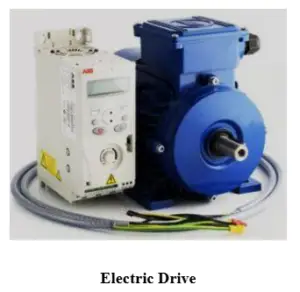
Electric drives combine a motor, power converter and control system to set load speed, torque and direction across industrial and domestic applications.
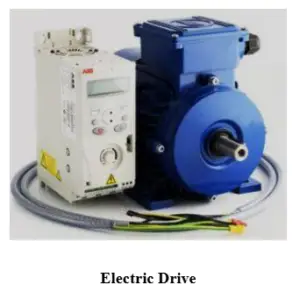
Electric drives pair a motor with power conversion and control equipment to match a machine’s motion to its load. The system can regulate speed, torque and rotation direction, making it useful wherever equipment needs controlled mechanical output. The central design task is matching the motor and its control hardware to the load and available power supply.
An inverter drive is generally used to control motor speed and torque. A servo drive adds precise control of position, as well as speed and torque, for applications that need accurate, coordinated motion. Both rely on a controller and power electronics, but their control requirements differ.
What the drive system contains
A typical drive connects a power source to a mechanical load through a power modulator and an electric motor. A control unit sets the operating behavior, while sensors can feed motor measurements back to the controller. In the block diagram, these parts form the path from an input command to mechanical motion, with feedback supporting regulation and protection.
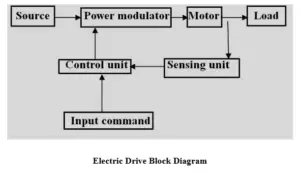
- Power source: Supplies electrical energy to the drive. The source and modulator together determine the electrical power available to the motor.
- Power modulator: Adjusts the power delivered to the motor to meet operating demands. It can limit excessive current during starting or temporary operating conditions, convert power between forms when needed—such as DC to AC—and select motoring or braking operation.
- Control unit: Receives input commands and produces signals for the power modulator. Those signals govern the requested speed, torque and direction, while the control unit also supports operation within safe limits.
- Sensing unit: Measures parameters such as motor speed and current and reports them to the control unit. In closed-loop systems, this feedback helps regulate performance and identify abnormal conditions.
- Electric motor: Converts electrical energy into mechanical output to drive the load. Selection depends on required power, speed, torque, performance, cost and operating conditions.
- Load: The driven equipment, such as a pump, fan, conveyor or machine tool. Its operating requirements shape the choice of motor, controller and converter.
Ways to classify drives
Drive categories describe different design choices, so a single system can fit several categories at once. The number of motors, supply type, speed behavior and torque or power requirements each offer a useful way to characterize an installation.
By motor count and mechanical arrangement, a group drive uses one motor to operate several machines through a shared arrangement. An individual drive assigns a separate motor to each machine. A multi-motor drive uses two or more motors to operate different parts of one machine or system. The latter arrangement is also described as a multi-motor drive in classifications focused simply on the number of motors, while a single-motor drive uses one motor for its load.
Supply type separates AC drives, which use alternating-current motors and are common in industrial settings, from DC drives, which use direct-current motors where controlled speed and torque are required. Speed behavior provides another distinction: constant-speed drives run at nearly fixed speed under normal conditions, while variable-speed drives allow adjustment to suit the application.
Control requirements can be expressed in terms of torque or power. A constant-torque drive is designed to provide approximately steady torque across its required speed range. A constant-power drive aims to maintain approximately steady power across a specified range. These characteristics help define whether a drive can meet the load’s demands as operating speed changes.
Trade-offs in operation
Electric drives are available across a broad range of power, speed and torque ratings, and they offer flexible speed and torque control. They need no fuel storage or routine refuelling, and they produce no direct exhaust emissions while operating. Electric braking can improve control, while semiconductor converters have made variable-speed AC operation easier and more efficient. Those features support use in settings from household appliances to industrial machinery.
The system depends on electrical power, so a supply failure can stop the drive unless backup arrangements are available. Installation can carry a high initial cost, and performance and dynamic response depend on the motor, controller and converter working together. Some systems also generate electrical or mechanical noise. Protection and control equipment can add complexity and cost.
Where electric drives are used
Applications span transportation, production equipment and everyday machinery. Electric traction systems use drives in trains, buses, trams and trolleybuses; battery-powered cars and scooters use them for propulsion. In factories, drives operate textile machinery, machine tools and other production equipment. Pumps, ventilation fans and air-conditioning systems use them to control flow or speed.
Robotic arms and automated machines depend on controlled movement and positioning, while conveyors, cranes, hoists and lifting equipment use drives for material handling. Washing machines, refrigerators and mixers are familiar domestic examples. Across these applications, the practical choice comes down to the motion the load requires, the available supply and the degree of control the process needs.