Melexis MLX90901 Adds Three-Axis Force Sensing to Humanoid Robot Fingertips
- Published
- Author
- Semiconductor For You
- Reads
- 980
The MLX90901 measures normal and two-direction shear forces in a complete fingertip module, giving robot developers a platform for tactile sensing trials.
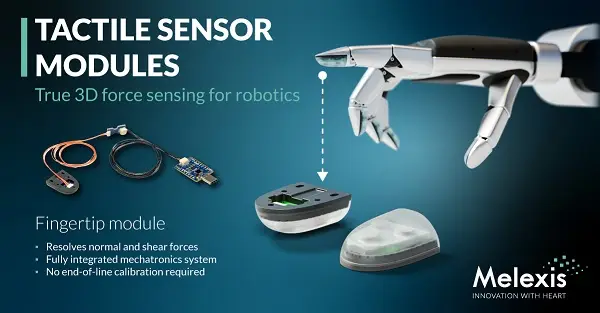
Humanoid hands need to know more than whether a finger has made contact. To keep a grasp stable, adjust to a shifting load or handle an object without damaging it, a robot needs information about both the size and direction of the forces at its fingertips. Melexis’ MLX90901 packages three-axis force sensing with the mechanical and electronic elements needed to evaluate that feedback in robotic hands.
Introduced on 12 November 2026 in Tessenderlo-Ham, Belgium, the MLX90901 is Melexis’ first mechatronic module built around its magnetic Tactaxis® sensing technology. It measures force perpendicular to the fingertip surface and shear in two directions. The company is targeting humanoid-hand manufacturers and robot developers who need a practical way to assess tactile feedback and collect contact data for control development.
Three force axes at the contact point
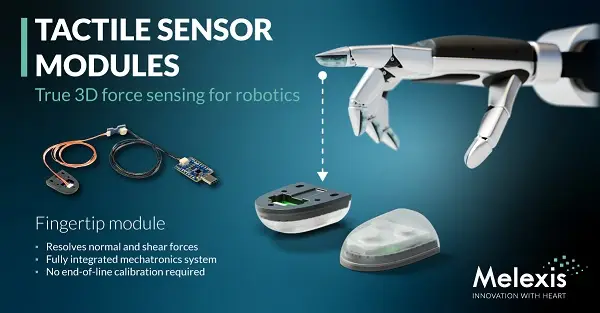
Many robotic grippers have no tactile feedback, while other systems measure contact force along only one axis. That leaves a robot with limited information about what happens when an object shifts across a fingertip or when a grasp begins to slip. The MLX90901 resolves contact forces across three axes: normal force and shear force in two directions. That lets a developer examine not just how hard a finger presses, but also how the load moves across the contact surface.
The sensor’s stated normal-force range is 15 N, and its shear-force range is 4 N. Melexis specifies 10% full-scale accuracy and a typical resolution of 200 mN. Together, those figures describe the measurement range and the scale of force changes the module can resolve. The module communicates over I²C, a common interface for connecting sensors to embedded controllers and development platforms.
Three-axis measurements can give a robot controller a richer picture of a grasp than a single perpendicular-force reading. For developers, the practical value will depend on how the measurements behave in their own hand geometry, materials and control loop. The module is intended to support that evaluation by providing a ready-to-integrate sensing assembly rather than leaving every team to build the mechanical stack around a sensor from scratch.
A complete fingertip assembly
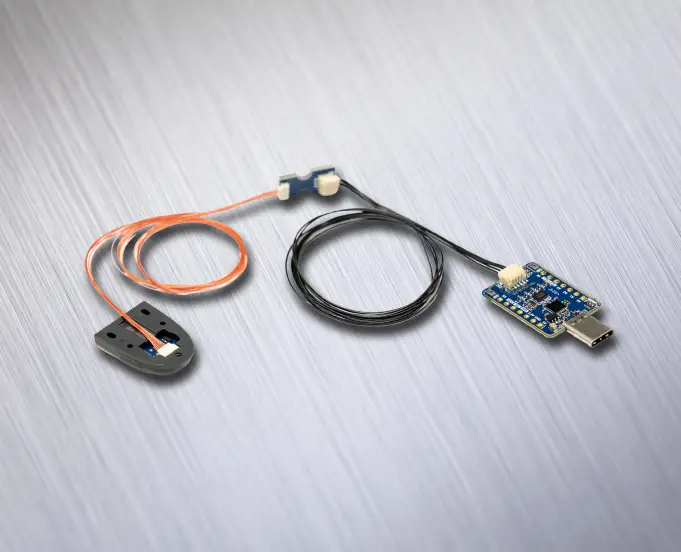
Tactaxis® uses magnetic sensing. In the MLX90901, the sensing element is integrated with a magnet, elastomer, mechanical structure and supporting electronics. These parts work together: the fingertip’s mechanical and material behavior shapes the response to contact, while the sensor converts that response into measurements. Treating them as a module gives developers a defined assembly to characterize and integrate.
That packaging addresses a familiar development burden in tactile sensing. A team working from a sensor element alone must also choose and assemble the materials, create a mechanical structure, and determine how those choices affect the resulting measurements. With the MLX90901, Melexis supplies those elements together. This can make early comparisons and prototyping more direct, although each robotic hand still needs to be assessed in its intended configuration.
The evaluation kit is identified as DVK90901. It gives developers a way to benchmark the fingertip, characterize its three-axis force response and begin integrating it into hand designs. Melexis presents the kit as a route for hand manufacturers and robot OEMs to collect contact data for developing and validating closed-loop control and physical AI systems.
From individual taxels to a standard module
The MLX90901 follows four years of Tactaxis® development. Melexis first demonstrated the underlying biomimetic sensing principle through individual taxels, allowing engineers to evaluate the sensing concept. Customer trials and application work then informed the move to a complete fingertip module. The shift puts attention on system-level integration as well as the sensing element itself.
That progression matters because tactile performance depends on the assembled fingertip, not only on the sensor’s nominal specifications. Developers will need to examine how the module responds in their grasping tasks and how its data fits into their control architecture. A common evaluation platform can help teams make those assessments before committing to their own hand designs.
Julien Ghaye, Melexis Product Line Manager, said the company developed Tactaxis® in response to accelerating research into tactile sensing and its connection to Melexis’ magnetic-sensing expertise. He described the MLX90901 as the company’s first complete mechatronic module and pointed to its materials, mechanics, electronics and integration as parts of that productization effort.
What developers can evaluate
For hand designers, the near-term question is whether the stated force ranges, accuracy and resolution suit the contact conditions they need to measure. The kit provides a basis for characterizing that response and gathering representative data. For robot developers, the three-axis output offers another input for testing how a controller responds to changing contact forces during grasping and manipulation.
The DVK90901 evaluation kit is now available. The MLX90901 gives Melexis a standard Tactaxis® fingertip module to build on as humanoid-hand designs and their sensing requirements develop. Its value in practice will be established through evaluation in specific robotic hands, where sensor behavior, mechanical integration and control needs meet.