Toray Develops Polyester Display Film with Retardation of 200 Nanometers or Less
- Published
- Author
- Semiconductor For You
- Reads
- 524
Toray’s biaxially oriented film combines lower optical retardation with moisture resistance and repeated-bend durability for display and sensor applications.
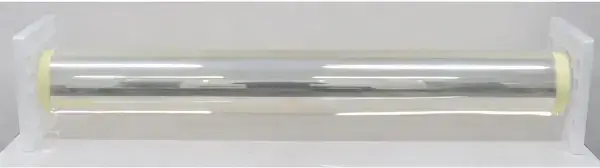
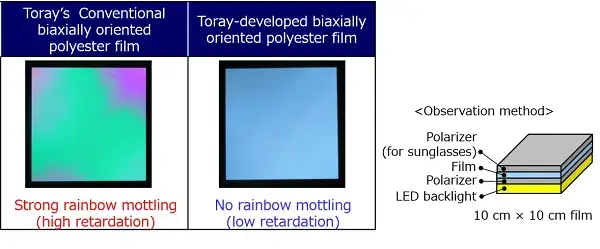
Reducing optical retardation without giving up the mechanical and environmental properties of polyester film could make it more useful in display stacks. Toray Industries says its new biaxially oriented polyester film reaches 200 nanometers or less of retardation when viewed head-on, about one-tenth the level of film made with conventional technology. The company also reports reduced retardation through the film’s thickness and more uniform retardation across its width.
Those optical changes address a familiar problem with films placed over displays: rainbow-like mottling can appear when the screen is viewed through a polarized filter, including polarized sunglasses. The effect is linked to retardation, which describes the difference in how light travels through a material as a result of its molecular orientation. Lowering retardation can reduce that interference in the viewing path.
Controlling orientation across the film
Polyester film gains much of its usefulness from being stretched in two directions. Biaxial stretching, lengthwise and widthwise, improves strength and dimensional stability while supporting processability. But the molecular alignment created by stretching also affects how the film interacts with polarized light. That creates a trade-off: the processing used to deliver mechanical performance can produce optical retardation that limits use on display surfaces.
Uniformity adds another manufacturing challenge. Stretching conditions can vary across a wide web, leaving different regions with different retardation. Even if a film performs well at one point, variation across its width can make it harder to use consistently in optical applications. Toray says its process refinements reduce that variation while lowering retardation overall.
The company’s approach combines adjustments to the biaxial stretching process with a proprietary multilayer structure. That structure includes a special polyester layer with low retardation. Together, these changes are intended to manage optical behavior while retaining the practical properties associated with polyester. Toray reports that the film’s lower thickness-direction retardation helps suppress rainbow mottling across different viewing angles; the company does not provide further measurement conditions for that comparison.
Film properties and potential uses
The stated optical result is for head-on viewing, defined as looking perpendicular to the film surface. Toray reports a value of 200 nanometers or less in this orientation. It describes the result as industry-leading based on its own research as of November 2026. The figure should be read as a company-reported performance claim: no test method, sample dimensions or independent comparison data are provided in the announcement.
Toray also identifies low moisture permeability and resistance to repeated bending as part of the film’s property set. Those characteristics matter when a display assembly needs to maintain dimensional stability as humidity changes or when a component flexes repeatedly in service. Combining these attributes with low retardation may broaden the material’s options in display structures, where optical behavior must coexist with environmental and mechanical demands.
Another proposed application is in sensors that use polarized light. In those systems, changes in polarization carry information, so a film that adds less unwanted retardation may be useful in the optical path. The announcement does not name specific sensor designs or quantify the improvement such a film could deliver, so its practical fit will depend on the requirements of each system.
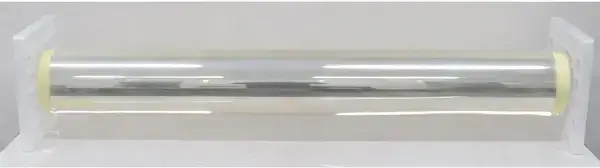
Scale-up remains the next step
The reported performance establishes a material and process result, while production readiness remains under development. Toray says it will continue developing technology for mass production. For manufacturers assessing the film, the next useful details will be whether the low retardation and widthwise uniformity hold at production scale, and how those results compare across film thicknesses and operating conditions. No production date, commercial availability, dimensions or pricing are specified.
For now, the key engineering point is the combination: a biaxially oriented polyester film designed to retain strength, dimensional stability and processability while reducing optical retardation, limiting moisture transmission and tolerating repeated bending. If scale-up preserves that balance across wide film, it could give display and polarized-light sensor designers another material option where conventional polyester’s optical effects have constrained its use.