Murata SCI36LT IMUs Add Embedded Processing for Industrial Motion Sensing
- Published
- Author
- Semiconductor For You
- Reads
- 910
Murata’s SCI36LT combines six degree of freedom MEMS sensing and an embedded MCU, with turnkey orientation software or a user programmable option.
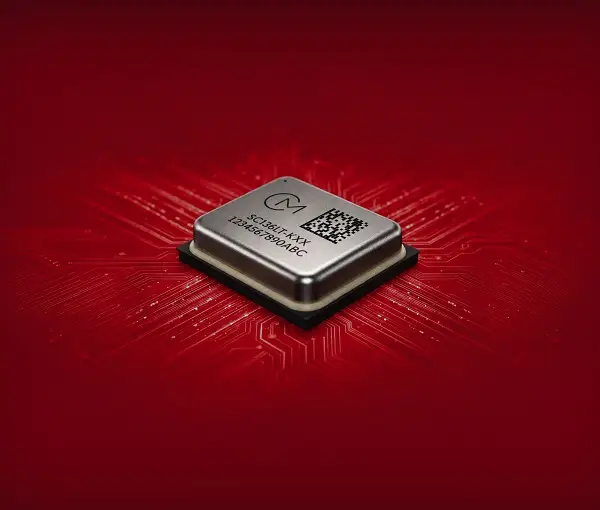
Murata’s SCI36LT puts inertial sensing and application processing inside one compact component. The two initial versions pair a six degree of freedom MEMS IMU with an embedded microcontroller (MCU): the SCI36LT-K01 runs Murata’s orientation algorithm, while the SCI36LT-K02 lets customers load their own software. For designers, the main change is where computation can happen. Orientation calculations or application-specific processing can run beside the sensors, reducing work assigned to a host processor.
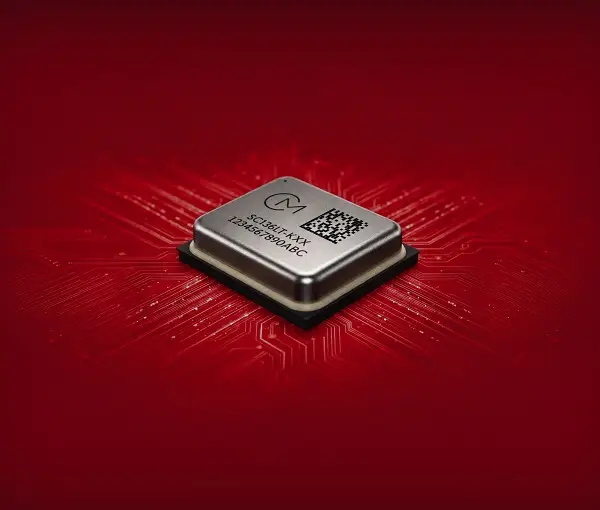
That integration addresses a familiar design burden. An IMU measures angular rate and linear acceleration, but those measurements alone do not describe an object’s orientation. A host system typically has to combine the sensor data, account for calibration, and tune the resulting behavior for the application. This takes processor capacity and specialist development effort. Murata’s approach moves some of that work into the sensor package, giving system designers a choice between supplied orientation processing and their own embedded code.
Two ways to use the embedded MCU
The SCI36LT-K01 is the ready-to-use option. Its integrated MCU runs Murata’s proprietary sensor fusion algorithm, which calculates pitch, roll, and relative yaw. The device combines a gyroscope with a ±490°/s range and an accelerometer with a ±16 g range. Orientation data can be output in Euler angle or direction cosine matrix (DCM) form. Configurable algorithm dynamics and output data rates let designers adjust the response and reporting behavior to suit different motion profiles and system needs.
The K01 also includes calibration features that support calibration at module level after the sensor has been assembled into the end system. That timing matters for designs where the behavior of the installed board or module needs to be accounted for during compensation. Murata describes this as a way to simplify calibration at PCB or module level; the supplied information does not specify calibration procedures or performance figures.
The SCI36LT-K02 uses the same basic IMU and MCU architecture, but omits Murata’s sensor fusion algorithm. Customers can program the MCU with their own software, putting application-specific processing in the sensor component. This option offers more control over how inertial data is handled, while still moving some processing away from the host. The practical fit will depend on the customer’s software requirements and the resources available on the embedded MCU; details such as programming tools and MCU specifications haven’t been provided.
Packaging, supply and operating range
Both variants measure 11.2 × 9.2 × 2.9 mm (0.44 × 0.36 × 0.11 inches) and use a surface-mount LGA package. The package brings together the MEMS sensor, MCU, supporting electronics, passive components, and crystal resonator. Integrating those parts can reduce the number of external components needed for an inertial sensing design and makes the platform relevant where board area is constrained.
The stated supply range is 3.1 V to 5.5 V, and the operating temperature range is -40°C to +85°C. These figures give designers key limits for assessing power and thermal compatibility. The announcement doesn’t specify interface details, current consumption, shock limits, or vibration performance, so those characteristics will need to be checked against the requirements of a particular system.
Murata says the SCI36LT family is intended for industrial and robotic uses that need motion or inclination data. Examples include grade control on heavy machinery and excavators, dynamic inclination sensing in construction machinery and industrial equipment, and support for real-time kinematic (RTK) positioning in surveying equipment and autonomous systems. Other cited applications include humanoid robot motion sensing and commercial drones used in agriculture, infrastructure and facility management, civil engineering and construction, and logistics. These examples span very different motion profiles, which makes the K01’s configurable algorithm behavior and the K02’s custom software path distinct design choices.
A platform for later variants
Murata characterizes the SCI36LT architecture as a base for a wider product family. Future versions may pair different algorithms and IMU calibration configurations with application-specific sensing needs. No future model numbers or release dates are given, so the initial design decision rests on the two available approaches: use Murata’s orientation processing in the K01, or develop software for the K02.
Juhani Pelttari, Senior Manager, Business Development at Murata Europe, said demand from industrial and robotic motion-control systems is extending beyond inertial measurement to processing flexibility at the sensor. His description of the product’s value centers on letting designers choose where inertial data is processed and reducing system-level integration work.
Samples of the SCI36LT-K01 and SCI36LT-K02 are available now, with mass production scheduled to begin in Q1 2027. The immediate engineering question is whether the supplied pitch, roll, and relative yaw processing covers the application, or whether custom MCU software justifies the development work. Either way, the integrated package gives designers a route to keep more inertial-data handling close to the sensing element.


