InfiMech MX Series Brings Six or Eight Toolheads to Desktop 3D Printing
- Published
- Author
- 3DWithUs
- Reads
- 1,002
The MX pairs six toolheads with a 220 mm build volume; the enclosed MX Pro adds eight tools, a 300 mm build volume and active chamber heating.
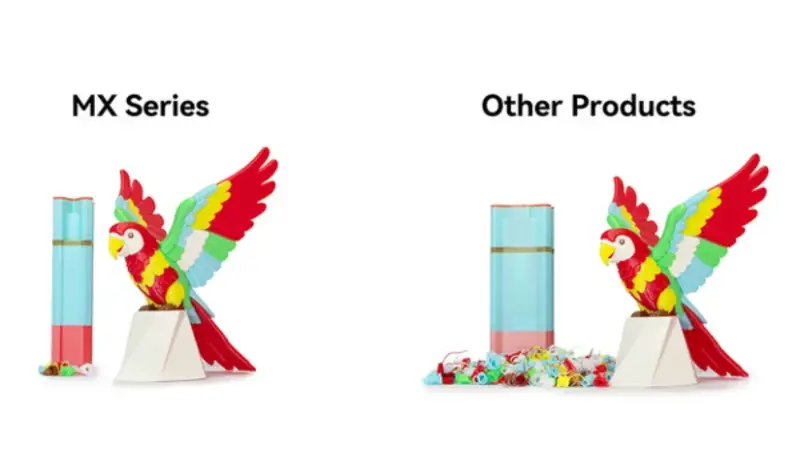
Dedicated toolheads could make the InfiMech MX Series useful for more than multicolor prints: each nozzle can stay loaded with its own filament, so changing materials doesn’t require purging one shared melt path. InfiMech has launched two FDM printers on Kickstarter: the six-toolhead MX and the larger, eight-toolhead MX Pro.
That architecture targets a familiar limitation of single-nozzle color systems. When a printer feeds a new filament through the same hotend, it may need to extrude material to clear the previous color. With separate toolheads, the machine parks one tool and picks up another. InfiMech says this can reduce purge waste; the actual savings will depend on the print and how its material changes are configured.
Two sizes, two machine configurations
The open-frame MX has six toolheads and a 220 × 220 × 220 mm build volume. The fully enclosed MX Pro expands the system to eight toolheads and a 300 × 300 × 300 mm build volume. It also adds active chamber heating, closed loop motors, AI monitoring and air filtration, features the standard MX does not list.
| Feature | InfiMech MX | InfiMech MX Pro |
|---|---|---|
| Toolheads | 6 | 8 |
| Build volume | 220 × 220 × 220 mm | 300 × 300 × 300 mm |
| Enclosure | Open | Fully enclosed |
| Active chamber heating | No | Yes |
| Closed loop motors | No | Yes |
| AI monitoring | No | Yes |
| Air filtration | No | Yes |
For prints that mainly need several colors of PLA, six independent tools offer considerable flexibility. The MX Pro’s added volume and heated enclosure are more relevant to larger parts and materials that benefit from a controlled printing environment. InfiMech presents it as the option better suited to engineering filaments, though the source material does not specify chamber temperature limits or compatibility for individual materials.
Changing tools instead of changing filament
Each filament can remain assigned to a complete toolhead, with its own nozzle and extruder. When the print calls for another color or material, the printer changes tools rather than feeding a new filament through the nozzle already in use. This avoids the shared melt path that creates purge waste in many single-nozzle systems.
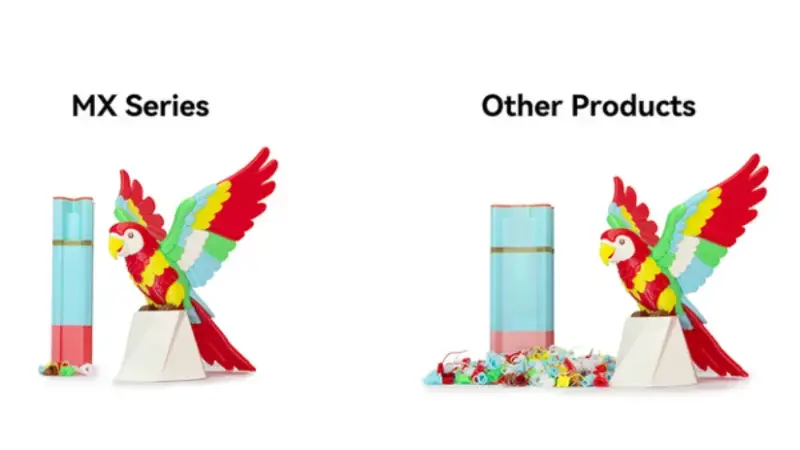
The separate tools also create options beyond color changes. A user could assign different materials, support filament or nozzle configurations to different heads, avoiding repeated loading and unloading from one hotend. That may help when a part combines, for example, a primary material with a separate support material or flexible sections. The source doesn’t give detailed limits for tool compatibility or mixed-material combinations, so those capabilities will need to be assessed against the printer’s software and material guidance.
Toolchanging itself is an established approach, with machines such as the Prusa XL demonstrating dedicated printheads. InfiMech’s pitch is to bring the format to lower price points. The practical test will be whether tool changes, nozzle positioning and print preparation remain dependable across complex jobs.
Induction-heated toolheads and alignment
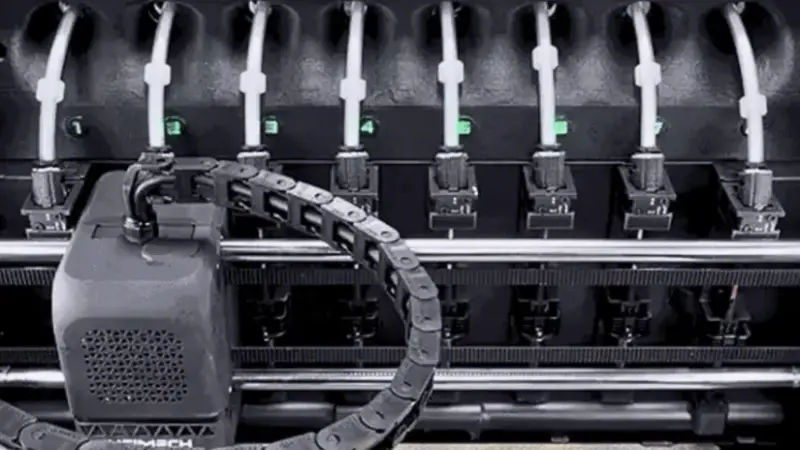
InfiMech says the MX Series uses induction to heat its removable hotends. The company describes the heating as contactless and fast, and says temperature monitoring does not rely on conventional wiring to every parked toolhead. With six or eight tools available, that design could simplify how parked heads connect to the moving carriage, though detailed heating times and temperature specifications aren’t provided.
Multiple nozzles also make positioning important: each must return to a consistent height and location when selected. InfiMech lists adaptive calibration, automatic nozzle alignment and a dedicated sensor intended to detect material buildup around the nozzle. These features address the setup and maintenance demands that come with exchanging tools, but their performance in extended use remains to be established.
Materials, pricing and development
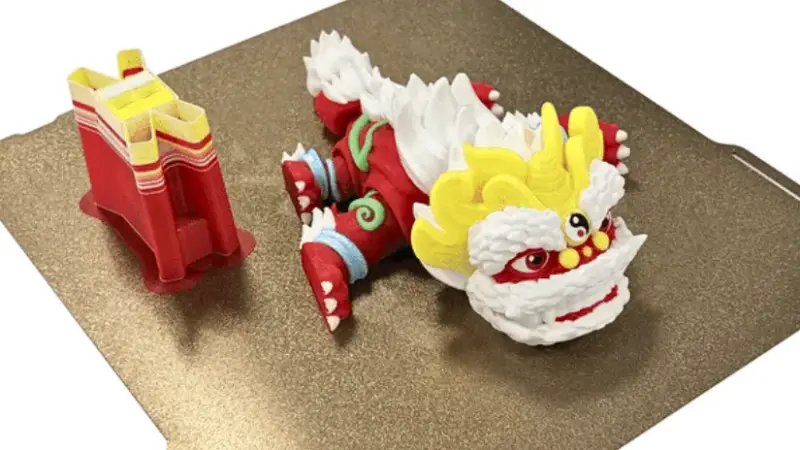
InfiMech is working with eSUN as a filament partner for the Kickstarter launch. The materials highlighted for the platform include high speed PLA, PETG, TPU and engineering-grade filaments. The MX Pro’s enclosure and active chamber heating are intended to support materials that benefit from a more stable environment, including larger parts prone to warping.
At launch, listed Super Early Bird prices were $299 for the MX and $549 for the MX Pro. VIP cashback prices were listed at $249 and $499, respectively, while the stated MSRPs were $399 for the MX and $1,399 for the MX Pro. Reward tiers and availability can change during a campaign, so current offers are shown on the Kickstarter campaign page.
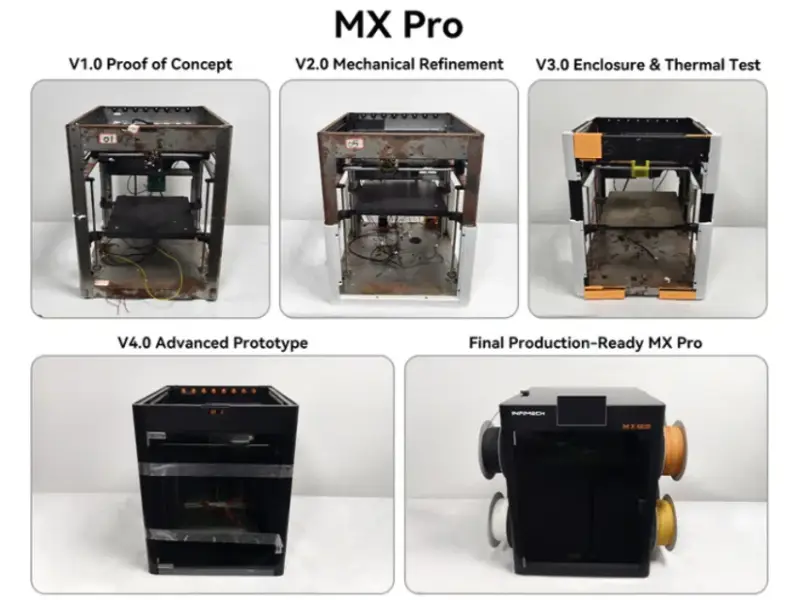
The MX Pro went through several development stages, from an early proof of concept to a refined prototype with enclosure and thermal testing, before the production-ready design shown by InfiMech.
InfiMech was founded in 2023 and develops desktop 3D printers and related products. Its earlier work includes the TX printer platform and accessories. The company says its team includes PhDs and engineers with 3D printing industry experience. A video from The Real Samprentice shows the six-toolhead setup in operation, offering an early look at the toolchanging workflow.
For prospective users, the key question is how the MX Series handles the details that determine everyday usefulness: reliable tool exchanges, accurate nozzle alignment and software support for multi-material prints. The tool count and build volumes set out the platform’s scope; sustained printing will show how well those capabilities translate into a repeatable workflow.