Hanji-Based 3D Printed Patch Combines Microneedle Drug Delivery and Sweat Sensing
- Published
- Author
- Paloma Duran
- Reads
- 396
Jeonbuk National University’s breathable paper patch pairs printed drug-delivery needles with wireless uric acid sensing; the functions were tested separately.
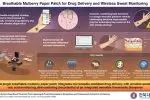
A wearable patch built on hanji, traditional Korean mulberry paper, combines two functions that are often developed separately: microneedles for delivering a drug and printed electrodes for measuring uric acid in sweat. Jeonbuk National University (JBNU) researchers say the paper substrate could help address a practical problem in long-wear devices: keeping a patch breathable while it collects sweat and carries a treatment component.
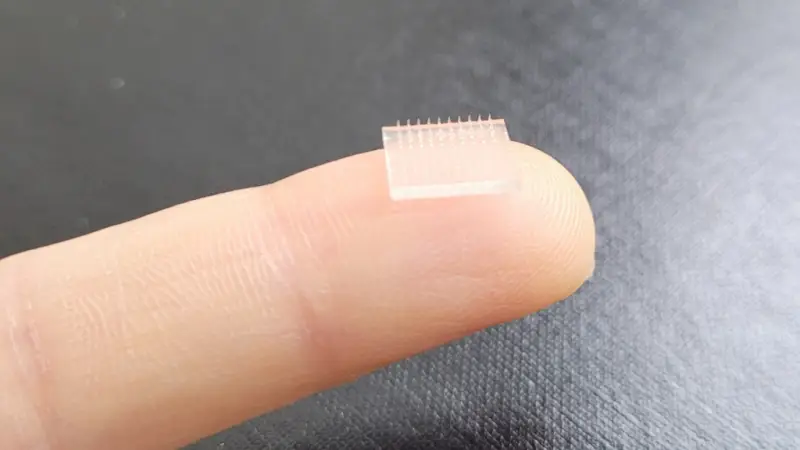
The team tested the delivery and sensing systems separately. Its microneedles held more of a model drug formulation than a baseline design, while its electrochemical sensor measured uric acid across a reported micromolar range and produced results that tracked laboratory analysis. Those results are promising for a combined wearable, but the study does not yet demonstrate simultaneous treatment and monitoring on a person.
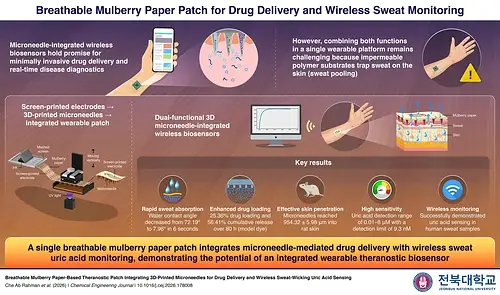
Printing needles directly onto hanji
Attaching small, relatively stiff structures to a flexible, fibrous sheet can require a separate bonding layer. JBNU’s team used a light-based 3D printing process to form the microneedles directly on hanji, curing them in place without adhesive. After adjusting the design, the needles held a drug load of 25.36%, compared with 12.6% for the baseline version.
In a release test using a model dye, the needles discharged 56.41% of their load over 80 hours. That gradual release suggests a possible route to sustained delivery, although the study’s dye test does not establish how a particular medicine would behave. The team also tested the printed structures on excised rat skin: they penetrated to a depth of roughly 954 micrometers and retained their shape.
The choice of substrate matters because a patch has to manage moisture at the skin interface as well as hold its functional components. The researchers’ rationale is that plastic-backed patches can trap moisture against skin, potentially causing irritation and complicating sweat collection. Hanji’s network of fibers instead draws liquid away. In a wetting test, a water droplet’s contact angle on the paper fell from 72.19° to 7.96° in six seconds.

That rapid change indicates that water spread across and entered the fibrous sheet. It supports the team’s case for hanji as a breathable sensing substrate, though real-world wear will depend on more than droplet behavior: the assembled patch’s fit, durability, and performance during movement still need to be assessed.
Uric acid readings checked against LC-MS
The printed electrochemical sensor targets uric acid, a biomarker used in managing gout and hyperuricemia. Blood tests are currently used to monitor uric acid, while a sweat sensor could offer a route to repeated measurement without drawing blood. The researchers report a sensing range of 0.01 to 8 micromolar and a detection limit of 9.3 nanomolar.
To check the measurements, the team compared the sensor with liquid chromatography-mass spectrometry (LC-MS), using both buffer and real sweat. Recovery ranged from 98.1% to 101.3% of known amounts. The sensor’s surface dried in 13 seconds, and three repeat measurements returned the same results. The wireless link drew 15 mW.
These figures describe specific laboratory checks, rather than a demonstrated at-home monitoring system. The reported agreement with LC-MS is useful evidence that the sensor can quantify prepared samples and sweat under the tested conditions. Further work will need to show how reliably it measures changing uric acid levels during wear, including the effects of sweat volume and patch contact.
Two functions, still tested apart
Professor Sooman Lim led the study, with Aqila Che Ab Rahman and Habibulla Imran as joint first authors. Their work was published in Chemical Engineering Journal. Lim said the results establish a basis for combining microneedle delivery and wireless sweat sensing on one breathable substrate, while noting that the two functions were evaluated separately.
That distinction sets the current boundary of the work. The study shows that microneedles can be printed onto hanji and that the paper can support an electrode-based sweat measurement. It does not show that a treatment can be delivered while the same device tracks uric acid on a living wearer. The team’s next steps are to replace the model dye with clinical drugs, assess skin safety, and test the patch on the body in real time.
The design fits into a broader push to print microneedles for drug delivery and sensing. Researchers at Queen’s University Belfast have developed a dissolvable skin patch that carries two anti-cancer compounds in the printed resin. Stanford University and UNC Chapel Hill have also used Carbon’s CLIP process to print a microneedle vaccine patch. Those examples address different delivery needs; JBNU’s distinctive engineering choice is to make the substrate itself part of the moisture-management strategy.
Other research groups have paired printed structures with sensing or delivery in different configurations. A team with contributors from West China Hospital of Sichuan University and The Chinese University of Hong Kong developed a wound dressing using solid microneedles as electrodes and hollow needles to carry medication. Researchers at the National and Kapodistrian University of Athens printed an electrochemical ring that reads glucose from sweat and displays the result on a smartphone.
For JBNU’s patch, the next decisive step is integrated testing on skin. The separate results make hanji a plausible base for a breathable wearable that both delivers a treatment and monitors a biomarker. Whether it can do both reliably during everyday wear will depend on the combined device’s performance with real drugs, real skin, and continuous sweat sampling.