KIT Tracks 2PP Resin Conversion into Silica Glass with 5.94 GPa Tensile Strength
- Published
- Author
- Aura Moreno
- Reads
- 465
A POSS resin’s heat driven conversion produces 2PP silica glass with tensile strength of 5.94 ± 0.45 GPa at 1000°C, while mapping shrinkage and chemistry.
Heat treatment can turn a rubber-like two-photon polymerization (2PP) print into silica glass with a measured tensile strength of 5.94 ± 0.45 GPa. Researchers at Karlsruhe Institute of Technology (KIT) tracked the material’s shrinkage, color, mass loss, chemistry and mechanical response as it converted, addressing a practical challenge in nanoscale glass printing: knowing what happens inside a part while its organic structure is removed.

The work, by Jiajie Liang, Lisa Hoffmann, Paul Albrecht and Jens Bauer, was published in Communications Materials under the title “Uncovering the thermolysis conversion mechanisms of 3D nanoprinted silica glass.” Its findings give process designers a clearer view of how the heating schedule changes both the material and the part’s dimensions.
Following the resin through heat treatment
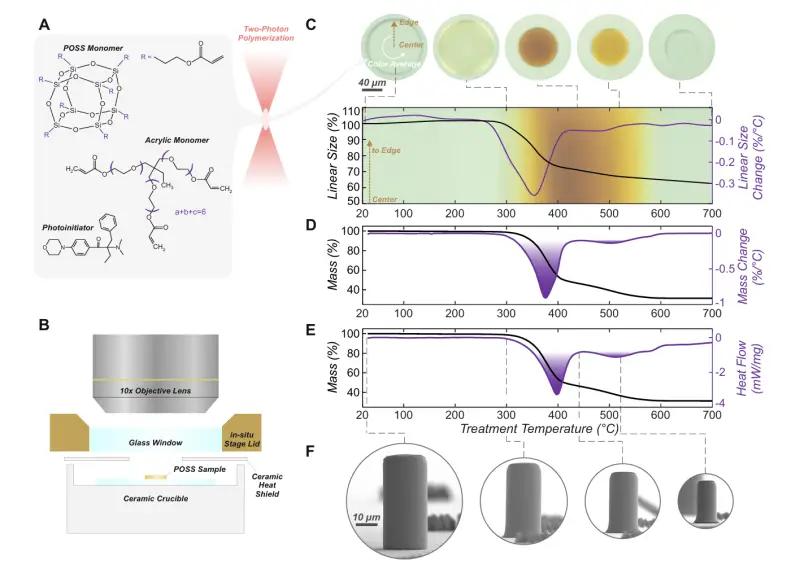
The team printed a resin based on polyhedral oligomeric silsesquioxane, or POSS. The molecules have silicon-oxygen cages with acrylic groups at their corners. The formulation combined a POSS blend from Hybrid Plastics, an acrylate from Sartomer and a photoinitiator. Printing took place on a Nanoscribe Photonic Professional GT2. Heating the printed material in air removes its organic portion, leaving silica.
To observe the transformation, researchers heated 100 µm disks under a microscope and measured their size and color. They also recorded mass loss and heat flow. The disks began yellowing and contracting near 300°C. At 440°C, they had turned brown and measured roughly 70% of their starting size. Continued heating brought back full transparency, with the parts reduced to close to 60% of their original dimensions.
Above around 600°C, mass and heat flow stopped changing. The remaining mass was near 32%, close to the 33% expected for pure silica. The researchers associate the temporary darkening with carbon-rich byproducts; as those residues burn away, the material clears. The measurements connect visible changes in a part to the underlying loss of organic material.
Mechanical properties shift with temperature
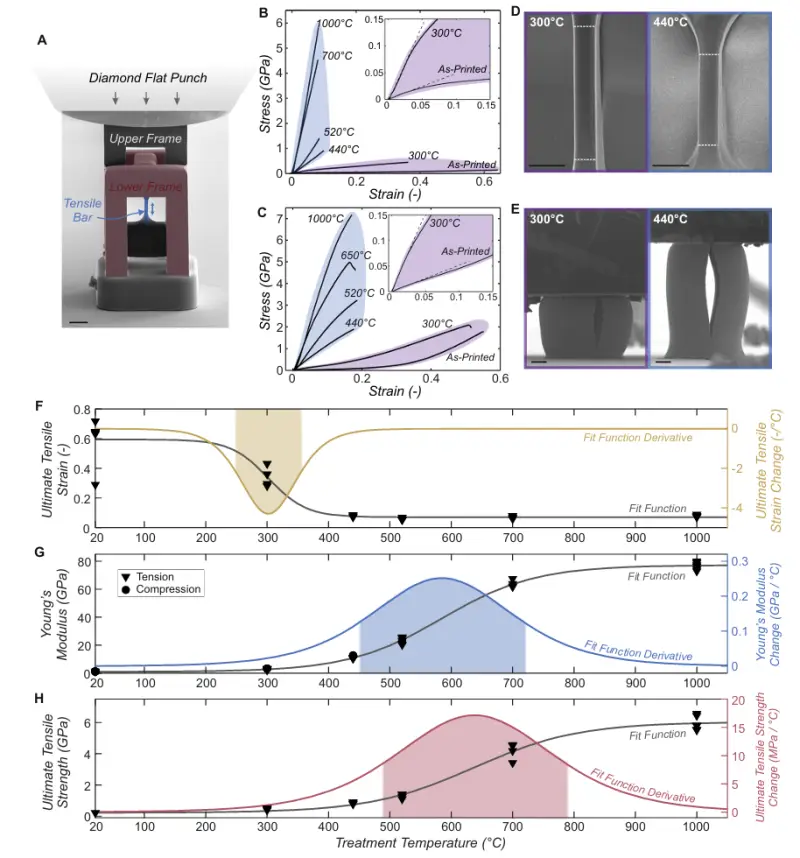
Tests on specimens treated between 300 and 1000°C showed that the conversion is not a simple progression toward one fixed mechanical state. Untreated parts behaved like rubber: their tensile strength was 129 MPa, and elongation exceeded 60%. After heating to 300°C, stiffness and strength rose by a factor of four to six while the material retained that rubber-like behavior. The authors attribute this early increase to heat-driven crosslinking outpacing decomposition.
At 440°C, the material became brittle and ceramic-like. Its strength reached the gigapascal range, while elongation fell to about 9%. Further heating increased tensile strength: specimens treated at 700°C measured 4.17 ± 0.46 GPa, and those treated at 1000°C reached 5.94 ± 0.45 GPa, with a modulus of around 77 GPa. The authors report that these strength values exceed those of the strongest commercial glass fibers and are roughly three times the value for pyrolytic carbon.
Chemistry identifies the transition to glass
Infrared spectroscopy helped explain the mechanical changes. After treatment at 300°C, signals from the POSS cages and polymer backbone remained largely intact. At 440°C, both had disappeared, while bands associated with amorphous silica emerged. The researchers interpret this as the point at which a silica network becomes the material’s main load-bearing structure.
The silica signature became more distinct at 520°C. By 700°C, the spectrum matched dense fused silica. The network therefore formed more than 500°C below the melting point of SiO2. That sequence matters for process development: the part’s strength and dimensional stability depend on when a supporting inorganic network forms relative to the breakdown of the organic framework.
What the process may enable
Stopping treatment at different stages offers a broad range of stiffness and strength, spanning more than two orders of magnitude. Optical clarity returns above about 575°C, according to the study. The researchers suggest that this could be useful for microsystems containing temperature-sensitive features, including conductive aluminum layers, where the full thermal cycle may be a constraint.
The key process condition they identify is formation of a self-supporting inorganic network before the organic framework breaks down. If that sequence is achieved, a fine printed structure has a better chance of retaining its shape and precision through conversion. The team expects the approach to extend to other resins and materials that have not yet been used in 2PP.
The work sits alongside earlier heat-based routes to glass-like 2PP parts, but the feedstock and transformation differ. In 2021, researchers at the University of Freiburg and Nanoscribe used a Photonic Professional GT2 to print Glassomer, a silica nanoparticle and binder composite. Heating to 600°C removed the binder before sintering produced fused silica microlenses with a surface roughness of 6.1 nm. That route consolidates pre-existing silica particles; the KIT process converts molecular POSS cages into a silica network.
A 2018 effort at Vilnius University used two-photon lithography with SZ2080, a resist containing silica and zirconia precursors in a photopolymer. Sintering at up to 1500°C removed about 80% of the material and shrank the parts by 40–50%, producing crystalline silica and zirconia phases. The intended result was glass-ceramic, with medical microdevices among the possible uses.
Both earlier routes use heat to turn 2PP prints into glass-based materials. KIT’s contribution is a temperature-resolved account of the changes in chemistry, dimensions and mechanical behavior. For engineers designing nanoscale optical or microsystem parts, that conversion map makes the trade-offs in heat treatment more visible—and gives a starting point for selecting a treatment that balances strength, clarity and dimensional retention.