Battery Design for Wearable Electronics and Subsea Vehicles
- Published
- Author
- Casey Porter
- Reads
- 982
Wearable power management can reduce battery burden, while pressure tolerant modules give subsea vehicle designers more flexibility.
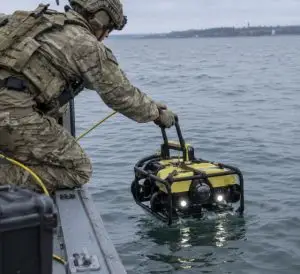
Battery design for wearable electronics and subsea vehicles starts with the same constraint: dependable power has to fit the conditions in which the equipment operates. The engineering response differs sharply between a person carrying multiple devices and a vehicle working underwater, but both applications reward careful attention to weight, temperature, environmental protection and system integration.
Reducing the wearable power burden
Radios, navigation equipment, sensors and situational awareness tools can make a field operator’s electronic load substantial. Every separate battery adds mass and another item to carry and manage. Reducing battery weight can support mobility and reduce fatigue; the source also identifies long term musculoskeletal injury risk as a concern associated with the overall load.
A wearable battery system can consolidate power for several connected devices. The UBBL72 battery from Ultralife is one example described for this use. Paired with a power manager, a single energy source can supply multiple devices, with the manager distributing power across the connected equipment. The practical aim is to reduce the number of batteries and simplify logistics while lowering carried weight.
That arrangement makes the power manager an important part of the system, rather than an incidental accessory. The connected devices still need suitable power, and the system must distribute it safely and efficiently. Consolidation changes how equipment is powered and managed; it does not remove the need to account for each device’s requirements.

Temperature and environmental protection
Temperature affects both battery output and the conditions cells experience during operation. Discharging a battery generates heat, so a hot ambient environment can push cell temperatures higher still. The example given is an environment where temperatures regularly approach 38°C (100°F): engineers may specify a battery able to operate at 50°C (122°F) or higher to maintain dependable performance through a mission.
Cold environments create a different constraint. Lower temperatures reduce electrochemical activity, which can limit the voltage and power a battery delivers. Battery selection therefore has to reflect the expected operating range, rather than relying on a single headline capacity or energy figure to describe performance in every condition.
Dust, moisture, heavy rain, vibration and mechanical shock also shape the design. Enclosures, seals and protected electrical interfaces help keep environmental exposure from damaging cells or connected electronics. Their quality can affect service life and maintenance needs, so enclosure design belongs in the system requirements alongside electrical performance and mass.
Pressure tolerant power underwater
Subsea vehicles face many of the same broad design demands, including temperature variation and the need to protect electrical systems. Their distinctive challenge is the combination of seawater corrosion and hydrostatic pressure at depth. If an enclosure cannot resist those conditions, it may deform; damage to internal components can then compromise the power system.
Traditional subsea battery installations often placed cells and electronics inside pressure vessels. Those vessels protect components from the surrounding water pressure, but add mass, take up space and increase system complexity and cost. Pressure tolerant battery modules are designed to operate directly in water, reducing the need for a heavy protective structure and giving vehicle designers more freedom over how they arrange the power system.
That design approach shifts demands onto the battery module itself. The enclosure and electrical interfaces must suit direct water exposure, including corrosion resistance and the pressures associated with the intended depth. The supplied information does not state a specific operating depth or pressure rating, so those values have to be matched to the requirements of each vehicle.
Modularity and thermal range
Pressure tolerant modules can also be combined to suit a platform’s power needs. Connecting modules in series or parallel allows system designers to configure voltage, capacity and power for different vehicle layouts and mission profiles. Modules can be added or removed as available space or weight limits change, giving manufacturers a way to adapt the power system without treating every platform as a wholly separate battery design.
The stated discharge temperature range for these subsea systems is -20°C to +60°C. It accounts for heat generated during operation as well as cold conditions during storage, transport and deployment. Thermal management helps maintain cell efficiency and battery health across those conditions, supporting long term reliability.
There is no single battery configuration suited to every platform. A wearable system may need to supply as many as 80 electronic devices at once, while an autonomous underwater vehicle must meet the electrical and environmental demands of operation below the surface. The useful design decision is therefore application specific: choose the battery, power management and protection approach around the actual load, temperature range, available space and exposure conditions.