Grid Protection and Investment Will Shape the 35 by 35 Electrification Goal
- Published
- Author
- Casey Porter
- Reads
- 937
Rising electricity demand will test grid capacity and equipment protection. Fault management and commissioning need to keep pace with new loads.

Raising electricity’s share of global final energy consumption from around 20 per cent today to 35 per cent by 2035 would require more than adding generation and connecting new loads. Distribution networks, substations and industrial systems must also handle higher demand, changing load patterns and electrical faults while keeping equipment and people safe.

The proposed “35 by 35” goal from the COP31 Presidency of Türkiye and Australia gives the shift a measurable destination. The engineering test is whether the infrastructure behind it can perform reliably as transport, manufacturing and other sectors move toward electricity. Capacity matters, but so do protection, control and the ability to test systems before they enter service.
Demand growth reaches the distribution system
The International Energy Agency’s Electricity 2026 report forecasts that global electricity demand will grow by an average of 3.6 per cent annually between 2026 and 2030. The report identifies industrial electrification, electric vehicles, air conditioning and data centres, including AI infrastructure, among the drivers. These uses place different demands on electrical systems, but they all add to the need for networks and equipment with enough capacity.
Factories converting processes to electricity, high-power vehicle charging hubs and data centres can create substantial new loads. Their effects extend beyond the equipment installed at each site: distribution networks and substations must be able to supply those loads, while industrial systems need to operate within their electrical limits. In some applications, demand can change quickly as equipment starts, stops or shifts operating state. Planning must account for these conditions as well as the expected steady load.
The IEA estimates that annual investment in electricity grids will need to rise by roughly 50 per cent by 2030 from today’s USD 400 billion to meet forecast demand. That figure points to the scale of network work required; it doesn’t by itself describe whether an individual connection or installation is ready. Local capacity, protection arrangements and equipment behaviour still need to be considered in the design of each project.
As electricity becomes more central to transport, industrial production and essential services, a fault can affect more than a single component. An uncontrolled earth fault can damage transformers, generators and cabling, threaten personnel and lead to unplanned outages. Switching high-voltage equipment can produce transient currents and voltage disturbances, while rapid load changes test the response of equipment and control systems. Readiness therefore involves managing both normal operation and the events that interrupt it.
Protection matched to the operating condition
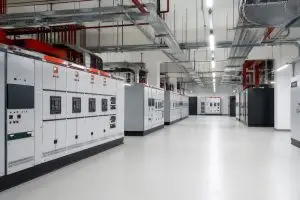
Protection choices depend on what the system needs to control. Neutral earthing resistors (NERs), for example, limit earth-fault current in resistance-earthed systems to a predetermined level. That limit helps protect transformers, generators and cables while allowing protection relays to detect the fault and clear it. The resistor is part of a coordinated arrangement: its role depends on the system’s earthing design and the protection equipment that responds to a fault.
Pre-insertion resistors (PIRs) address the moment high-voltage equipment is energised. They help limit inrush current and switching transients associated with equipment such as transformers, capacitor banks, cables and HVDC converter stations. Those conditions occur during switching rather than ordinary steady operation, so the protection must be designed around the equipment and the way it is brought into service.
Dynamic braking resistors (DBRs) handle energy produced during braking or deceleration. In rail traction, cranes, lifts and other industrial drives, they dissipate regenerated energy as heat. This is a different job from limiting earth-fault current or managing energisation transients. The examples underline why a resistor’s rating and role cannot be chosen in isolation from the application’s operating conditions.
These components can be small in relation to the installation they protect, yet their function affects the reliability of much larger assets. Engineers need to consider how each protection measure interacts with the wider electrical system, including operating sequences, fault response and control equipment. A design suited to an industrial drive may not address the requirements of a high-voltage switching installation or a distribution network.
Commissioning is part of the design work
Protection belongs in project planning from the outset. Engineers need to account for routine use as well as abnormal conditions, including faults, switching events and fast changes in load. Equipment also needs to be selected for the application, integrated with the wider system and tested before service. Leaving protection decisions until an operating problem appears can make corrective work more disruptive than including them in the initial design.
Load banks provide one way to assess backup power equipment under load. At data centres, hospitals and industrial sites, they can be used during commissioning to test generators, uninterruptible power supply (UPS) systems and other backup power under realistic load conditions. Testing can expose weaknesses before they contribute to downtime. The useful result is not simply that equipment has been installed, but that its performance has been checked under conditions relevant to its intended role.
For industrial operators, an interruption can halt production and create operational costs. For facilities that rely on backup systems, commissioning checks are part of confirming that those systems can support the required load. Across both settings, the same principle applies: adding electrical capacity without checking how equipment responds under load, during switching and when faults occur leaves important parts of system performance unexamined.
Progress depends on the infrastructure behind the goal
The 35 by 35 ambition offers a way to track the broader shift toward electricity, but the percentage alone can’t show whether the supporting systems are prepared. That depends on network upgrades, investment and engineering decisions at the level of each installation. Capacity and protection have to develop together if rising use is to be matched by reliable operation.
The practical measure of progress will be whether networks and connected equipment can handle the loads they are built to serve, respond appropriately to faults and maintain safe operation through demanding conditions. For project teams, this means treating protection and commissioning as part of electrification planning. The more transport, production and essential services rely on electricity, the more the transition’s success will depend on infrastructure that has been designed and checked for the work it must do.