Vision-Guided Robots Adapt Tightening and Drilling to Part Position
- Published
- Author
- Casey Porter
- Reads
- 537
Tool-mounted 3D vision can help robots locate parts and adjust for positional variation, reducing dependence on fixed fixtures in flexible production.
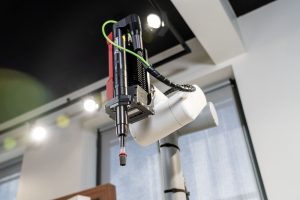
Flexible production asks robots to work with parts as they arrive, even when components shift or their features vary in position. For tightening and drilling, that change matters at the point of contact: a tool must align with the hole or fastener before the operation begins. Vision-guided execution offers one way to measure that variation and adjust the robot’s movement before it acts.
Why fixed presentation becomes harder to maintain
Dedicated nests, fixtures and carriers have long helped production teams present parts in repeatable positions. In stable processes, that mechanical constraint makes automation easier to engineer: the robot can follow a known path because the part is expected to be in a known location.
That assumption becomes harder to sustain when a line handles more product variants, frequent changeovers or assemblies that are not fully constrained. Mobile platforms such as AGVs can also introduce different presentation conditions from a fixed station. Tolerance stack-ups across an assembly may shift the location of a hole or fastener even when the larger component is held consistently.
High-mix, low-volume production increases the pressure. Each variant may call for different tooling or part presentation, and maintaining the same carefully constrained setup for every version can demand substantial engineering effort. More fixtures and control logic can compensate for some variation, but they add complexity as the number of products and process conditions grows.
Alignment must be checked at the feature
A consistently positioned component does not guarantee that every feature on it will land in the same place. A vehicle seat is one example: the seat may be fixed in a known location, while a moving component such as its backrest can vary. The robot therefore needs to reach the actual feature position, not simply the expected position of the larger assembly.
That distinction is significant for operations such as tightening and drilling. If the tool approaches off-axis, engagement and process consistency can suffer. A system built around a predetermined coordinate may continue to send the robot to that point even when the part has shifted. Correcting the setup can involve changes to tooling and control logic, and those adjustments become more demanding when production conditions vary.
The practical shift is from trying to make every part conform to one fixed presentation toward checking where the relevant feature is before the tool engages. That does not remove the need for sound process design. It gives the robot updated positional information so its motion can account for variation present in the cell.
Using vision to update robot motion
Vision-guided robotics adds perception to the execution sequence. A vision system captures the part in the production environment, identifies its position and orientation, and calculates offsets that the robot can use to revise its approach. The operation can then be carried out relative to the detected location rather than a single assumed coordinate.
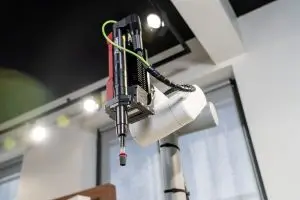
Desoutter’s Automated Robot Guidance (ARG) is designed around this approach. The company describes ARG as a compact, tool-mounted 3D vision system that identifies component position and orientation, detects features such as holes or fasteners, and calculates coordinates for robot guidance. The system processes captured images to generate positioning data, allowing the robot to adjust its end-of-arm tooling before tightening or drilling.
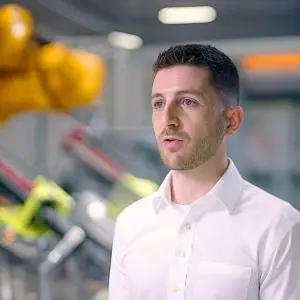
Alexander Hale, Desoutter
With the feature location measured before execution, the cell can accommodate some positional variation without relying entirely on tightly controlled part presentation. This may reduce the amount of dedicated fixturing needed for applications where parts arrive in different positions. The value depends on the process: teams still need to determine whether the system can identify the relevant features reliably under their actual production conditions.
Integration and production fit
Desoutter says ARG is robot brand agnostic and can be used with robotic and gantry-based systems. It uses industry-standard communication protocols to connect with existing control architectures and customer or integrator PLC systems. That makes the approach applicable to new automation projects as well as retrofits where a production setup needs more flexibility or positional accuracy.
For an existing cell, integration means considering how detected coordinates pass from the vision system into robot motion and how the process responds when a feature is not found as expected. The source details ARG’s compatibility approach but does not specify detection limits, cycle time, accuracy figures or operating conditions. Those details would need to be established for the particular application before teams can judge the performance impact.
Vision guidance is most useful where the part or feature position varies enough to challenge a fixed path, while the operation still requires accurate tool alignment. Stop-and-go lines, AGV-fed stations and production with multiple variants are examples of the environments described for this approach. The engineering question is whether sensing and correction can handle the variation more effectively than further constraining the part.
As production becomes less dependent on fixed infrastructure, measuring the feature at the point of work gives automation another way to preserve alignment. The next step for teams considering this method is to assess the actual range of part variation, the features the system must locate and how the updated coordinates fit into the cell’s existing controls.


