Industrial Router Market to Reach $4.08 Billion as Wi-Fi and 5G Upgrades Expand
- Published
- Author
- Satyajit Sinha
- Reads
- 368
Industrial router revenue is forecast to reach $4.08 billion by 2030, with mobile automation, site resilience and wireless upgrades driving demand.
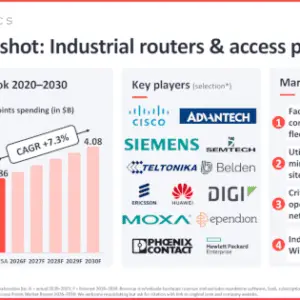
Industrial wireless demand is spreading across factory floors, transport vehicles and remote infrastructure sites. That shift is expected to lift industrial router and access point revenue from $2.86 billion in 2025 to $4.08 billion in 2030, even as annual growth slows from the previous five-year period. The forecast points to a practical change for network planners: equipment demand depends on where connections are needed, how much redundancy a site requires and whether older devices can work with newer wireless standards.
More shipments, slower growth
IoT Analytics’ Industrial Routers & Access Points Market Report 2026–2030, published in October 2026, puts 2026 revenue at $3.11 billion and forecasts a 7.3% compound annual growth rate through 2030. That compares with 9% between 2020 and 2025. Yet the market is forecast to add $1.21 billion over 2025–2030, more than the $1.03 billion added in the preceding five years.
Annual hardware shipments are projected to rise from 4.6 million units in 2025 to 6.6 million in 2030. The blended average selling price (ASP) is expected to remain close to $620, with just a 0.5% cumulative increase over that period. These figures cover wholesale hardware revenue. They exclude IoT gateways, industrial Ethernet switches, firewalls, private 5G infrastructure, software and services.
Wi-Fi is forecast to account for about 75% of the additional shipments. Cellular equipment is set to contribute disproportionately to revenue growth because 5G and RedCap routers typically occupy a higher price tier. The result is a market where shipment growth and revenue growth don’t move in lockstep.
Mobile equipment changes network requirements
Factories and warehouses are adding automated guided vehicles (AGVs), autonomous mobile robots (AMRs) and other assets that move through the work area. Each needs dependable wireless coverage, and mobile equipment also requires onboard connectivity. The number of access points and other network devices needed depends on factors such as coverage, network layout and the count of mobile endpoints. Robot installations alone don’t determine the hardware requirement.
Cisco is bringing industrial mobility functions into products that can also support conventional Wi-Fi clients. In an April 2026 webinar, the US network hardware company demonstrated its Ultra-Reliable Wireless Backhaul (URWB) technology on its industrial IW9165 and IW9167 access points, as well as selected enterprise Wi-Fi 6, 6E and 7 models. The approach lets one wireless infrastructure serve both ordinary Wi-Fi clients and moving equipment such as AGVs and forklifts, with shared network management tools. It also brings Cisco into closer competition with vendors focused on operational technology networking.
Remote sites and redundancy add hardware
Utilities, rail networks, ports and mines often need rugged links across geographically dispersed or mobile operations. Connecting new locations, extending networks and maintaining service through a link failure all increase demand for routers and access equipment. In these settings, cellular connectivity can bridge gaps where fixed network infrastructure doesn’t reach each asset.
Lithuania-based Teltonika Networks introduced its first 5G transport router, the ATRM50, in July 2025. Designed to connect onboard equipment in rail and other transport vehicles to external networks, it combines 5G with EN 50155 and EN 45545 rail certifications. Its specified operating range is -40°C to 75°C. The product reflects a requirement specific to mobile operations: the router must connect equipment while meeting the conditions and certifications associated with rail use.
Resilience can raise unit demand beyond what a primary connection would require. In a project involving more than 1,000 migrations at existing sites and more than 4,000 new sites, a European energy distribution company selected Taiwan-based Advantech’s ICR-2431 LTE router. Standard sites use dual-SIM routers for network redundancy. At critical locations, two LTE routers operate on separate mobile networks in hot-standby mode, with satellite connectivity as a third backup path. The design adds multiple devices and connection paths to protect service at selected sites.
Wireless generations are changing at different speeds
For industrial WLAN, Wi-Fi 6 and 6E remain the main replacement generations in the forecast. Wi-Fi 6/6E and Wi-Fi 7 together are projected to grow from 40.4% of industrial Wi-Fi revenue in 2025 to 79.1% in 2030. Within that total, Wi-Fi 6/6E is forecast to account for nearly 70% of revenue in 2030, while Wi-Fi 7 reaches about 9%. The figures suggest that Wi-Fi 7 adoption will build alongside a much larger installed base of Wi-Fi 6/6E equipment.
Cellular upgrades have a different revenue profile. 5G/RedCap is forecast to reach 59.2% of industrial cellular revenue by 2030, while 4G/LTE is still expected to represent approximately half of cellular shipments. Higher-priced 5G/RedCap devices can therefore raise cellular revenue faster than they increase unit volume.
Compatibility may shape upgrade choices
Industrial routers and access points generally need less memory than industrial PCs and compute-intensive gateways, which may limit their exposure to memory price increases. IoT Analytics’ forecast of a 0.5% cumulative rise in blended ASP between 2025 and 2030 is consistent with a relatively stable average price across the market.
For network teams, the harder question may be whether older operational technology devices will continue to connect as IT departments introduce newer Wi-Fi generations and standards such as WPA3. A faster access point offers limited value if legacy endpoints lose connectivity or cannot interoperate across vendors. Compatibility and security support are therefore likely to sit alongside wireless performance in purchasing decisions.
The report’s outlook links growth to four connected requirements: mobile automation, more dispersed operations, redundant links at critical sites and replacement of aging wireless equipment. For engineers planning upgrades, the useful distinction is between unit demand and revenue: Wi-Fi is expected to drive most additional shipments, while higher-value 5G/RedCap equipment lifts cellular revenue. The next practical test for each deployment is whether new network capability fits the installed devices it must continue to serve.


