Northwestern’s DIAL 3D Printing Combines Thick Inks with Patterned Light
- Published
- Author
- Paloma Duran
- Reads
- 305
DIAL spreads particle-filled inks into 50-micron layers and cures each layer with projected light, making detailed parts faster without printed supports.
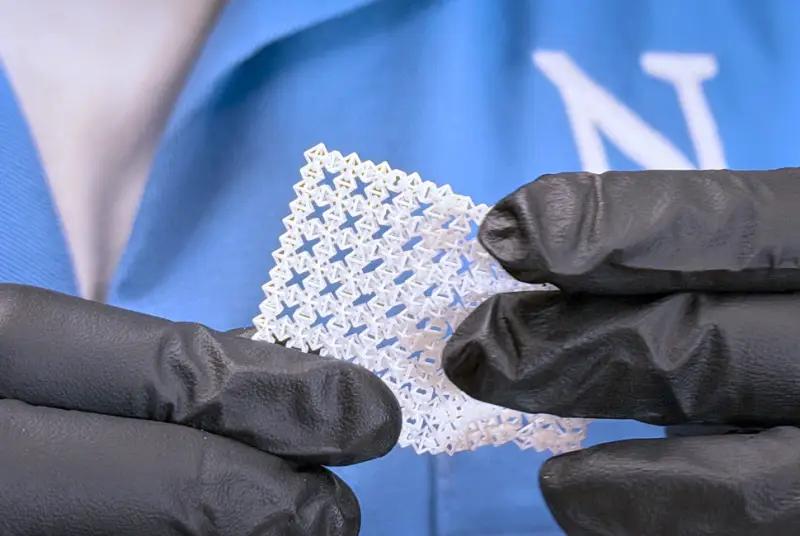
Direct ink additive lithography (DIAL) brings paste handling and projected-light curing into one 3D printing process. Northwestern University engineers report that it can print a porous grid in 30 minutes, compared with 124 minutes using conventional extrusion. The method also produced features that extrusion could not make and works with dense, particle-filled inks that can challenge resin printers.

The central design choice is to spread material into a thin sheet, then cure a whole patterned area at once. That changes the usual trade-off: extrusion accepts thick functional materials but builds slowly and struggles with fine details, while light-based systems can be fast and precise but are often limited to thinner, clearer resins. DIAL’s results suggest that a thin print layer can make patterned-light curing practical with paste-like inks.
Three steps build each layer
A slot-die nozzle first lays a generous amount of thick ink onto a flat surface. A blade then spreads it into a uniform film 50 microns thick, thinner than a human hair. A projector exposes the desired pattern, hardening the ink wherever light lands. The printer repeats that sequence to build the part layer by layer.
Because the projector cures an area at once, it avoids tracing each shape line by line. Feature resolution depends mainly on projector pixel size and layer thickness, rather than nozzle width. That sidesteps a familiar extrusion compromise: a narrow nozzle can produce finer detail but is more prone to clogging, while a wider nozzle improves flow at the cost of resolution.
DIAL’s ink also helps hold the geometry during printing. The demonstrated formulation combines a light-curable resin with fumed silica nanoparticles, creating a yield-stress material. It remains firm when undisturbed, flows briefly under the blade, then firms again. Uncured ink around the printed features supports overhangs and bridges as they form, so the process doesn’t require separate printed supports. The team can adjust the ink’s stiffness by changing its silica content.
After printing, the surrounding ink can be washed away; excess material on the print surface can be collected and reused. That matters for delicate geometries, where removing conventional supports can damage the finished features. DIAL’s approach makes the ink itself perform two jobs: it supplies the part material and temporarily holds unsupported areas in place.
Geometry and scale tests
In addition to the porous grid, the researchers printed lattices with walls 150 microns thick, a feature size they say extrusion could not produce. They also made interlocking chainmail, a geometry that is difficult to print with either extrusion or resin-based methods. A desktop resin printer could match some of the delicate lattice structures only by adding support structures.
The team also demonstrated printing multiple objects in one run and changing inks between layers. In one build, it moved the projector across overlapping sheets of ink to produce a honeycomb almost four times larger than the projector’s light field. Conventional vat-based light printers cure resin inside a container, which constrains the build volume. DIAL has no vat, and the researchers expect that design to make scaling up easier. They also expect print times to improve by reducing the time spent switching between tools.
Electrolytes and hydrogels extend the material range
To demonstrate uses beyond structural parts, the team formulated two additional inks. One was a structural electrolyte based on a polymerizable ionic liquid, a liquid salt already made in the lab for soft iontronic sensors. In a 15-minute run, DIAL printed 15 porous lattices, each about the size of a small coin-cell battery. Shaping an electrolyte into a controlled three-dimensional structure could offer another way to design energy-storage devices, though the reported print is a material demonstration rather than a finished battery.
The other formulation was a water-rich hydrogel, a material that can reproduce some properties of living tissue. The researchers printed small containers modeled on cell-culture inserts used in tissue-engineering labs. Their floors carried arrays of tiny inverted pyramids, a surface pattern used for growing cells and organoids.
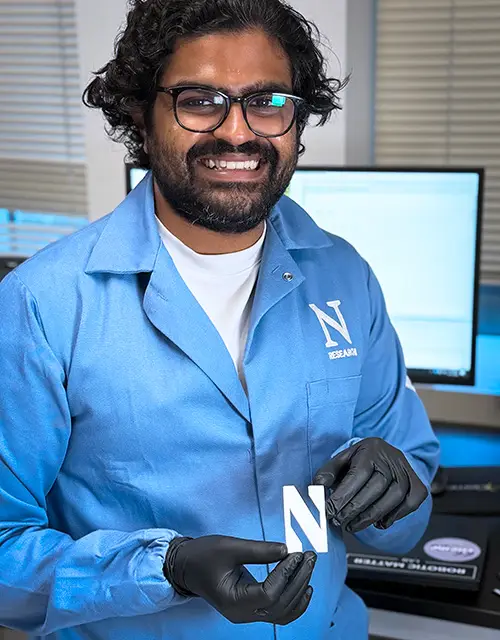
Assistant Professor Ryan Truby, senior author and head of the Robotic Matter Lab at Northwestern’s McCormick School of Engineering, said that printing such materials depends on coordinated changes to software, hardware and inks. Ph.D. candidate Pranav Kaarthik led the work; Michael Bayer, EunBi Oh and Alexander Kane were co-authors. The research appeared in Science Advances.
Where the process fits
Other additive-manufacturing approaches address parts of the same challenge. Ceramic or metal powders in photosensitive resin can raise viscosity and scatter light, making fine features harder to print. An EPFL team has instead printed hydrogel scaffolds and infused them with metal salt solutions afterward. Repeated infusion brought metal loading close to 80 wt% in some cases. That separates scaffold printing from metal loading; DIAL’s approach is to print with the functional ink itself.
Speed has also driven work on volumetric printing. Researchers at Tsinghua University reported a holographic light-field method that formed millimetre-scale polymer structures in as little as 0.6 seconds. Their inks ranged from a low-viscosity PEGDA hydrogel at 4.734 cP to acrylate resins above 500 cP. Volumetric systems rely on light passing through the resin volume, while DIAL cures a thin sheet, a distinction that lets it work with opaque, paste-like inks.
Support removal is another active area. Researchers at Lawrence Livermore National Laboratory and UC Santa Barbara developed a dual-wavelength resin that forms permanent features and degradable supports from one formulation. A team at the University of Texas at Austin demonstrated multicolor DLP printing with supports that dissolve in ethyl acetate in under 10 minutes at room temperature. Those methods simplify support removal; DIAL avoids printing supports by using uncured ink to hold the part during the build.
Northwestern’s next targets include spacecraft hardware designed for extreme conditions, soft-robot body parts, medical devices and tissue culture for biomanufacturing. Structural components and energy storage are also potential applications. The practical test ahead is whether the team can carry its demonstrated material range, feature quality and parallel curing into larger builds while shortening the tool-change intervals. DIAL’s defining move is already clear: spread functional paste thinly, then cure the required pattern in one exposure.


