Cold-Chain Cyberattacks: What the Evidence Shows About Two Waves of Refrigeration Sabotage
- Published
- Author
- Dennis Knake
- Reads
- 972
France links October’s refrigeration sabotage to an Iranian unit; claims about November’s attacks remain unverified, while exposed controllers remain the clear weakness.
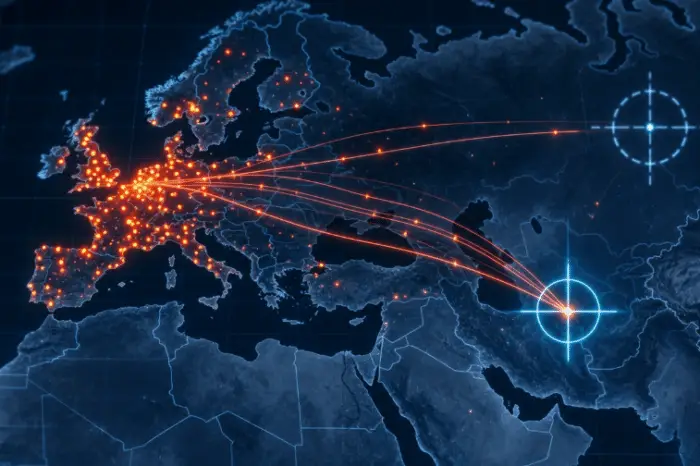
Internet reachable refrigeration controllers turned a set of food stores into vulnerable industrial systems. The October 2026 attacks affected around 700 French food retail sites, according to France’s cyber response team, CERT-FR. A second wave in November reached more than 100 sites across at least ten European countries. The evidence points to different levels of certainty: France has named an Iranian unit in connection with October, while the November attackers remain unidentified.

For engineers responsible for refrigeration and remote maintenance, attribution is the less actionable finding. The systems were reachable from the internet, and operators had not consistently installed security updates. Attackers could alter control settings that govern refrigeration and defrost cycles. That leaves a practical question: how many sites still expose similar equipment, and who can reach it?
Two waves, different evidence
CERT-FR attributes the October sabotage to the Shahid Kaveh unit of Iran’s Islamic Revolutionary Guard Corps. French authorities named three people: Hamid Reza Lashgarian, described as head of the group’s cyber centre, and Mahdi Lashgarian and Reza Salarvand, described as commanders of the unit. The alleged activity took place on the night of 11 to 12 October. France’s report says the attackers changed defrost parameters to high temperatures; fires broke out at least 15 times.
The report is the basis for France’s attribution, but outside analysts cannot readily check its technical case. It does not publish the refrigeration systems’ IP addresses, technical indicators of compromise or a confidence rating. It describes a “bundle of circumstantial evidence.” Those limits matter: an attribution can draw on intelligence that is not public, but the published technical detail is not enough for other teams to reproduce the investigation.
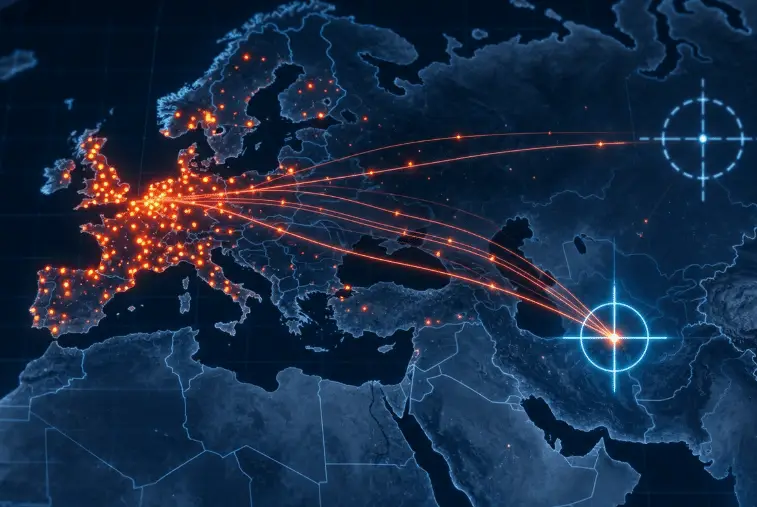
The November wave is less clear. Unit 42, Palo Alto Networks’ threat research team, counted between 100 and 115 affected sites across at least ten countries. No public attribution has identified a single operator. The pro-Russian groups NoName057(16) and Z-Pentest claimed the attacks, but their published material has not established that they accessed refrigeration systems.
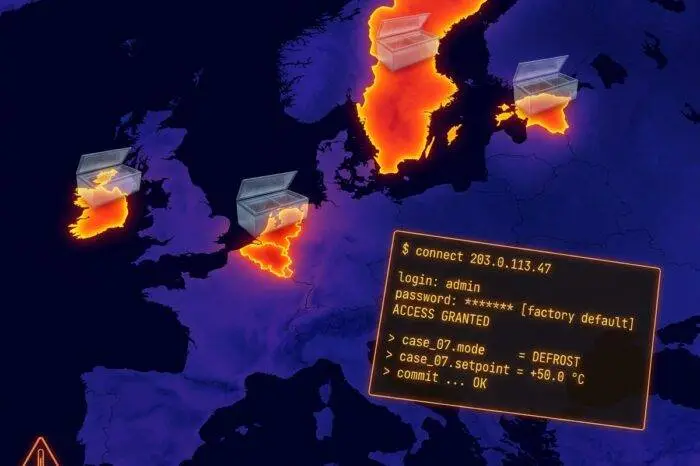
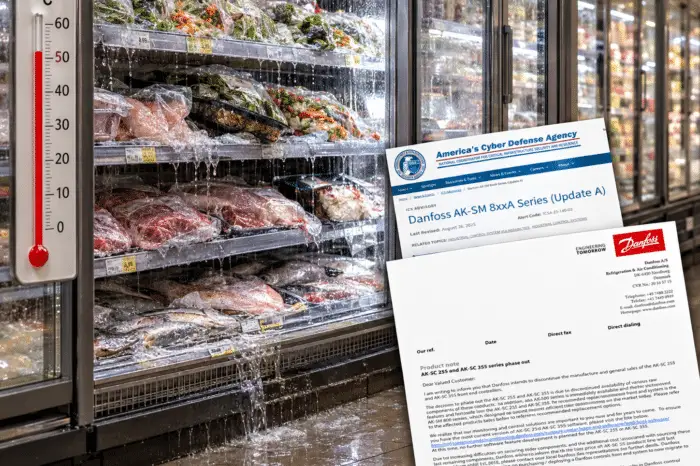
Events in France and Germany show the operational consequences. The French blood service EFS reported that attackers reached cold rooms at three sites through refrigeration contractor Coolworld, which blamed a flaw in a third-party component. Monitoring raised the alarm quickly, and no blood products were lost. In Bavaria, an Edeka store in Reisbach discarded large quantities of food. In Wetter-Volmarstein, the attackers targeted the company remotely maintaining refrigeration at a shop operated by the welfare organization Arbeiterwohlfahrt. A butcher’s shop in the Upper Palatinate reported that attackers set its cold stores as high as 150 °C. Other cases were reported in Wuppertal, Münsterland and the Western Palatinate.
Why France points to Shahid Kaveh
France’s attribution rests partly on infrastructure used at the same time to scout Schneider Electric controllers at small energy and water facilities. France has linked that activity to Shahid Kaveh since April 2026. The unit scans the internet for devices that communicate using Modbus, an industrial protocol common in control systems.
Other clues include the group’s reported use of FOFA, a public search engine for internet connected devices; traces of Farsi in the attack infrastructure; and the Iranian outlet CyberbanNews, which began circulating reports of the attack on 13 October. These points may support an investigation, but none is equivalent to a direct claim of responsibility. Server locations and language traces can be manipulated or misread.
The French report also describes earlier activity involving refrigeration systems. It says the group claimed a sabotage campaign against Israeli and US targets in March and April, including refrigeration equipment in Israel. In May 2026, attackers changed setpoints, safety limits and alarm thresholds at an Israeli food plant. Carbon dioxide escaped and three compressors were damaged, according to the refrigeration trade publication Cooling Post. Israeli security firm Profero attributed that incident to Cyber Isnaad Front, which it describes as an Iranian state controlled identity. Profero’s chief, Omri Segev Moyal, said the activity appeared to have been developed against Israel, tested in Europe and the United States, and then expanded.
Microsoft had privately linked Iran to the October attacks at least two weeks before France’s public attribution, Reuters reported, citing three people familiar with the matter. Microsoft declined to comment. The French report lists several names associated with Shahid Kaveh, including CyberAv3ngers and Cyber Isnaad Front. Such labels can be reused, shared or fabricated, which complicates comparisons between separate incidents.

France’s case also includes context beyond the technical evidence: the report connects the activity to a period of tension between Paris and Tehran. Context can help investigators assess motive, but it cannot establish who operated a particular controller. The published material does not resolve that gap.
What weakens the competing claims
The pro-Russian groups’ claim about November has more visible support than a bare assertion, but the available material remains weak. On 3 and 4 November, NoName057(16) and Z-Pentest published alleged login credentials for Danfoss employees and customers. Four analysts who reviewed the files for Swedish broadcaster SVT found no proof of access to refrigeration systems. They reported that 168 of the 171 email addresses had appeared in older data leaks. Danfoss said it saw no sign of a successful intrusion into its internal IT systems.
Z-Pentest has previously tracked internet exposed industrial controllers and reported ten refrigeration system attacks in one day, on 26 April. That experience gives the group familiarity with the target, but familiarity does not prove it carried out the November incidents. The groups’ Telegram channels were later deleted, and Z-Pentest wrote that the attacks resembled its own earlier actions. That wording is not a clear demonstration of access.
Network observations offer another incomplete clue. Lupovis, a security firm that operates decoy systems known as honeypots, recorded probes for Danfoss equipment in Europe before the November wave. The probes passed through hosting providers that had previously been used by Russian groups. Lupovis chief Xavier Bellekens said the evidence could point to Russia, while stressing that a server’s location does not identify an attacker’s nationality.
Romanian cyber chief Dan Cîmpean rejected the idea that a state actor was responsible, calling the attack “semi-amateurish.” No public evidence settles that disagreement. A joint statement issued on 4 November by European cyber response organizations named no perpetrator. The centre behind France’s October attribution has also not publicly connected the blood service incident to that wave, despite similarities in method. That link, if established, would provide the first official connection between the two sets of attacks.
Nor does a separate burst of activity against French websites establish a Russian role in the October refrigeration sabotage. NoName057(16) claimed those website overload attacks during the same week, and also claimed to have taken over a small hydropower facility. Security firm SOCRadar says the website activity was unrelated to the supermarket systems. France’s report attributes activity against small hydropower plants to the Iranian operation, but it is unclear whether it refers to the same facility.
Attribution is hard to verify
Attackers can route traffic through third party servers and virtual private network services, leaving investigators with infrastructure that may belong to someone else. That makes an IP address a weak indicator on its own. False trails have a long history: in 2015, attackers associated with Russian intelligence disrupted French broadcaster TV5 Monde while posing as the Islamic State’s Cyber Caliphate.
Group names are just as slippery. Shahid Kaveh is reported to use several aliases, while an identity can be copied or invented by another operator. Investigators may also withhold technical details to protect their sources and methods. As a result, public attribution is an evidence based assessment, but it is not the same as a finding that other teams can verify from raw network data.
For October, France’s case against Shahid Kaveh is the strongest public explanation available, and the fact that it named individuals suggests it is drawing on information that has not been released. That still leaves important technical questions unanswered. For November, the public evidence does not establish a single perpetrator or prove that the groups claiming credit reached the affected systems.
Copying the technique is easier than copying the investigation
Once the October method became public, other operators could try it. The second wave began about three weeks after CERT-FR issued its first warning. Andrei Sabelfeld, a professor at Chalmers University of Technology, told SVT that the attack required little expertise. Lupovis counted more than 276 access attempts from 91 actors over ten days. Those attempts do not represent 91 confirmed attackers, but they show the interest that exposed industrial equipment can attract.
Access routes varied. In Wetter, attackers went through a maintenance company; at the blood service, they used a contractor; and Swedish retailer Coop pointed to older 4G connections. The equipment also came from several suppliers. The October wave, which France attributes to a single actor, affected controllers from Danfoss, Copeland and Dixell. Multiple manufacturers and access paths do not by themselves prove multiple operators, but the spread is consistent with several actors testing the same weakness.
There is also a difference between copying the technique and claiming credit. NoName057(16) has previously claimed activity carried out by others, and no independent evidence has confirmed its claim about a hydropower facility. SentinelOne considers independent ideological operators, copycats, financially motivated intruders and actors linked to states consistent with the public evidence. No ransom demand has been reported. The most plausible reading is that an organized operation drew attention to the weakness, after which other actors began probing or imitating it.
The exposed controllers are the clearest finding
The technical weakness is easier to establish than the identity of the attackers. Censys found 2,991 publicly reachable interfaces for Danfoss’s StoreView system on the day of the October attack. Six in ten were in France. Afterward, 71 per cent of France’s publicly reachable StoreView interfaces disappeared from the internet within three days. According to Censys, operators largely removed access rather than installing security updates.
That response reduced exposure quickly, but it does not show that the underlying systems were patched or that their remote access arrangements were redesigned. Forescout found almost 13,000 internet reachable refrigeration control services worldwide, spread across 99 countries. The figures describe a large attack surface, though they do not establish that every exposed service was vulnerable or compromised.
The incidents also show why equipment suppliers, refrigeration contractors and site operators need a shared view of remote access. A controller may sit behind a maintenance provider’s connection, an older cellular link or a third party component, so a site inventory must account for the whole path into the system. The practical priorities are to identify connected controllers, keep them off the open internet, install available security updates and protect remote maintenance with individual accounts and a second authentication factor.
Attackers can change names, routes and claims of responsibility. Exposed control interfaces are easier to find: Censys and Forescout have already counted thousands. The next useful signal will be whether operators close those access paths and maintain them securely, regardless of who investigators eventually name.


