AM Solutions D3 Automates Powder Removal for EOS P 770 Build Jobs
- Published
- Author
- TCT Team
- Reads
- 956
The enclosed D3 system unpacks EOS P 770 polymer builds without compressed air, with options for powder recovery and separate collection.
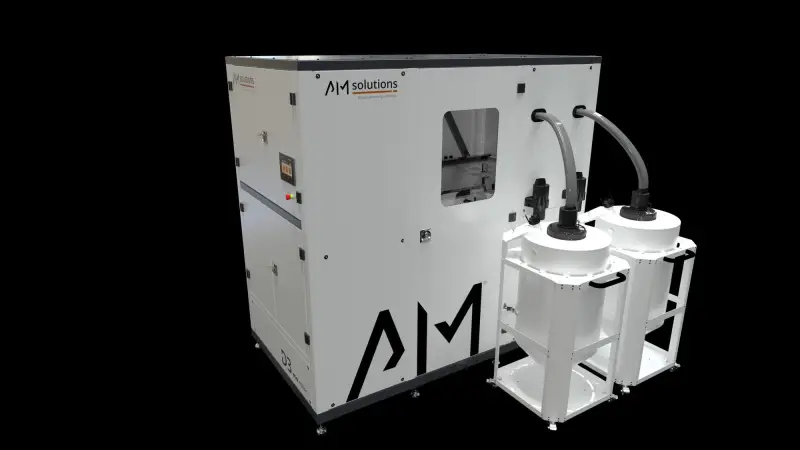
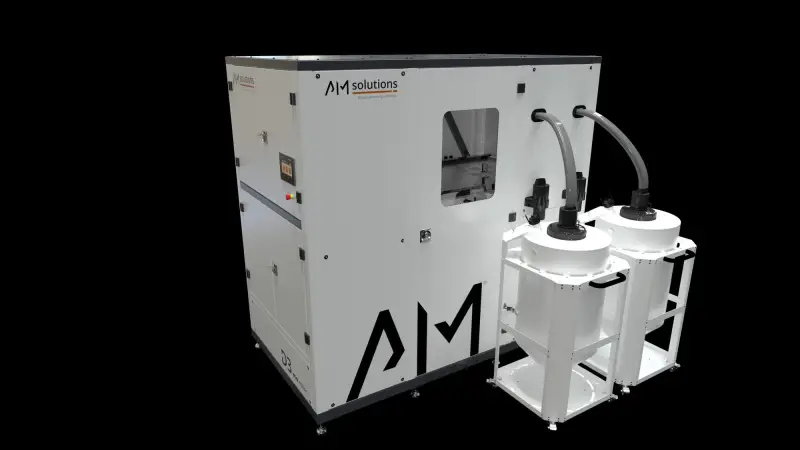
Large polymer build jobs can make unpacking a substantial manual task after printing. AM Solutions’ D3 system is designed to mechanise that stage for the EOS P 770, handling build jobs weighing up to 90 kg. Its central engineering choice is to move parts through powder removal without compressed air, using controlled vibration and the surrounding powder to limit part movement and contact.
The D3 follows AM Solutions’ D1 system for the EOS P3 Next. The company says the new machine is sized for the P 770’s high-weight build jobs and future systems in the same size class. It is due to make its first public appearance at Formnext 2026.
Three stations control the unpacking sequence
The enclosed system moves the build job through three stations in sequence. At the loading station, an exchangeable frame is transferred from the printer after the build has cooled to approximately 60°C. AM Solutions says unpacking at temperatures up to 100°C is possible under certain conditions.
An electrically driven actuator pushes the parts and surrounding powder from the frame into a chamber. The chamber then moves to the central process station, where it is secured and set in motion on a vibration platform. In the third station, powder passes through integrated screens and is discharged into Polyboxes.
When the cycle ends, the chamber returns to the loading station. The base of the exchangeable frame lowers in a controlled way, bringing the parts back into the frame without dropping them. They can then be removed. For a PA 12 build job, AM Solutions gives an approximate unpacking time of 20 minutes; actual cycle time depends on build height and packing density.
Vibration replaces compressed air
Compressed air is commonly used to clear powder from laser-sintered parts. The airflow can make parts move and collide, creating a risk of contact damage. The D3 instead retains powder in the chamber during its first vibration cycle. That powder acts as a cushion between parts, reducing friction and impacts—an approach intended to protect delicate geometries.
During screening, the parts remain nearly stationary while the screen surface vibrates. That distinction matters for builds containing components whose shape or surface could be damaged by vigorous movement. The system also avoids the energy use and operating costs associated with compressed air during unpacking, according to AM Solutions.
For parts that can tolerate contact, an optional mode called “Unpacking Plus” runs the build job through vibration and powder discharge a second time. The extra cycle releases more powder from part surfaces for recovery. AM Solutions says powder recovery rates of up to 95 percent are achievable, depending on packing density and geometry. Operators can choose between the standard cycle, which prioritises part protection, and the additional recovery pass according to the parts being processed.
Separate powder streams address different material conditions
The D3 also addresses a production need reported by EOS P 770 users: separating powder from the less thermally stressed peripheral zones of a build from powder nearer the parts, which experiences greater thermal stress. Previously, this separation required manual work or was not carried out.
In the D3’s separation sequence, a shortened first vibration cycle releases powder from the build’s peripheral layer into a dedicated Polybox. The system then makes a second pass, using adjusted parameters to release powder adhering to the parts and route it to a separate box. Valve control switches the powder path automatically. Operators can therefore return the lower-stress peripheral powder to the powder loop while sorting or treating the more heavily stressed material separately.
“The requirement for powder separation came directly from our customers' day-to-day production environments,” said Alexander Gückel, Project Manager at AM Solutions. He said the design goal was to handle the separation without adding manual steps or making the workflow more complicated.
Controls, maintenance and beta evaluation
Operators use a Siemens control panel to select stored recipes and adjust vibration duration and intensity. The system can process build jobs of any height. For cleaning and maintenance, the vibration platform can be removed, and access panels open to relevant areas. A dedicated parking position holds the Polybox connection hose when it is not in use.
The D3 is undergoing beta testing at FKM Additive Manufacturing, a European provider of industrial additive manufacturing services for polymer and metal parts. FKM says automating the unpacking of large polymer builds could reduce manual work and employees’ direct exposure to polymer powder, while helping create a cleaner work area. Its Managing Director, Matthias Henkel, described the company’s initial feedback on the system as very positive.
EOS also sees post-processing as part of the production chain that affects productivity and cost efficiency. Vanessa Seidenschwarz, Head of Product and Program Management Polymer at EOS, said the D3 is intended to meet the needs of large-format production systems.
AM Solutions plans to show the D3 live at Formnext in Hall 12, Stand E79. Its production value will depend on how well the controlled handling, cycle time and optional powder separation fit each user’s build mix and material-reuse process.


