Synopsys AgentEngineer Targets End-to-End Chip and Systems Workflows
- Published
- Author
- Anand Thiruvengadam
- Reads
- 989
Synopsys describes long-horizon agents for design, verification, simulation and manufacturing workflows, with general availability planned for the end of 2026.
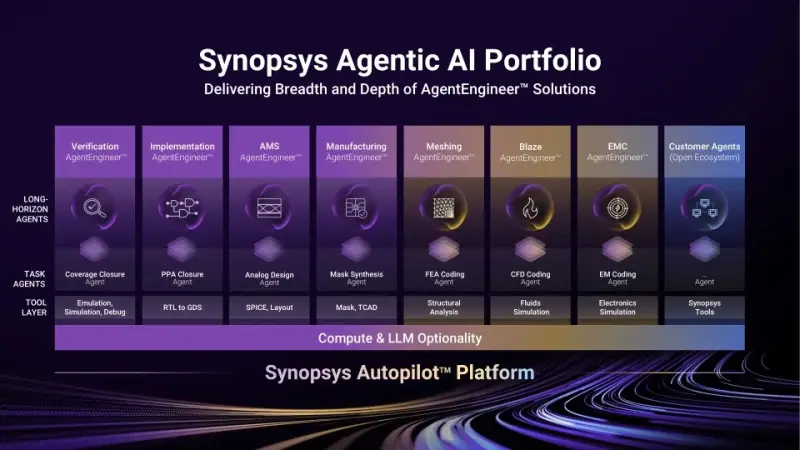
The engineering shift in Synopsys’ AgentEngineer portfolio is from completing isolated tasks to pursuing a design objective across a chain of dependent work. A verification workflow, for example, can move from interpreting a specification through RTL generation, test development, coverage analysis and repeated correction. Synopsys says its long-horizon agents are designed to keep track of that objective, evaluate intermediate results and adapt the plan as work proceeds.
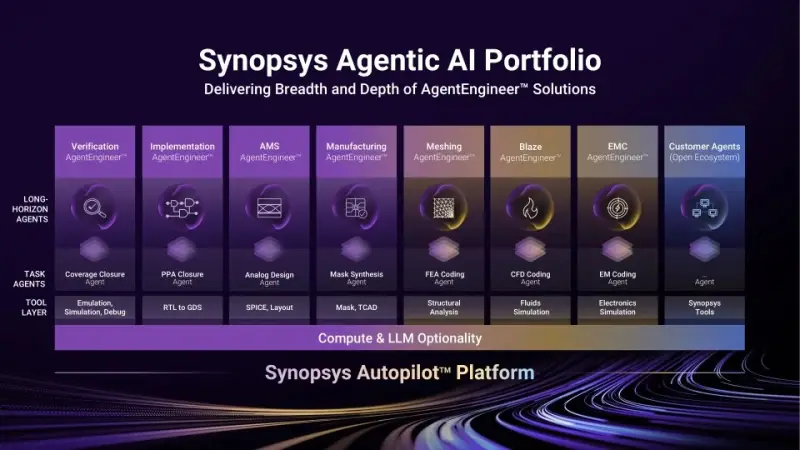
The company introduced AgentEngineer solutions for chip and systems design, built on the Synopsys Autopilot Platform. General availability for both the solutions and platform is planned for the end of 2026. The offering spans verification, implementation, analog and mixed-signal (AMS) design, manufacturing, meshing, gas turbine simulation and electromagnetic compatibility analysis.
Orchestrating a workflow, not just a task
Synopsys draws a distinction between long-running agents and long-horizon agents. A long-running agent might monitor nightly regression tests for hours or days while performing one defined activity. A long-horizon agent is intended to handle an objective whose completion may involve hundreds or thousands of reasoning steps, multiple specialized agents and repeated decisions based on engineering results.
In the company’s verification example, the target is verified RTL that meets a defined specification and coverage goal. Reaching it can require translating the specification into design requirements, generating RTL, preparing a verification plan and testbenches, running tests, measuring functional and code coverage, investigating failures, revising the design or tests, and repeating runs until the goal is met.
A Verification AgentEngineer is intended to coordinate that sequence. Specialized agents can take on bounded tasks such as testbench generation, coverage-gap analysis or root-cause investigation. The lead agent evaluates their outputs and chooses the next step; if a stage misses its target, it can revise the workflow and try again. That orchestration model puts the focus on continuity across the engineering loop, rather than on the quality of a single generated response.
Seven engineering domains
The announced portfolio applies the same orchestration approach to several distinct workflows:
- Verification AgentEngineer coordinates work from specification interpretation through coverage closure.
- Implementation AgentEngineer manages stages that include floorplanning, placement, routing, congestion analysis, design for test (DFT) optimization, and timing, power and design-rule closure.
- AMS AgentEngineer covers analog and mixed-signal design and optimization, layout synthesis, IP node migration, physical verification, design closure and signoff, plus transistor-level timing and characterization.
- Manufacturing AgentEngineer coordinates design-to-silicon activities across process and device simulation, mask synthesis and mask data preparation.
- Meshing AgentEngineer generates, validates, repairs and optimizes meshes from user intent, drawing on workflow automation and built-in meshing practices.
- Blaze AgentEngineer automates gas turbine combustion studies, selects combustion modeling strategies and flow-regime requirements, and coordinates simulation workflows.
- EMC AgentEngineer automates PCB EMI/EMC analysis, including EMI scanning, electromagnetic extraction, comparison of radiated emissions with applicable EMC limits, and design iteration aimed at meeting EMC requirements.
These applications vary considerably: some act on digital design closure, while others coordinate simulation or manufacturing preparation. Their shared structure is a supervisory agent that delegates specific jobs, checks results and determines what the workflow needs next.
Three layers of execution
Autopilot supplies the shared services behind that supervisory role. Synopsys describes the platform as an open and secure foundation that provides context intelligence, reusable skills and persistent memory, connects agents to engineering tools and data, and supports telemetry, security and governance. The company says context intelligence combines engineering knowledge, reusable skills and memory to guide workflows, improve accuracy, reduce token use and lower latency.
The platform groups execution into three layers. Long-horizon AgentEngineer solutions pursue domain-specific objectives and coordinate task agents. Task agents handle bounded jobs with defined inputs and outputs; engineers can also invoke them directly. At the tool layer, Synopsys electronic design automation (EDA), simulation and analysis engines perform functions and validate outcomes. Those engines execute requested work, while goals and workflow decisions sit with the agents or people directing them.
Teams can place human review checkpoints in the workflow to inspect results, validate decisions and redirect execution. Synopsys says organizations can start with frequent review and reduce intervention as they gain confidence. That makes oversight a deployment choice tied to the team’s experience with the workflow, rather than an all-or-nothing setting.
Working within existing engineering environments
Synopsys says Autopilot is designed for environments that already combine different infrastructure, data, models, tools and integrations. Customers can use Synopsys and third-party agents together, connect their own engineering data, and select commercial, open-source or fine-tuned language models according to their requirements.
Deployment options include Synopsys-managed and customer-managed environments, Synopsys Cloud, customer cloud infrastructure and on-premises systems. The platform’s stated security measures include architecture flexibility, access controls, encryption and runtime guardrails intended to protect customer, partner and Synopsys intellectual property while allowing organizations to manage how autonomous workflows operate.
The practical test will be whether the agents can maintain useful context across tool boundaries and make sound decisions when intermediate results fall short. Synopsys has outlined the workflow model and deployment options, with availability planned for the end of 2026; engineering teams evaluating the approach will have to judge how well its orchestration and review controls fit their own design processes.