AI Agents in EDA: Coordinating Design Workflows While Engineers Retain Signoff
- Published
- Author
- Reela Samuel
- Reads
- 847
EDA agents can connect design evidence and supported tool operations across multi-step workflows, with engineers responsible for validation and signoff.
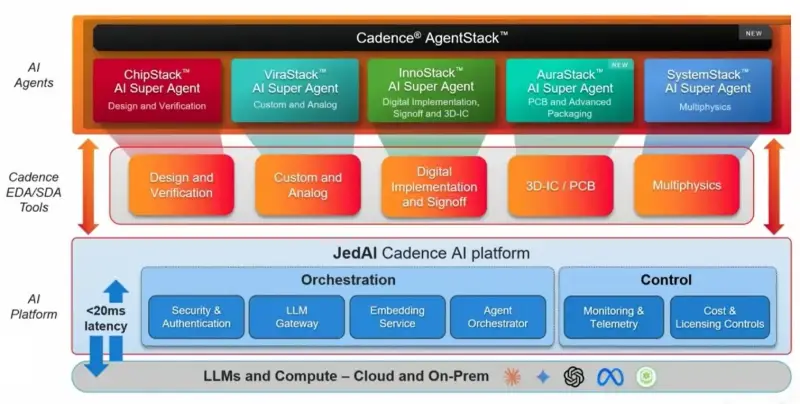
The time spent on an engineering tool is only part of the work. When a verification run fails, someone still has to connect the result to a design change, decide what to investigate, run the next analysis, and judge whether the fix holds. Cadence’s AI Super Agents are designed to coordinate parts of that loop across electronic design automation (EDA) workflows.
That distinction matters. Automating a single operation can speed up one step; coordinating analysis and follow-up can help engineers move from a result toward a design objective. Cadence describes its agents as tools for reducing repetitive investigation and coordination, exploring more design options, and progressing toward design goals. Engineers remain responsible for consequential decisions and final signoff.
The work between tool runs
A failing regression rarely identifies its own cause. The engineer may need to inspect logs, review a trace, check a recent RTL change, and consider whether the testbench or model missed a corner case. After changing the RTL, testbench, constraints, or methodology, the engineer runs the test again and evaluates the next result.
Similar loops appear in other parts of the flow. A late timing miss calls for investigation across reports, design structure, and constraints. Analog optimization involves weighing performance and power requirements. PCB development brings electrical, thermal, mechanical fit, and manufacturing constraints into the same design problem. The tools can automate many individual operations, while deciding which operation to run next still takes context and judgment.
Cadence positions its AI Super Agents as a way to connect selected tasks into multi-step workflows. Their practical value depends on the objective being pursued, the integrations available, and how the workflow is configured.
From an answer to an investigation
A conversational assistant might explain an error message or generate a script. An engineering agent is intended to take on a broader task: examine available results, correlate relevant evidence, coordinate supported analyses, and present findings for review. For a timing issue, that could mean more than explaining a violation; the agent could help investigate it using relevant reports and design information.
Cadence’s description of agentic AI in EDA centers on working toward an engineering objective. Intermediate results can guide later steps, so the workflow has a chance to adapt as evidence arrives. The useful measure is therefore not the number of commands an agent can issue, but whether it can advance a defined task and make its reasoning reviewable.
| Workflow stage | With agent assistance |
| Investigating a failure | The agent can analyze available results, correlate relevant evidence, and identify possible causes for an engineer to assess. |
| Coordinating analysis | It can sequence supported operations, use intermediate results to guide subsequent steps, and present its findings. |
| Recording results | Where supported, it can organize findings, evidence, and suggested follow-up actions. |
| Making design decisions | The engineer defines objectives, checks evidence, evaluates proposed changes, and remains responsible for design decisions and signoff. |
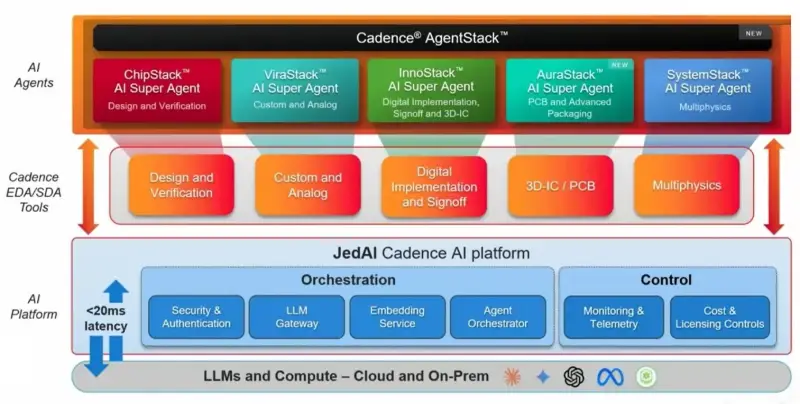
The degree of automation varies by agent, supported tool integrations, and workflow configuration. Cadence’s overview of automation in EDA describes a range of possible arrangements; an agent’s actual scope depends on the capabilities enabled for it.
Why design context matters
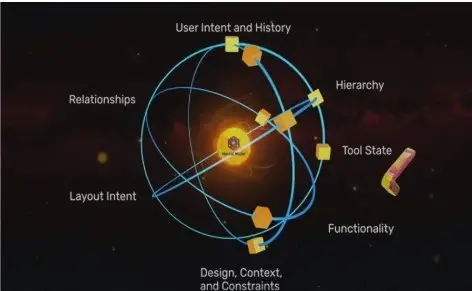
Logs and reports provide evidence, but isolated fragments don’t necessarily explain how a design is structured or what it is meant to do. Cadence’s Mental Model is a structured representation intended to give agents that broader context. It brings together information from specifications, RTL, behavioral models, diagrams, libraries, and other human-readable design material.
The process has three stages. Elaborate extracts structural details such as hierarchy, connectivity, and parameters. Enrich adds behavioral and contractual information, including functionality, interfaces, and protocols. Reason organizes relationships across that information to make connections within the design.
The intended result is a shared design context that can change as the design changes. With it, an agent may be better placed to connect a verification failure to relevant RTL, relate a timing violation to structure and constraints, or consider how an analog specification maps to circuit behavior. The representation provides context; it does not establish that an interpretation or proposed change is correct.
Context plus tool skills
Design knowledge alone cannot run an analysis. Domain-specific skills define how an agent interacts with supported Cadence tools and engineering outputs such as traces, reports, and logs. The Mental Model supplies structured information about design intent; the skills give the agent a way to use tools and interpret their results within its permitted scope.
In a supported workflow, that combination can let an agent use design context to guide a task, invoke an operation, interpret the resulting evidence, and identify a useful next step. The boundaries matter: tool access and workflow configuration determine what it can do, while engineers still need to validate findings and assess proposed changes.
Keep engineering judgment in the loop
Automation doesn’t transfer responsibility for defining requirements or accepting a design. Engineers must set objectives and constraints, judge tradeoffs, check whether results meet requirements, and consider risks introduced by a change. A completion message on its own is not enough. Reviewable findings and supporting evidence are needed, and automated execution does not prove that a design meets its requirements.
That makes three things central to a useful deployment: clear intent and acceptance criteria; access to the evidence behind an agent’s findings; and validation against design requirements before signoff. The aim is to reduce repetitive coordination and investigation while leaving engineering decisions with the people accountable for the design.
Evaluate the workflow, not the demo
Start by identifying a real bottleneck and defining the outcome that would improve it. That might be faster investigation of failures, more efficient design iterations, or progress toward design closure. Then establish what the agent can analyze, execute, and coordinate, and whether it has access to the design representations, constraints, reports, and EDA tools the task requires.
Also examine how its autonomy is bounded, what happens when an operation encounters an exception, and how consequential actions are handled. Check how results can be compared with design intent and verification criteria, and whether engineers can inspect the evidence and retain signoff responsibility. Finally, set a baseline so changes in engineering effort, iteration efficiency, design quality, and workflow performance can be assessed.
Faster tool execution may help, but the more meaningful test is whether coordinated work improves progress on an engineering objective while preserving accuracy and review. For teams considering EDA agents, a narrowly defined workflow with measurable outcomes is a practical place to judge that claim.