Autonomous Root Cause Analysis Targets Regression Triage at Semiconductor Scale
- Published
- Author
- Zackary Glazewski
- Reads
- 989
Intelligent failure grouping and selective waveform reruns could cut redundant debug work before autonomous root cause analysis investigates fixes.
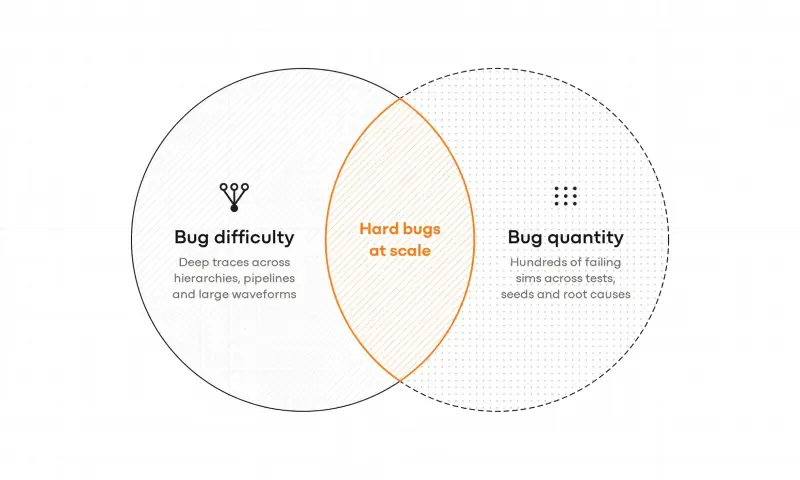
Regression triage becomes a scaling problem when a design produces hundreds of failing simulations and engineers still have to determine which failures share a cause. Autonomous root cause analysis (RCA) can help with difficult individual bugs, but applying it economically across a full regression takes more than launching an agent for every failure. The workflow must first decide what to group, what to rerun, and where detailed waveform data is needed.

The pressure is growing with design complexity. At DVCon earlier this year, Nvidia’s Stuart Oberman described first-silicon success as approaching a “statistical impossibility.” Semiconductor Engineering reported in 2018 that debugging consumed 44% of verification effort; designs have since continued to grow in scale and complexity. The practical challenge is not only tracing a subtle failure through a large design, but repeating that work across many tests and seeds.
Two dimensions of debugging effort
One dimension is bug difficulty. A root cause may sit several levels down a design hierarchy, after a long sequence of pipeline activity and interactions among components. Finding it can require examining large waveforms and testing multiple explanations. ChipAgents describes its RCA approach as a search across likely traces and hypotheses: it ranks candidate explanations and gives engineers confidence scores to help assess the results.
A customer example illustrates why a failure may need that kind of reasoning. A design contained a bidirectional serialization interface between a manager and a subordinate. During a transaction, the subordinate triggered a reset while the manager continued transmitting beyond the reset grace period. Part of the transmitted payload matched the protocol’s start code. The subordinate treated that value as the start of a new frame, and the sequence eventually caused a downstream failure.
The failure depended on several events lining up: a reset during the transaction, payload data matching the start code, and transmission continuing beyond the grace period. Looking at a single symptom would not necessarily reveal that chain. An RCA system has to trace the interaction and distinguish a plausible root cause from a surface-level correlation.
The other dimension is bug quantity. A regression can include hundreds of simulations across many tests and seeds. Some may fail for unrelated reasons; others may show different symptoms caused by one underlying defect. The hardest operating condition combines both dimensions: difficult bugs appearing across a large batch of failures.
Why triage needs orchestration
At regression scale, every failing simulation may carry logs and waveform data, and a debug case can already involve very large files. A naive workflow would launch an agent for each failure, rerun simulations whenever more evidence is needed, capture waveforms for every failing test, try fixes, and repeat the regression. That can multiply compute use and elapsed time, particularly when a proposed fix is wrong and prompts more cycles of investigation.
Efficiency depends on accuracy. An unreliable RCA process can consume extra resources as it tests and abandons hypotheses. A useful system therefore needs to limit redundant work while retaining enough evidence to identify each distinct problem. It must also account for the possibility that fixing one issue exposes another.
Group failures by likely cause
Conventional regression tools often use deterministic scripts and signature matching to place similar failures into bins. Those techniques remain useful, but different log signatures do not always mean different bugs. A secondary analysis can look for failures that are likely to share a root cause, even when their visible patterns differ.
ChipAgents RCA Triage uses such a pass after conventional binning. Its aim is to shrink a large set of failing simulations into a smaller set of meaningful groups for investigation. Each group can then be treated as a likely debugging problem, instead of sending every simulation through an independent RCA run. The method still depends on correctly identifying relationships among failures; the grouping is a way to focus analysis, not proof that every failure in a bin has the same cause.
Choose witness simulations for waveform capture
The same selectivity applies to reruns. Capturing a waveform from every failure may be wasteful when a smaller number of representative runs can explain the group. The proposed workflow selects a minimum set of “witness simulations” for each bin, then reruns those cases with waveform dumping enabled.
This makes waveform generation a targeted step. Instead of collecting all available debug data up front, the system seeks the smallest set of runs that provides evidence for explaining the represented failures. Since regressions can take minutes or hours, avoiding unnecessary reruns can reduce both compute demand and the wait before engineers see a useful result.
Connect triage to resolution
Once failures have been grouped and witness runs selected, their debug packages can flow into autonomous RCA. The system investigates each group, proposes fixes, and checks those fixes. A successful check adds evidence that a proposal addresses the cause; RCA confidence and witness results can also inform whether it is ready for a final regression run. That full run remains the confirmation that the failures have been resolved.
The workflow runs from regression through intelligent binning, witness selection, waveform reruns, RCA, proposed fixes, verification, and a final regression. The intended shift is from engineers beginning triage manually after an overnight run to engineers reviewing what the system resolved and what still needs attention. The result may be partial: some failures could be addressed while others remain for investigation.
Scale also means controlling agent cost
Multi-agent systems can explore several lines of reasoning, which may improve performance and accuracy, but repeated agent execution consumes resources. ChipAgents says its internal benchmarks show its multi-agent systems achieving what the company calls state-of-the-art performance at costs comparable to traditional single-agent systems. Those are company-reported benchmark claims; no benchmark conditions or figures are provided here.
For semiconductor engineering, the next measure of an autonomous system is therefore broader than whether it can solve one difficult bug. It must also handle a regression reliably, choose where additional evidence is worthwhile, and keep the cost of investigation manageable. The key test will be whether selective analysis can resolve failures across real development workloads without turning every symptom into a separate, expensive debug campaign.


