Cyber Resilience Act: What Chip and IP Suppliers Need to Prepare
- Published
- Author
- Leon Brown
- Reads
- 381
The Cyber Resilience Act brings security evidence and reporting duties into chip supply chains, with broader product requirements due from December 11, 2027.

The Cyber Resilience Act (CRA) brings chip and semiconductor IP suppliers into the security work required for digital products sold in the European Union. For suppliers, the practical change is that customers may need more than a component description: they may ask for evidence about security design, evaluation scope and assumptions for safe use. The obligations depend on the product and how it reaches the market, so companies will need to establish which responsibilities apply to each product line.
Why components are part of the picture
Networked products exchange data, coordinate with other devices and receive software updates. Those connections can make a vulnerability in one product a route into systems that users trust. Responding to an incident can consume time and money, while reputational effects may persist after the technical problem is addressed. The CRA, adopted in October 2024, sets common cybersecurity requirements for digital products supplied to the EU market.
The framework reaches beyond companies selling finished products. It also applies to separately sold semiconductors, and manufacturers must use due diligence when incorporating third-party components. Semiconductor IP suppliers may be asked to share security evaluation results and state the assumptions under which their IP is intended to be used securely. That information can help a product manufacturer account for component risks in its own product documentation.

The CRA identifies semiconductor categories including microprocessors, microcontrollers, ASICs and FPGAs. Classification depends on core functionality, including whether a product provides security-related functions, as well as how it is placed on the market. The resulting obligations can differ across products, which makes early classification a practical first step for chip and IP teams.
Reporting and evidence across the supply chain
A mandatory reporting phase took effect in September 2026. If a manufacturer learns that a vulnerability in its product is being actively exploited, or that a severe incident has affected the product’s security, it must submit an early warning. A more detailed notification follows, then a final report covering findings and corrective measures. Manufacturers submit these notices through the CRA’s Single Reporting Platform.
Component suppliers may contribute information that helps manufacturers meet those reporting and documentation needs. The division of work is not identical for every product: it depends on classification and the supplier’s role. Suppliers therefore need to understand what evidence they can provide and what customers may reasonably request for the specific component or IP product.
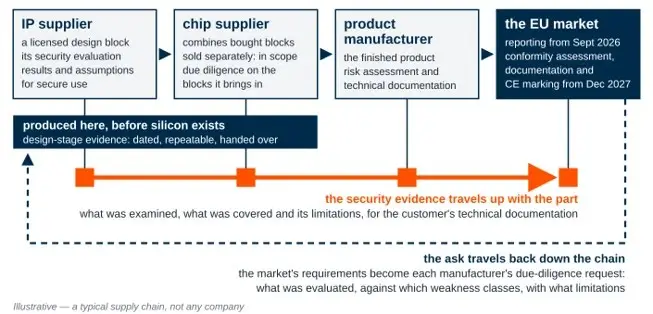
Fig. 1: Illustrative supply chain showing how component information and security evidence may move between suppliers and the product manufacturer in support of its EU CRA documentation. (Source: Arteris, Inc.)
For hardware teams, useful evidence starts with a clear account of what was examined. Dated, repeatable evaluations can identify the design version, the areas covered and any limitations. Mapping findings to named hardware weakness classes can make results easier to trace through design reviews and customer documentation. The CRA sets security outcomes but does not prescribe one evaluation method, leaving companies to select methods suited to their designs and development flows.
Turning design work into traceable records
Arteris’s EU CRA Hardware Readiness Guide provides a checklist for assessing product scope, assigning responsibility and identifying information customers may request. It can also help teams spot gaps in classification, processes or security records. The guide distinguishes design-stage evidence from a completed conformity assessment; using the checklist does not fulfil every duty that applies to a manufacturer.
The checklist prompts companies to identify assets such as cryptographic keys, configuration data and debug state, then define the boundaries that should protect them. Teams can document where those assets may travel within a design and where they must remain blocked. A circuit that performs its intended function does not, by itself, demonstrate that sensitive assets stay within those boundaries.
Annex VII of the CRA describes material manufacturers must include in technical documentation, including cybersecurity risk assessments, relevant design and development information, and supporting evidence where applicable. Suppliers can organize their own records so customers can use relevant information in that documentation. The value of a repeatable evaluation is practical: it ties a finding to a defined design and scope, making follow-up work easier to plan.
Arteris brand Cycuity offers Radix for hardware security verification. The software translates security requirements into rules that can run in existing simulation and emulation flows. Radix-S checks rules during simulation, while Radix-M carries them into emulation for system-level analysis. The tools track selected assets, such as cryptographic keys and configuration data, through a design and flag flows that breach defined rules. They can also help teams examine whether Root of Trust features behave as intended, gauge evaluation coverage and identify areas for further testing.
Planning for the 2027 requirements
December 11, 2027, is the next major date: the CRA’s broader cybersecurity, conformity assessment and documentation requirements take effect, along with CE marking for products that must meet applicable EU requirements.
Hardware and IP suppliers can prepare with customers by identifying which product versions are intended for the EU market. Doing that while designs are still in development gives both sides time to align schedules and plan the evidence work. For chip teams, a useful starting point is a product-by-product record of classification, security assumptions, evaluation scope and customer-facing information. Those records can give manufacturers a clearer basis for their own documentation as the 2027 date approaches.


