RECOM Adds 720W IP67 Supplies for Decentralised Industrial Power
- Published
- Author
- Saba Aafreen
- Reads
- 584
RECOM’s new 720W RACPRO1 supplies support installation outside control cabinets; one version adds four isolated, individually protected outputs.
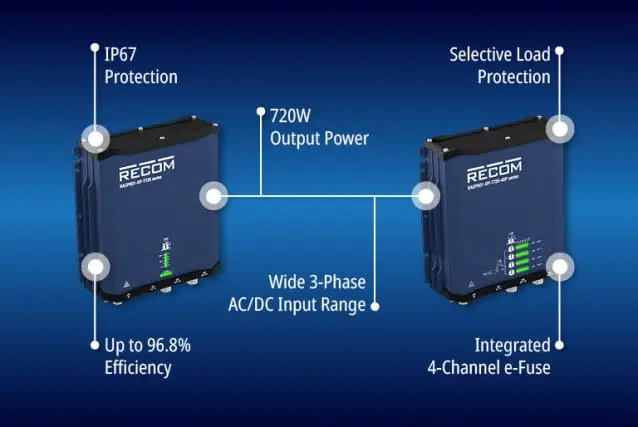
Moving power conversion closer to industrial loads can reduce the wiring that runs back to a central control cabinet. RECOM’s expanded RACPRO1 family takes that approach with two 720W power supply series rated IP67 for installation outside cabinets: the RACPRO1-DP-T720 and RACPRO1-DP-T720-4SP. The second adds four isolated outputs with electronic fuse protection, giving machine designers a choice between a general supply and one that also provides per-output load protection.

Power conversion at the machine
Conventional cabinet-based distribution places the power supply apart from many of the devices it feeds. Decentralised systems put conversion nearer to the point of use. That can shorten wiring runs and give machine builders more freedom in how they lay out equipment, while reducing installation work and associated costs, as RECOM describes it.

The trade-off is that a supply installed outside an enclosure needs to suit its intended mounting environment. Both new series carry an IP67 rating, which RECOM identifies as supporting installation beyond control cabinets. The rating and output power are shared; the main difference is how the supply distributes and protects its outputs.

One 720W output with overload headroom
The RACPRO1-DP-T720 accepts three-phase AC input from 320VAC to 600VAC, or DC input from 425VDC to 800VDC. RECOM specifies efficiency of up to 96.8 percent and says the unit can deliver its full output power through ambient temperatures up to +45°C with convection cooling.

For brief overload conditions, the supply can provide up to 1080W for 5 seconds. That short-duration capacity may help accommodate temporary demand peaks, though the stated overload figure is limited to that five-second interval. Designers still need to match the supply’s continuous output and input range to the load and the installation’s electrical conditions.
RECOM gives the unit a power density of 400W/L, a figure relevant where mounting volume is constrained. The company positions this model as the straightforward option for decentralised conversion when a single supply is appropriate and separate downstream protection is handled elsewhere in the system.

Four isolated outputs with electronic fuses
The RACPRO1-DP-T720-4SP combines power conversion with a four-channel electronic fuse, or e-Fuse. Its four outputs are isolated, and each has an adjustable current limit. That arrangement lets a designer set protection for individual loads supplied by the unit instead of relying on one shared output limit for all connected equipment.

RECOM also lists safe start-up for capacitive loads, selectable hiccup or trip modes, and priority disconnect during overload. Those functions give system designers options for how connected loads behave when starting or when an overload occurs. The company does not specify the current-limit adjustment range or provide further timing and coordination figures in the product information described here, so those details will matter when selecting the unit for a particular load set.
With separately protected outputs, a fault or overload on one branch can be managed at that channel according to its configured limit and selected operating mode. That may simplify distribution within a machine, especially where multiple loads have different requirements. The practical benefit depends on how the e-Fuse settings align with load characteristics and the system’s wider protection design.
Where the new series fit
RECOM lists factory and process automation, machine building, intralogistics, battery energy storage, water treatment, HVAC and agriculture among the intended application areas. These settings can include equipment spread across a machine or facility, where bringing conversion closer to loads may reduce long power runs. The 4SP variant adds a way to divide and protect those loads at the supply, while the T720 offers the same 720W rating without the described four-channel e-Fuse.
Michael Peters, product manager at RECOM, said the two series address different industrial requirements: the T720 provides a high-performance supply, while the T720-4SP combines conversion and an integrated e-Fuse in one compact unit. His distinction reflects the central selection question for engineers: whether the system benefits from individual, adjustable protection at the power supply or calls for a conventional supply arrangement.
For machine builders, the specifications to resolve first are the available three-phase input, the load’s continuous and transient demand, the ambient temperature, and the need for independent output protection. The IP67 rating supports the intended cabinet-external installation, while the choice between the two series determines whether four isolated, current-limited branches are built into the supply.