TAPe+ML v3.5 Runs Detection, Classification and Segmentation on One CPU Core
- Published
- Author
- Saba Aafreen
- Reads
- 820
Comexp Research Lab says its 4.2 MB vision package handles three image tasks on one CPU core, with benchmarks on Raspberry Pi and Intel N100 systems.

Running image classification, object detection and instance segmentation on one CPU core could simplify vision workloads for compact devices. Comexp Research Lab’s TAPe+ML v3.5 combines all three tasks in a shared recognition core, with fewer than 100,000 parameters and a total file size of around 4.2 MB, including model weights, inference code and libraries.

The reported results make the package relevant to teams working with small computers that lack a dedicated graphics processor. Comexp says the system was tested on Raspberry Pi 4, Raspberry Pi 5 and Intel N100 hardware, with inference times ranging from 8.6 ms to 34.7 ms per frame using one CPU core. The reported Raspberry Pi figures are 20.4 ms on the Pi 5 and 34.7 ms on the Pi 4.

One shared image representation
Many vision systems assemble a workload from separate models for classification, detection and segmentation. TAPe+ML takes a different approach: it builds a structured representation of the image before inference, then uses that representation across the three tasks. The design aims to avoid maintaining an entirely separate recognition core for each output type.
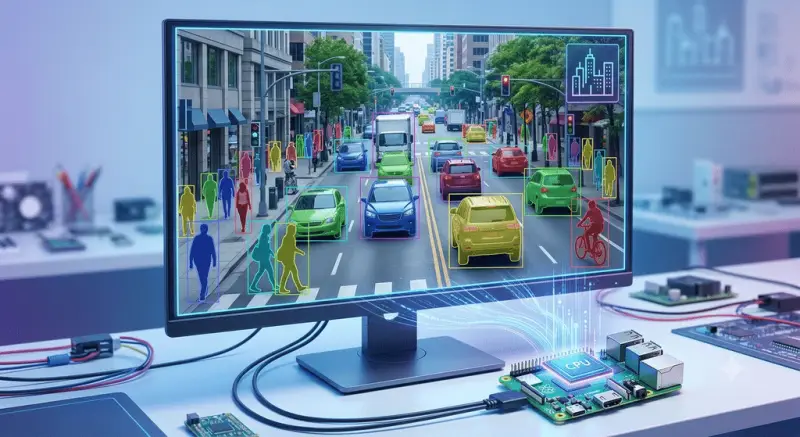
Those outputs serve different purposes. Classification identifies what is present in an image; detection locates objects, typically with bounding boxes; instance segmentation assigns a pixel-level outline to each detected instance. A shared internal representation may reduce duplication in a compact deployment, though the available figures don’t quantify memory use during execution, power draw or the difference in runtime versus separate models.

The system also uses a learned region selector on larger images. That means the model can select image regions for processing rather than treating every part of a larger frame in the same way. The description doesn’t specify the selector’s operating thresholds or how much computation it saves, so its effect will need to be judged in the intended application.

Reported accuracy and speed
Comexp reports 88.0% top-1 accuracy on ImageNet-1k. For object detection, it reports 71.1 box average precision (AP) on the COCO validation set. The instance-segmentation result is 60.3 mask AP. The system is also reported to score 66.0 and 58.0 on the COCO test set, though the task associated with each of those two figures isn’t specified in the available details.
These metrics describe different aspects of the system and shouldn’t be read as interchangeable measures. Top-1 accuracy records whether the highest-ranked classification matches the expected label. Box AP evaluates detection quality across precision and recall, while mask AP evaluates the quality of segmented object regions. For an engineering deployment, benchmark scores are only part of the decision: the relevant image size, camera input path, target frame rate and acceptable error modes also matter.

The latency range of 8.6 ms to 34.7 ms per frame suggests performance varies substantially across the tested CPU configurations. The stated Pi 4 and Pi 5 timings provide two reference points, but the results don’t identify the specific Intel N100 latency or detail clock settings, memory configuration, thermal conditions, software build or measurement method. Those details are useful when comparing results with an existing pipeline or estimating sustained performance in an enclosure.

Compact deployment, with integration work to check
At around 4.2 MB for the complete system, TAPe+ML’s package size is small enough to make local deployment worth evaluating on constrained hardware. The figure includes the weights, inference code and libraries; it describes the file package, not the system’s full runtime memory footprint. Device selection should therefore account for working memory and the surrounding application, in addition to storage.
The TAPe+ML workbench supports uploading images, annotation, training, evaluation and API integration. The system is available through an online platform and can also be provided locally for integration with devices and on-premise use. Comexp notes that some newer processors may need adjustment to work with the system, a practical compatibility point for teams targeting hardware outside the tested Raspberry Pi and Intel N100 configurations.
For embedded vision engineers, the useful question is whether a shared model can meet the application’s accuracy and latency requirements on the processor already in the design. TAPe+ML v3.5 offers reported results across three vision tasks and several CPU targets; validating the exact model build, image dimensions, sustained timing and runtime memory on the chosen device will determine how well those results transfer to a deployed system. More information is available from Comexp Research Lab.


