SparkFun IoT RedBoard Combines ESP32-P4 Processing With ESP32-C5 Wireless
- Published
- Author
- Ananthu Ashok
- Reads
- 630
SparkFun’s $49.95 RedBoard pairs a 400 MHz ESP32-P4 with an ESP32-C5 for wireless, camera and display projects, with open hardware files.
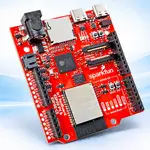
SparkFun’s IoT RedBoard puts two Espressif processors to work on different parts of an embedded project: the ESP32-P4 handles application processing, while the ESP32-C5 provides wireless connectivity. That division gives developers a board aimed at projects that combine user interfaces, images or sound with network links, including human-machine interface (HMI) prototypes.

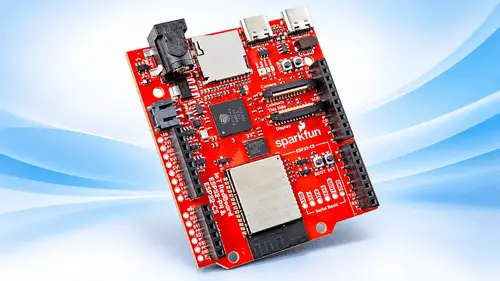
The ESP32-P4 runs at 400 MHz and is intended to process applications involving images and audio. The ESP32-C5 takes on wireless communication, with dual-band Wi-Fi 6, 5 GHz capability, Bluetooth 5 LE and Zigbee listed for the board. Keeping those roles on separate chips gives a project a dedicated wireless processor alongside the main application processor; the practical value will depend on how a developer divides tasks and on the software support available for each interface.

Memory, storage and expansion
The board includes 32MB of PSRAM and 16 MB of flash memory, plus a microSD card slot. These resources give developers several places to hold program code and project data, though the available source details do not specify the microSD capacity or the precise memory allocation between the two processors. For an image or audio interface, the amount and arrangement of memory can shape how developers manage buffers and application assets, so those details should be checked against the design files and software examples before a project depends on them.
Its connectors are intended to make peripheral prototyping part of the board’s appeal. MIPI connectors provide routes for camera and display connections. A pair of USB-C ports serve separate functions: one is for serial and JTAG programming, while the other provides high-speed USB OTG. The board also carries a Qwiic connector and RedBoard/R3 expansion headers, offering familiar options for attaching compatible modules and add-on hardware.
For portable builds, a JST connector accepts a single-cell LiPo battery. SparkFun says the board includes onboard charging and battery monitoring. Those features bring battery integration onto the board, although the published specifications here do not provide charge current, battery runtime or operating limits. Designers will need those figures for a power budget and should consult the board documentation before choosing a battery or estimating endurance.

Open hardware and software choices
SparkFun provides KiCad schematic and PCB design files in the project repository. That gives hardware developers a way to inspect component connections and board layout, then use the published design as a reference when adapting the hardware. The repository also contains Arduino board support files, installation scripts and patches for the ESP32-C5 wireless interface.

The RedBoard arrives with MicroPython and can also be used with Espressif’s ESP-IDF and the Arduino IDE. There is a software qualification for Arduino users: the standard Arduino ESP32 Core version 3.3.12 does not natively support the board’s ESP32-C5 wireless co-processor. SparkFun supplies a temporary patch while upstream support is being developed. That means teams choosing Arduino should account for the patch in their setup and verify that the required wireless features work in their intended software environment.
For teams comparing development boards, the distinction between the main processor and the wireless companion matters as much as the headline chip count. The P4’s stated role covers application work, while the C5 supplies the listed radio functions; camera, display and USB interfaces broaden the range of prototype configurations. But connector availability alone does not establish compatibility with every peripheral or software stack. Developers will still need to check signal requirements, available libraries and the board’s detailed pin assignments for their chosen components.
Two board versions
The Wi-Fi/BLE version is listed at US$49.95. SparkFun also offers a separate PoE variant of the RedBoard, which uses wired Ethernet instead of the wireless companion. The available details do not specify that variant’s price or provide a full feature comparison, so buyers should check the product documentation to confirm which interfaces and capabilities differ.
With open KiCad files, multiple programming options and connectors for displays, cameras and expansion hardware, the IoT RedBoard is positioned as a flexible base for embedded interface development. Its most immediate software caveat is the temporary ESP32-C5 patch required with Arduino ESP32 Core 3.3.12; checking that support status alongside the project’s peripheral and power needs will help determine whether the board fits a particular build.