Renesas RZ/T2N MPU Integrates Four Axis Motor Control and Industrial Ethernet
- Published
- Author
- Saba Aafreen
- Reads
- 775
Renesas’ RZ/T2N combines application processing, real-time motor control for up to four axes and industrial Ethernet in one 64-bit MPU.
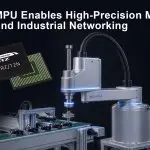
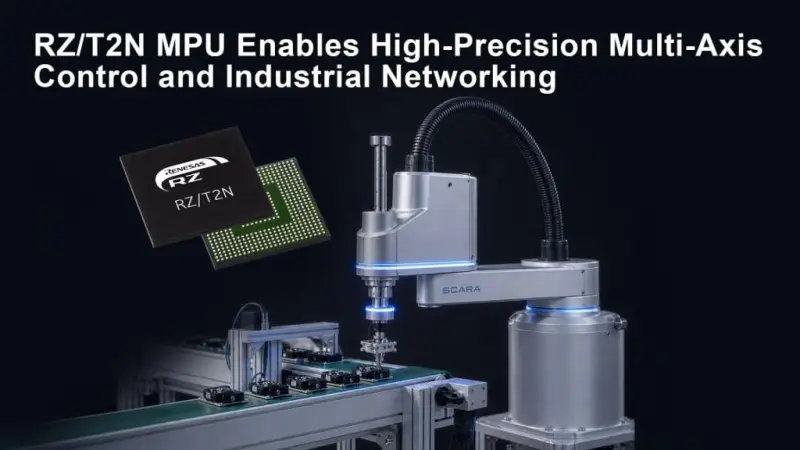
Renesas Electronics’ RZ/T2N brings application computing, real-time motor control and industrial networking into one 64-bit microprocessor. For robot controllers, multi-axis servo drives and programmable logic controllers, that integration could reduce the number of separate devices on a board and simplify the design work needed to connect them.

Two processing domains on one device
The RZ/T2N pairs two Arm Cortex-A55 application cores, running at up to 1.2GHz, with two Arm Cortex-R52 real-time cores, running at up to 800MHz. That division gives equipment designers separate processing resources for application software and time-sensitive control tasks within the same MPU.

Each Cortex-R52 core has 576KB of tightly coupled memory (TCM) with error-correcting code (ECC) protection. TCM provides the real-time core with closely coupled storage for code and data; Renesas says this arrangement helps reduce variation in execution time during motor control. That predictability matters when control tasks must run at regular intervals, though the stated specifications alone don’t establish system-level timing performance for a particular design.

Consolidating those roles can change the board architecture. Designs that previously used separate processors for application handling, motion control and communications may be able to bring those functions together on the RZ/T2N. The practical gains will depend on the required interfaces, software partitioning and system design, but fewer separate chips can mean fewer component connections and less board area to allocate.
Motion control for up to four axes
Integrated motion-control peripherals support as many as four motor axes. That makes the MPU a candidate for equipment such as SCARA and Delta robots, where coordinated motion across several axes is central to operation. The device also provides two encoder interface channels per axis.

Supported encoder formats include Tamagawa T-Format, HIPERFACE DSL, A-format, EnDat 2.2, EnDat 3, BiSS C and BiSS Line. This range gives designers options when matching the processor to feedback hardware used in different motion systems. Encoder compatibility still needs to be checked against the specific sensor, wiring and system requirements; listing a format does not by itself establish compatibility with every implementation.

Putting encoder interfaces and motor-control peripherals on the same MPU as application processing may reduce the need for external control devices. It also places real-time control and higher-level software on a shared platform, so the design must account for how those workloads are allocated and how the control software uses the available real-time resources.
Ethernet functions built in
The networking hardware includes three Gigabit Ethernet MACs, a three-port Ethernet switch and an EtherCAT SubDevice Controller. The RZ/T2N supports EtherCAT, PROFINET RT/IRT and EtherNet/IP, as well as Time-Sensitive Networking (TSN). Renesas positions the integrated communications functions as a way to handle industrial networking without external communication ICs.
The MPU can serve as a network controller or as a networked device. That flexibility could help equipment makers build different products around a common processing platform, while still adapting each design to its role on the network. The announcement identifies the protocols and integrated hardware, but doesn’t specify throughput under a given traffic mix or provide latency figures; those are system-level details designers will need to evaluate for their application.
Network resilience features include support for High-availability Seamless Redundancy (HSR), Parallel Redundancy Protocol (PRP) and Frame Replication and Elimination for Reliability (FRER). These protocols are intended to maintain communications when a network path is interrupted. Their usefulness depends on the network topology and the other devices in the system, so integration planning remains part of the engineering work.
Security and design implications
Renesas lists secure boot, secure firmware updates and Arm TrustZone among the RZ/T2N’s security features. Together, these provide hardware and software mechanisms for protecting the startup process, update path and separated execution environments. The announcement doesn’t detail configuration steps or describe a specific threat model, so product teams will need to assess how the features fit their own software and maintenance requirements.
The RZ/T2N’s main engineering proposition is functional consolidation: application cores, real-time cores, multi-axis control and industrial Ethernet sit on a single component. That could shrink a controller’s component count and board footprint, while giving designers one platform for processing, motion and communications. The next practical questions are how the supported interfaces fit the target machine, how software workloads map to the two core types, and whether the integrated network and control functions meet the system’s timing needs.