Arduino Nano XL Link Brings CAN FD, RS485 and Ethernet to the Nano Format
- Published
- Author
- Ananthu Ashok
- Reads
- 647
The Nano XL Link pairs a 120MHz Cortex-M33 with CAN FD, RS485 and 10/100Mbps Ethernet for automation and building control projects.
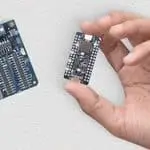
Arduino’s Nano XL Link puts three wired network interfaces on a compact development board, giving automation designers a direct route to CAN FD, RS485 and Ethernet without adding separate communication modules. Announced at electronica 2026 alongside the Nano XL Link Connector Carrier, it extends the Nano range toward industrial and building automation work. That combination is more significant than it looks: a controller that can connect to several kinds of equipment can simplify early system layouts, even if it doesn't settle the harder questions of protocol support, timing or installation.

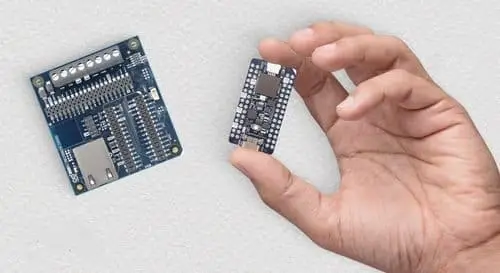
Processing and network hardware
The Nano XL Link is built around Microchip’s PIC32CK2051SG01144 microcontroller. Its 32-bit Arm Cortex-M33 processor runs at 120MHz, with 2MB of flash and 512KB of RAM. Those resources give developers room for control code, communication tasks and local data handling, but their practical limits depend on the application and software. Arduino hasn’t specified performance figures for particular workloads, so the processor and memory figures describe the hardware rather than guaranteeing a given control response or number of simultaneous tasks.

Each wired interface has dedicated hardware on the board. A Texas Instruments TCAN3414 transceiver handles CAN FD, an RS485 link uses a THVD2410 transceiver, and a Microchip KSZ8081 PHY provides Ethernet connectivity at 10/100Mbps. Arduino gives a maximum CAN FD speed of 8Mbps. These components establish the electrical interfaces; the behavior of a complete network will also depend on its wiring, connected devices and configuration.

These interfaces serve different wiring and network needs. CAN FD supports communication among control nodes and equipment, while RS485 is commonly used for wired links between devices in automation systems. Ethernet adds a familiar network connection that can link the controller to compatible networked equipment. Putting all three on one board can simplify prototypes that need to bridge equipment or communicate with several classes of device. Here's the thing: having the ports on the board doesn't make unlike networks interchangeable. The actual design still depends on the connected equipment, wiring, software and system requirements.
Expansion and enclosure integration
Two 30-pin, double-row connectors provide access to digital and analogue I/O, PWM, UART, SPI and I2C. A Qwiic connector offers another way to attach compatible sensors and devices. That mix gives a project ways to connect local inputs, outputs and peripherals while using the board’s wired networks to communicate beyond the controller. If you're working in this space, the value is in having those options on the same platform; you’ll still need to map the signals and connections against the needs of the specific design.

The companion Nano XL Link Connector Carrier is intended to make physical integration more convenient. It provides screw terminals for CAN FD and RS485, plus an RJ45 Ethernet interface, and its DIN-rail mounting format is aimed at installation in industrial enclosures up to 4U in size. The carrier changes how the board can be mounted and wired, which can make enclosure planning more direct. It doesn't remove the need to check that the selected enclosure, connectors and wiring suit the application, or that the assembled layout leaves room for the connections the system requires. In practical builds, those details matter as much as a controller’s interface list.

Software and potential uses
Arduino says the Nano XL Link can be programmed with the Arduino IDE and Arduino Cloud, and that it supports the Arduino Zephyr core. That gives developers familiar Arduino tooling alongside a Zephyr-based option for embedded projects. The announcement doesn't specify which libraries, protocols or software features will be available for each interface, so the presence of an interface shouldn't be read as confirmation that every target device or protocol is supported out of the box.
Arduino describes potential roles including real-time machine control, fieldbus gateway functions, smart lighting, HVAC and energy management. Those applications put different demands on a controller. A machine controller may need predictable responses to inputs and outputs; a gateway must exchange data across connected networks; and building systems may coordinate sensors, lighting or HVAC equipment. The board’s listed interfaces and processing resources make those uses plausible targets, but the announcement doesn't provide timing results, network throughput tests beyond the interface ratings, or details of supported protocols and software libraries. Engineers considering it for a finished system will need those specifics to judge whether it fits the design.
And yet. The board’s broad connection options make it relevant even before those questions are answered: they give developers a starting point for testing how several kinds of equipment might fit into one control system. That’s useful during prototyping, when hardware choices and network boundaries are still being worked out. It isn't evidence of production readiness. The difference will come down to the software support and implementation details that Arduino hasn't described in this announcement.
What engineers should watch for
Arduino hasn't announced pricing or availability for either the Nano XL Link or its Connector Carrier. For now, the main engineering change is the concentration of CAN FD, RS485 and Ethernet alongside the Nano’s expansion connections. The carrier adds a mounting and wiring option for enclosure use, while the software choices may appeal to teams already working with Arduino or Zephyr. The announcement leaves open practical questions about when the hardware will ship, what documentation will accompany it, and how much compatibility and protocol support developers can expect.
For engineers, the next step is to compare the board’s listed connections with the devices and software a project actually needs. That means checking the supported protocols, library coverage, timing behavior and physical integration details once they’re documented. The board offers a compact set of wired interfaces. The proof will be in how well those interfaces work together in real applications.
Further product information is available from Arduino’s Nano XL announcement, which provides the company’s product context for the new board and carrier.