Wirepas RF Mesh Reaches 700,000 Smart Meters Across Himachal Pradesh
- Published
- Author
- IoT.Business.News
- Reads
- 328
Wirepas says its RF mesh connects about 700,000 meters across Himachal Pradesh, where steep terrain and dense hill towns test network coverage.
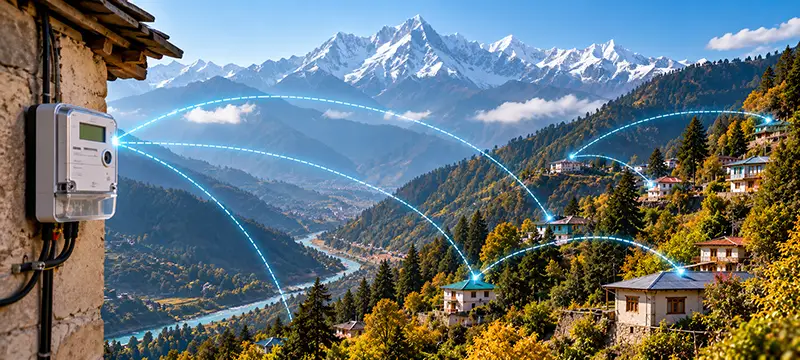
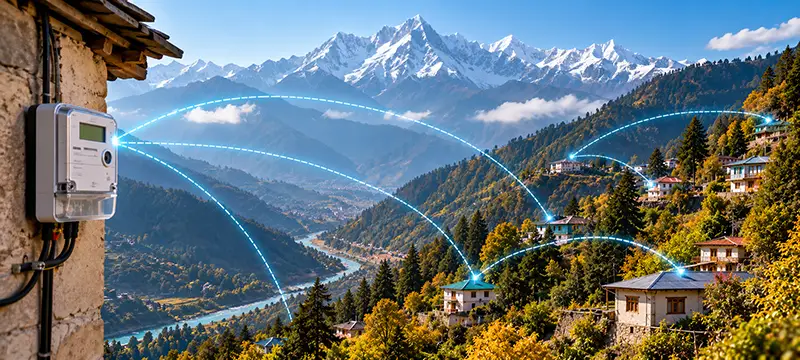
Himachal Pradesh puts two very different demands on a smart meter network: meters may be widely separated in mountain valleys, while those in hill towns can be packed into buildings where walls, basements and stairwells weaken radio links. Wirepas says its RF mesh technology is now deployed in about 700,000 smart meters in the state, connecting installations across both kinds of terrain.
The deployment is part of a much larger rollout. Figures reported for 31 December 2025 show 7,02,046 consumer smart meters installed in Himachal Pradesh, against 28,00,945 sanctioned. The installed total was 1,74,360 on 4 March 2025, meaning it grew to roughly four times that level in about nine months. The programme’s stated period runs to March 2028, so the pace of installation and the ability to keep meters communicating will shape the work ahead.
A mesh designed to route around gaps
Wirepas Mesh treats each meter as both a radio transmitter and receiver. Instead of relying on every meter to reach a central collection point directly, the network can pass readings between meters and route around obstacles or a failed link. As new meters join, they can also extend the mesh’s reach. That arrangement is suited to areas where ridgelines and distance make a continuous direct radio path difficult.
In the company’s description, the network requires no dedicated gateways and no SIM cards. That removes the need to install a gateway at each coverage point and avoids a cellular subscription for every connected meter. The trade-off is that performance depends on the mesh having usable paths between devices: a meter’s ability to pass data along is part of the network design, rather than a connection being made independently from every meter to a central site.
Urban installations present a different radio problem. A meter in a basement or behind several walls may not have a clear route to a nearby collection point. In a mesh, other meters can provide intermediate links, but the network still needs enough participating devices and workable radio paths to carry readings across the area. The same architecture therefore addresses both long distances and local obstructions, while the actual route through the network varies with installation conditions.
One platform, two communication options
Wirepas Certified supports meters that communicate over RF mesh alone, as well as dual communication models that combine mesh with cellular connectivity. Utilities can use mesh in denser areas and cellular-backed connections in more remote stretches, according to the company. That gives a deployment more than one way to connect meters across varied terrain, while allowing the two meter types to be managed through one connectivity platform.
Wirepas reports a 99.9 percent service level across deployments using its platform. That figure is the company’s stated performance level; the material provided does not specify the measurement period, the definition of service level or the test conditions. Those details matter when comparing network performance, since terrain, meter density and the treatment of delayed or missing readings can affect the result.
“Himachal Pradesh is the kind of deployment that tells you quickly whether a technology was designed for India or merely adapted to it,” said Ashish Sahay, Sales Director and Country Manager, India at Wirepas. He described the requirement as serving both a village high in a valley and a meter in a crowded hill-town stairwell. His point is that the network has to support very different radio environments within the same rollout.
Why reliable readings matter to utilities
Smart meters give distribution utilities more frequent access to consumption data than a system based on periodic manual readings. In mountain communities, reliable remote reporting can reduce the need for a worker to travel to each meter, while consistent readings can reduce reliance on estimated bills. Those benefits depend on the meter being installed correctly and the communications network delivering usable data; mesh routing addresses the connection problem, while the meter and utility systems remain part of the wider chain.
National distribution loss figures cited alongside the rollout fell from 21.91 percent in FY21 to 15.04 percent in FY25. The programme’s stated target is a range of 12 to 15 percent. Smart metering is one part of efforts to improve utility performance, but the figures alone do not show how much of the change came from meter deployments or from other measures.
Wirepas has operated in India since 2018, working with Indian meter manufacturers and advanced metering infrastructure providers. Its Certified platform is based on the open NR+ specification, described as the first non-cellular 5G specification for massive IoT, and complies with India’s IS 15959 DLMS requirements. Wirepas identifies India as its largest market worldwide and lists Assam, Uttar Pradesh and Ladakh among other places where its networks operate at scale.
For Himachal Pradesh, the key engineering question is whether the network can keep meeting its service commitments as the installed base grows from roughly 700,000 meters toward the larger sanctioned total. Mesh routing and the option of cellular-backed meters give the rollout tools for different terrain and building conditions. The next measure to watch is how those connections perform as installations extend into more of the state’s valleys and hill towns.