Mimaki 3DUJ-553MkII Adds Wider Colour Gamut and Lower-Cost Infill
- Published
- Author
- Sam Davies
- Reads
- 607
The 3DUJ-553MkII pairs a reported 1.4-times-larger colour gamut with lower-cost internal infill and automatic job scheduling.
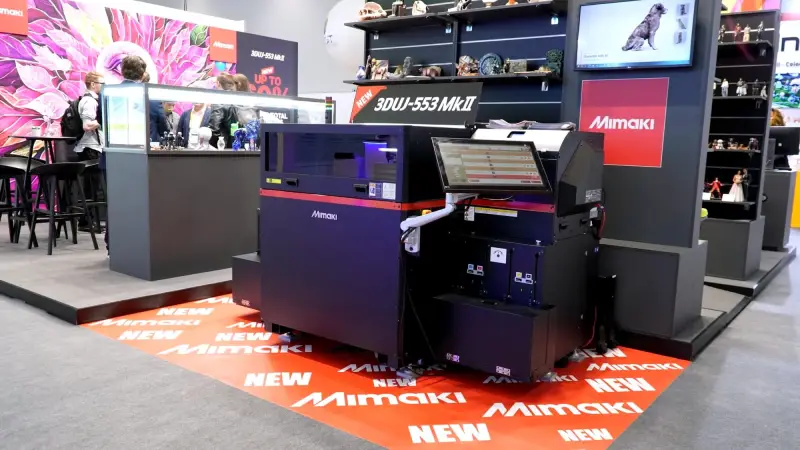
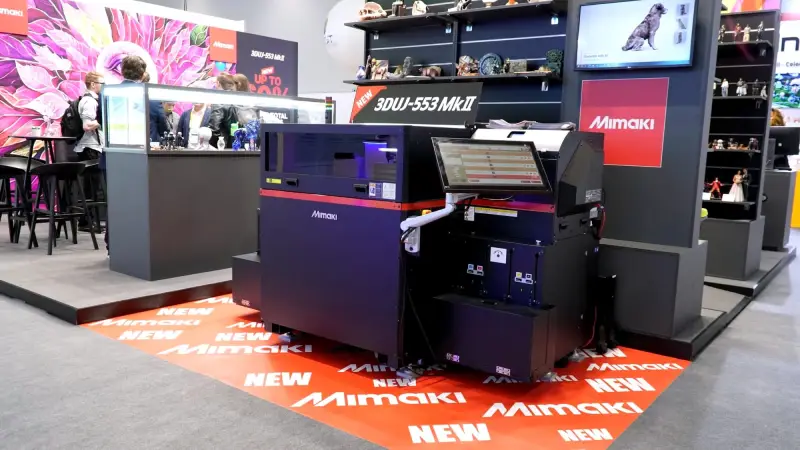
Mimaki’s 3DUJ-553MkII combines a wider colour gamut with a lower-cost material for internal infill, aiming to make detailed, full-colour models less expensive to produce. The second-generation printer also adds Smart Relay, which can start a queued job automatically after the current print finishes. Together, the changes address colour fidelity, material use and the time a machine sits idle between jobs.
Mimaki introduced the printer at Formnext. The company says its colour gamut is approximately 1.4 times larger than that of the previous model, helping it reproduce vivid hues, subtle shades and complex patterns more accurately. The stated aim is to represent the appearance of finished products more closely in prototypes, concept models and decorative parts.
Colour and surface appearance
The printer is designed to reproduce surface effects associated with materials such as wood grain, leather and carbon fibre. These are visual effects for printed models; Mimaki’s description does not establish that the parts have the mechanical properties of those materials. For designers reviewing a product’s appearance, however, bringing colour and texture cues into a physical model can make it easier to assess how a proposed finish reads from different angles and under different lighting.
The larger gamut matters most when a model depends on distinctions that can disappear in a narrower colour range: a vivid brand colour, a gradual tonal change or a patterned surface. Mimaki says the 3DUJ-553MkII can render these more accurately. The company has not provided numerical colour accuracy data or test conditions in the supplied product information, so the gamut comparison is the available measure rather than a quantified account of output fidelity.
That distinction is useful when evaluating a printer for a particular workflow. A broader gamut can expand the range of colours available to a system, while the result on a specific model also depends on the input data and the printing process. Teams considering the machine will need to judge sample parts against their own colours, patterns and viewing conditions.
Separate material for internal infill
The previous 3DUJ-553 used the same material throughout a printed object. The MkII adds a dedicated, lower-cost infill material for the interior, while retaining full-colour reproduction on the exterior, according to Mimaki. The approach focuses savings on material that is hidden inside the part, where it does not need to contribute to the visible colour and finish.
Mimaki says the cost benefit grows with part size. Larger objects generally contain more internal volume, so allocating a less expensive material to that volume can have a greater effect on material cost. The company has not supplied per-part savings, infill ratios or material prices, which means the practical reduction will depend on model geometry and the amount of infill used. Users would need to compare representative parts to understand the effect on their own production costs.
For product designers and model makers, the central trade-off is straightforward: the exterior remains the focus for colour and surface detail, while the interior uses a different material to reduce expense. The supplied information does not specify whether the new infill changes part strength, weight, print time or post-processing requirements. Those properties should be assessed on the intended parts rather than inferred from the material’s lower price.
Queued production and preparation software
Smart Relay is intended to reduce the operator’s involvement between print jobs. An operator can schedule a later job in advance; when the current job ends, the printer can begin the next one automatically, using available space on the build platform. This can reduce gaps between jobs and allow a prepared queue to continue outside normal working hours.
Automatic job handoff is most useful when the next job is ready and the platform has room for it. It doesn’t remove the need to prepare work or manage the machine, but it can cut the waiting time associated with manually starting each job. Mimaki says the function is intended to improve machine utilisation and production output; the supplied details don’t quantify the time saved or describe operating conditions for automatic starts.
The printer follows Mimaki’s introduction earlier in the year of 3D Print Prep Pro v2.0, a cloud software service for preparing 3D data. The update includes lattice structures that can create cushioning or softening effects depending on the material used. Mimaki identifies footwear, sofas and mattresses as relevant mock-up applications. That preparation capability and the printer’s new infill material address different parts of a model: one changes internal geometry, while the other changes the material used for the interior.
Mimaki Europe Sales Director Arjen Evertse said production cost can limit the applications customers offer, and described the MkII as a way to produce larger, more detailed models more economically while reproducing product colours and material effects. For a prospective user, the concrete points to evaluate are the wider colour range on representative designs, the infill cost on larger parts and whether automatic job scheduling fits the shop’s workflow.