UC San Diego’s One-Piece Soft Robot Reaches 4.72 Meters per Second
- Published
- Author
- Paloma Duran
- Reads
- 796
A six-legged, air-powered robot uses a compound-engine principle to reach 4.72 m/s, more than 100 times faster than its predecessor.

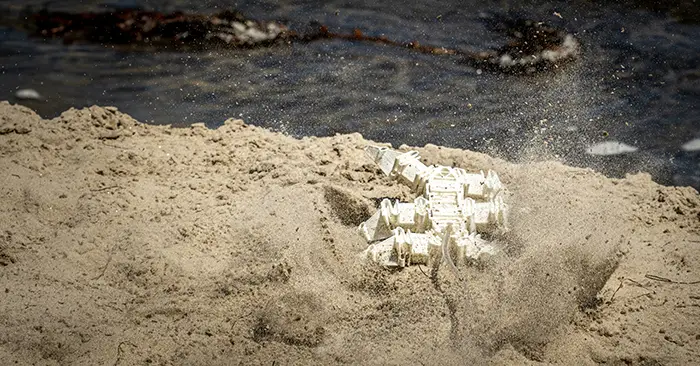
A soft robot built from a single 3D-printed material has reached 4.72 meters per second, addressing a longstanding weakness in soft machines: getting useful speed from a body that bends and moves without rigid electronics. Developed at the University of California San Diego, the six-legged runner uses compressed air for both control and motion. It handled concrete, gravel, lawn, mulch and sand, and also descended stairs, swam and operated fully submerged.

The result is a substantial jump from the team’s earlier air-driven walker, which topped out at 4 centimeters per second. That earlier design, developed in 2022 and described in a 2025 paper in Advanced Intelligent Systems, was limited by the pressure and airflow its internal structures could tolerate. The new machine runs at more than 100 times its predecessor’s top speed. The team, led by Yichen Zhai and Professor Michael T. Tolley, reported the work in the November 18, 2026 issue of Science Robotics.
One air supply controls and drives the legs
The robot carries no circuit board or other electronics. Instead, channels, chambers and valves printed inside its body route compressed air to coordinate the legs. The airflow acts as a pneumatic control system: pressure changes switch the valves, and the resulting sequence of air pulses produces the walking motion. Increasing pressure can raise the operating speed, but it also places greater demands on the printed structure and its internal passages.
Simply enlarging and strengthening those passages created a new problem. At higher pressure, the legs cycled rapidly, and the machine exhausted air while some of its energy remained unused. That is a poor trade for a design whose speed depends on moving large amounts of air through a flexible body.
The team addressed the waste with a principle used in compound steam engines. In that arrangement, a working fluid expands through multiple chambers, allowing energy to be extracted in stages. The robot applies a related idea to its pneumatic circuit: air first enters small, high-pressure chambers that operate the switching valves, then continues into larger, lower-pressure chambers that move the legs. The same air stream performs control and actuation in sequence, making better use of the available pressure before it is vented.
Translating that principle into a runner printed as one soft part was a key design challenge. The chambers must be arranged so their pressure changes produce the correct valve timing and leg motion, while the body remains capable of flexing. Zhai, a former postdoctoral researcher in Tolley’s lab, described the first robot as a demonstration of what was possible, but said its speed was inadequate. The new pneumatic layout was the team’s answer to that limit.
Speed comes with a hose
Despite its mobility, the robot is not yet self-contained. It remains connected to an external compressed-air source, such as a standard compressor, through a hose. The team’s next step is to reduce its air demand enough for a portable supply, with a compressed-air cartridge offered as one possible option. Future versions are also intended to steer and manipulate objects, extending the design beyond straight-line locomotion.
Those requirements are tightly linked. Lower air consumption could make untethered operation possible, while steering and object handling would require the pneumatic control network to coordinate more than a repeating gait. The current demonstrations show that the robot can move across varied surfaces and operate underwater; they do not establish that it can yet perform those more complex tasks independently.
Removing electronics could be useful in environments where electronic systems are difficult to operate, including places with high radiation or strong magnetic fields. The research team also identifies scientific reconnaissance and space exploration as possible areas of interest. These are potential applications, rather than demonstrated deployments: the present machine still depends on an external air line and needs further development for steering, carrying its air supply and handling objects.
Printing the control system into the body
Soft robots often require molding, assembly and separate control hardware. Those steps can make it harder to iterate on a design and reproduce predictable motion. UC San Diego’s approach puts the pneumatic control logic into the printed structure itself: chambers and valves are formed with the body, which is produced in one print job from one material, without a circuit board or post-print assembly.
Other research teams are exploring related approaches. At the University of Edinburgh, researchers have built soft robots that walk after printing and connecting them to compressed air, without electronics or post-processing. Harvard engineers have used multimaterial 3D printing to build programmable soft robots with actuation integrated into their flexible structures. These methods address fabrication and control in different ways; the UC San Diego work’s central contribution is showing how an air-powered, single-material design can reach a much higher running speed.
Materials work is expanding the options for soft machines as well. Researchers at Shanghai Jiao Tong University reported a 3D-printed hydrogel that stretches 1100%, using it to make inflatable actuators, a gripper, and robots that walk and crawl. Such developments point to a field experimenting with both the materials and the internal architecture needed for motion.
For this runner, the next engineering measure will be whether its speed can be retained as the air supply becomes portable and the control system takes on more tasks. At 4.72 meters per second, the design has moved beyond the slow gait of its predecessor; untethered operation and useful manipulation will show how far the one-piece pneumatic platform can go.