University of Arkansas Prints Interlocking Bricks from Simulated Lunar Regolith
- Published
- Author
- Paloma Duran
- Reads
- 537
A University of Arkansas team fused lunar dust simulant into binder-free, interlocking bricks. Their strength and performance in space still need testing.
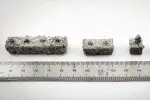
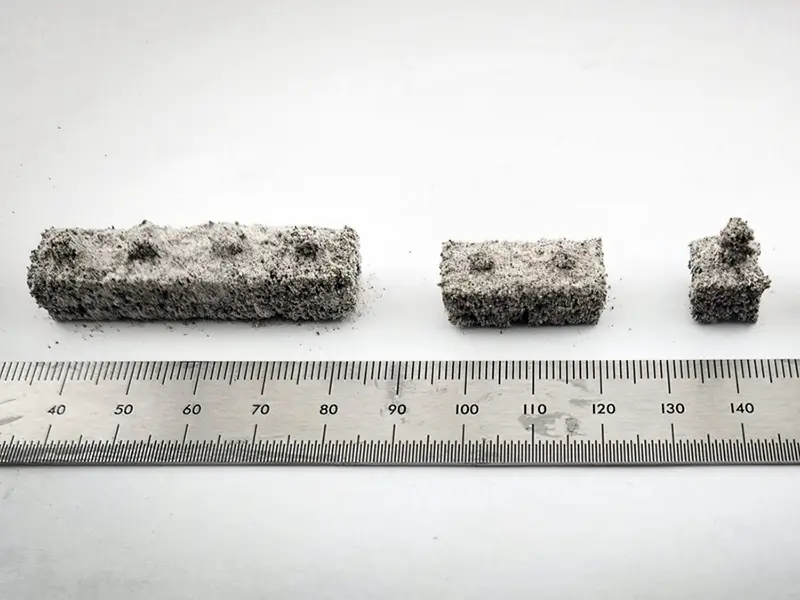
Turning lunar soil into construction material without imported binders could cut the number of supplies needed for a long-term Moon base. A University of Arkansas team has demonstrated one version of that idea: small, interlocking bricks made by fusing simulated lunar regolith with a laser powder bed fusion process. The parts use regolith as their only ingredient, though their current strength limits what they can support.
The team describes its work as the first demonstration of binder-free sintering of lunar regolith simulant into reconfigurable construction blocks. It also reports using a relatively low-power light source. The findings, led by mechanical engineering assistant professor Wan Shou, were published in npj Advanced Manufacturing. First author Cole McCallum conducted the research as an undergraduate.
Interlocking parts, with a strength limit
The printed bricks are a few centimeters across and come in two shapes: a cross and an H. Their geometry lets them lock together, so builders could combine small pieces into larger assemblies. That modular format could make it easier to rearrange or reuse components as a settlement changes, although the team has not demonstrated full-scale construction.
Removing binders addresses a practical supply problem. Previous regolith printing methods used added binding material to hold the powder together. Any binder unavailable on the Moon would have to be transported from Earth. In this process, the regolith grains fuse to one another; McCallum described the powder as “binding to itself.”
That material choice carries a mechanical cost. The binder-free parts have more internal pores than prints made with binders, and the team says they are weaker. McCallum said the pieces can support themselves, but he would be hesitant to use the process for structures that must carry additional loads. The results therefore show a way to make self-supporting modules, not a qualified method for load-bearing buildings.

Fusing the powder one layer at a time
Laser powder bed fusion builds a part by selectively heating a thin layer of powder until particles sinter together. The build platform then moves down, another powder layer is spread over the surface, and the process repeats. In the Arkansas work, the feedstock was Lunar Highlands Regolith Simulant (LHS-1), a commercially available material designed to resemble lunar highlands soil.
Actual lunar regolith differs from ordinary Earth soil. It has no organic content, and its grains are loose and jagged. The grains were shaped over billions of years by impacts from asteroids, micrometeorites and other space debris. Using a simulant lets researchers investigate processing on Earth, but the printed parts still need to be assessed under the conditions where lunar construction would take place.
Shou identified two main tasks ahead: determining how the process behaves in vacuum and microgravity, and increasing the strength of the bricks. Those questions matter because a manufacturing process that works with simulant on Earth may not produce the same parts in a lunar environment. The current results establish a promising material route, while leaving its performance in space and its structural capacity unresolved.
Using local material changes the supply equation
For lunar construction, every imported ingredient adds to the cargo that must be sent from Earth. Regolith-only printing removes the binder from that list. It does not remove the need to transport or operate the printing equipment, and the study does not establish how much material a future installation would require. But it shows why using local powder is attractive: the raw feedstock could already be present at the construction site.
The approach also fits broader research into making parts from materials available in space. A review by Purdue University researchers, published in March in the same journal, discussed powder-based additive manufacturing as a possible way to produce tools, habitats and infrastructure using material found in orbit or on the lunar surface. That work considers a wider set of applications; the Arkansas demonstration focuses on small, mechanically interlocking regolith parts.
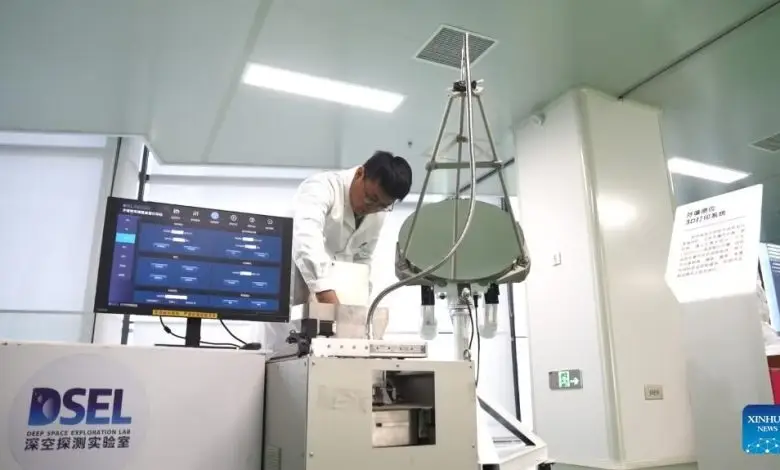
Researchers at the Deep Space Exploration Laboratory in Hefei have also developed a system for forming lunar soil into building material. Their setup uses a high-precision reflective concentrator, and senior engineer Yang Honglun said the work validated the feasibility of using lunar soil as the sole raw building material. The system can produce standard bricks as well as custom-molded structures. Together, these efforts show several ways to explore local-material construction, with different equipment and part designs.
The Arkansas bricks are an early demonstration, and their present load capacity is a clear constraint. The next useful evidence will be whether the process can produce stronger, repeatable parts and how those parts behave in vacuum and microgravity. If those hurdles can be addressed, interlocking units made from regolith alone could offer a flexible way to assemble and reuse components while keeping imported material to a minimum.