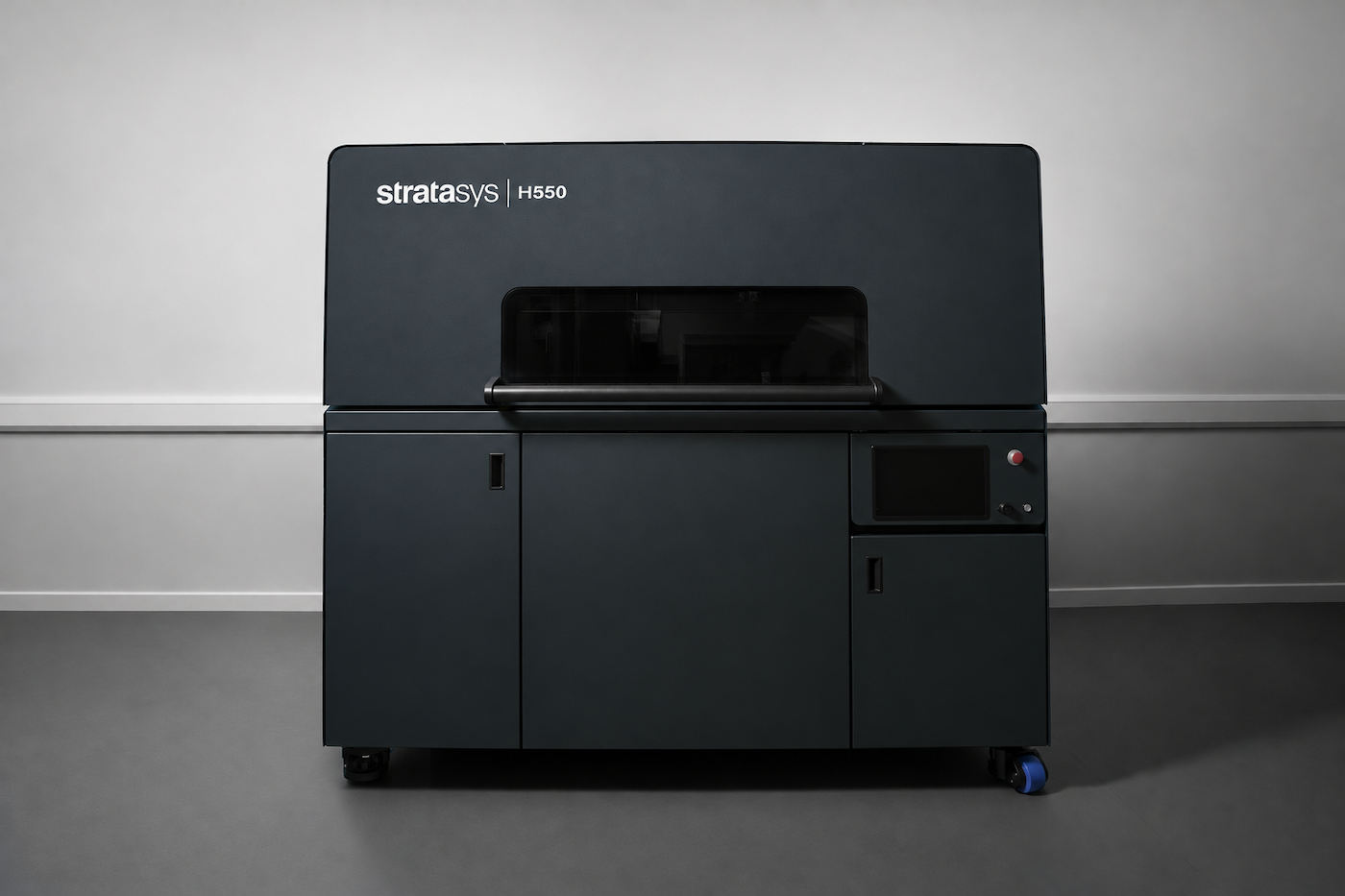
Stratasys H550 Expands SAF 3D Printing Build Volume for Larger Production Parts
- Published
- Author
- Laura Griffiths
- Reads
- 449
The H550 adds a 34.2-litre build space and targets larger parts and higher volumes, with pre-orders open and commercial availability planned for Q2 2027.
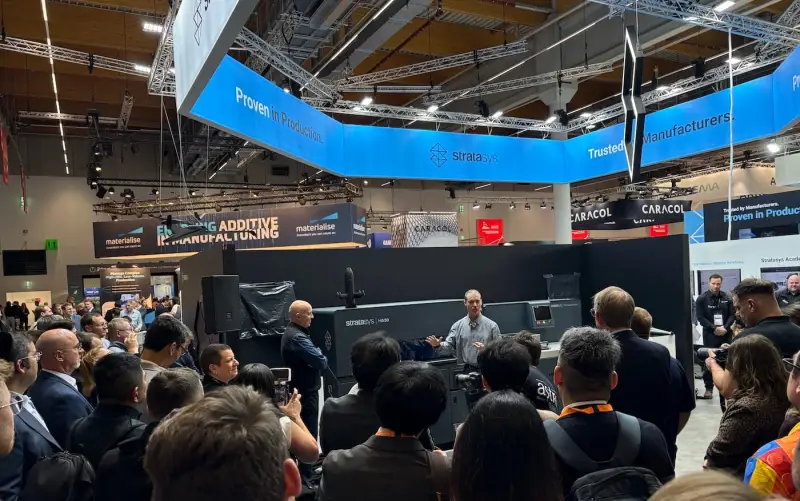
Stratasys is extending its selective absorption fusion (SAF) printer range with the H550, a larger powder bed system aimed at making more end-use parts practical to produce on the factory floor. Its 34.2-litre build space and 450 mm length are intended to accommodate parts that exceed the capacity of the company’s H350, while also allowing manufacturers to pack more small components into a build.
The H550 is making its debut at Formnext. Stratasys has opened pre-orders, with commercial availability planned for Q2 2027. The company is targeting applications that include robotics and end-of-arm tooling, medical devices, automotive components, manifolds and ducts, as well as UAV components. Those examples span individual larger parts and production runs of smaller items, so the machine’s practical value will depend on how its build capacity, cycle time and per-part cost fit each job.
More room for longer parts
Part dimensions can determine whether powder bed fusion fits a production need at all. Neil Hopkinson, Stratasys vice president of SAF and the technology’s inventor, said customers had told the company that some parts they wanted to make were too large for the H350. The H550’s added length is intended to address that limit. Hopkinson said it can make parts longer than other mainstream print-and-fuse options, though the company did not provide comparative machine dimensions in the launch details.
That extra room could matter for components such as ducts, manifolds and tooling, where splitting a design into smaller pieces may add assembly work or introduce interfaces. A larger build envelope can also give a production team more flexibility in arranging parts within a build. It does not, by itself, establish how many components will fit, how quickly they can be made, or whether a particular material and geometry will meet a part’s requirements. Those outcomes depend on the part design and the selected production settings.
Stratasys describes the H550 as a system intended to balance part size, throughput and production economics. The company says it is also seeking to lower total cost of ownership by up to 30% compared with current comparable print-and-fuse systems. It claims faster time to part than comparable selective laser sintering (SLS) systems. The launch information does not specify the equipment, materials, build conditions or accounting assumptions behind these comparisons, so they should be read as manufacturer claims rather than a universal cost or speed result.
Repeatability remains a production requirement
For parts intended for end use, a production system has to deliver consistent properties as well as acceptable cost. Hopkinson pointed to repeatability and confidence in part properties, including strength and accuracy, as key considerations for powder bed fusion applications. That matters when teams need to assess whether parts produced in different builds will meet the same design requirements.
The H550’s larger format addresses one constraint that can keep a part out of a machine, but the launch details do not include test data for dimensional accuracy, mechanical properties, or variation between builds. Manufacturers assessing the system will need application-specific information to determine whether it can produce their parts consistently. Material choice, part geometry, build arrangement and post-processing all influence whether a printed component is suitable for its intended use.
Stratasys positions the new printer for both larger components and greater quantities of smaller components. Those uses place different demands on a build: larger parts make use of the extended envelope, while batches of smaller parts depend on how effectively the available volume can be filled and processed. The company has not provided build-time figures or output rates for either case, so throughput will need to be evaluated against actual part mixes.
Powder handling joins the production workflow
Stratasys has also introduced the PowderEase T2, an automated system for part breakout, powder retrieval, sieving and dosing. It is designed to support up to six H550 printers using the same material. Stratasys says the production workflow requires less than 30 minutes of total operator time per build.
Automating powder handling can reduce the hands-on work associated with recovering parts and preparing powder for reuse. For a production cell with several printers, shared support equipment may help organize those tasks across machines. The stated operator-time figure offers a useful point for evaluation, but the launch details do not define which tasks are included in that total or describe the staffing and production conditions used to calculate it.
The H550’s case will ultimately rest on whether its larger build area and claimed economics hold up for specific parts and production schedules. Teams considering the system will have two practical questions to answer as more technical details become available: whether their components fit and meet repeatability requirements, and whether the full workflow—including powder handling—delivers the throughput and operator time their operation needs.