UCIe.mem Verification Across AXI, FDI and Chiplet System Configurations
- Published
- Author
- Ujjwal Negi
- Reads
- 954
UCIe.mem verification can span early AXI access checks, direct FDI protocol tests and system models that exercise compute and memory chiplets.
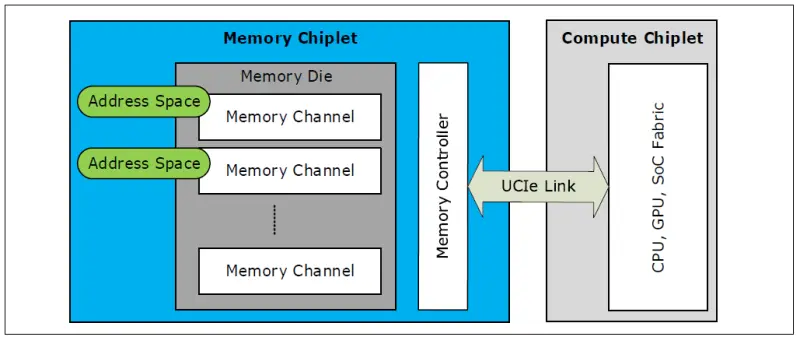
UCIe.mem verification has to cover more than whether a memory request crosses a die-to-die link. Teams need to check protocol behavior, preserve the relationship between concurrent requests and responses, and test the design in the context of a memory subsystem. The verification setup also has to fit the design’s maturity: an early compute die may expose AXI, while a later implementation may generate UCIe.mem traffic through an FDI interface.
Questa One Avery UCIe VIP is described as supporting those different stages and integration arrangements within a shared verification environment. The central engineering benefit is that teams can begin checking memory access before a design implements UCIe.mem, then move to direct protocol validation and system-level scenarios as the interfaces become available.
A common path between compute and memory chiplets
UCIe provides a standardized die-to-die interconnect, and UCIe.mem defines how memory transactions pass between compute and memory chiplets. That separation matters as systems combine compute dies with memory technologies such as HBM, DDR and LPDDR. Without a common transaction protocol, each combination can require technology-specific interfaces or custom integration work.
UCIe.mem makes the communication between compute and memory chiplets independent of the underlying memory technology. In principle, that lets teams develop the two sides separately and integrate them in different implementations. Reuse and scaling become easier to plan because the memory transaction interface does not have to be redesigned around each memory type.
The standard doesn't remove the need to verify the complete system. It defines a shared way to exchange memory requests and responses, but each implementation still has to handle protocol rules and interact correctly with the surrounding compute and memory logic.
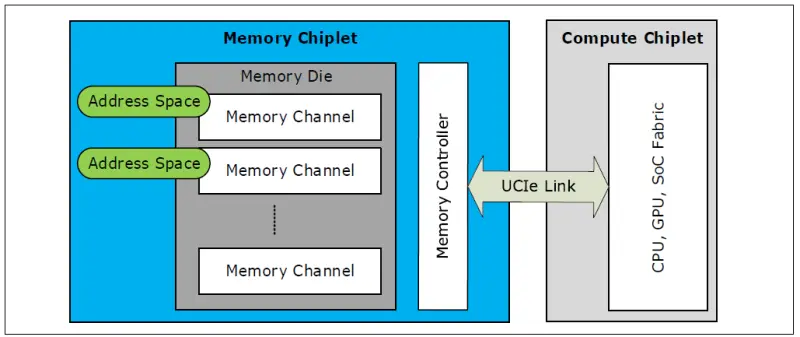
Fig. 1: Memory and compute chiplet over UCIe.
Verification spans protocol and system behavior
At the protocol level, verification needs to exercise initialization, credit management, transaction handling, packing and data integrity. These checks become more involved when several requests are active at once: responses must be matched to the requests that caused them, and channel configurations can change the traffic the design must manage.
There is also an interface problem. Early in development, a device under test (DUT) may not implement UCIe.mem at all. It may expose a conventional memory interface such as AXI. Later, a UCIe.mem-capable DUT may expose FDI, allowing its own logic to generate and receive control and memory payload flits. Those cases need different connections to the test environment, even though teams want to keep validating the same basic memory behavior.
Finally, an isolated request-and-response exchange does not represent every condition a chiplet design will face. System-level verification needs to include the other side of the memory path, with timing and latency that can affect the DUT’s behavior. That makes it possible to check integration as well as protocol rules.
One environment for different design stages
For an early DUT with an AXI memory interface, the Questa One Avery UCIe VIP can bridge conventional memory accesses to UCIe.mem transactions. This arrangement lets teams exercise memory-access functionality before the DUT contains a UCIe.mem implementation. It can help uncover issues in the surrounding design while the protocol block is still in development.
When the DUT exposes FDI, the VIP can act as its link partner. The DUT then produces and receives the protocol traffic, so verification can directly examine its UCIe.mem implementation. This is a different test objective from bridging AXI: the focus shifts from early memory access to the DUT’s own handling of UCIe.mem traffic.
For broader integration checks, the environment can model either side of a chiplet system. A CXL.mem root host VIP can represent the compute-side host while the DUT serves as the memory chiplet. In another arrangement, a memory subsystem VIP, made up of a memory controller and memory model, represents the memory side while the DUT operates as the compute chiplet.
Configurable latency, timing and memory operating parameters let teams model different system behaviors. The point is to see how the DUT responds when memory interactions take place under varied conditions, rather than checking only a simple exchange. The available description does not specify particular parameter ranges or performance results, so those depend on the configuration and design under test.
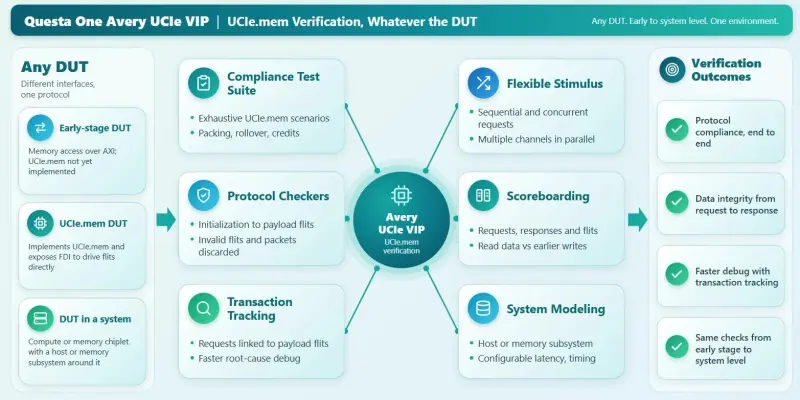
Fig. 2: Questa One Avery UCIe.mem solution.
Checking transactions end to end
The verification offering includes a UCIe.mem compliance test suite, protocol checking, and end-to-end data and transaction scoreboarding. Transaction tracking is intended to help teams trace activity during debugging. Together, these functions can check that protocol exchanges follow expected rules and that returned data remains associated with the correct transaction.
The broader workflow is a practical fit for designs that evolve through multiple interface stages. Teams can begin with memory-access validation over a conventional interface, shift to direct testing once FDI is present, and then add system models to examine interactions with host or memory logic. Reusing an environment across those stages can keep verification focused on the design as its integration changes.
For chiplet teams, the key consideration is whether the test setup can follow the DUT from early access checks through protocol and system validation. The described AXI bridge, FDI link-partner mode and host or memory subsystem models address those distinct needs. Further architecture and topology details are available in the UCIe.mem verification whitepaper.