AI Agents Could Shorten Custom Silicon Development for Physical AI
- Published
- Author
- Emily Yan
- Reads
- 358
Custom chips can match robots’ power and latency needs, but AI-assisted design must preserve context, manage long workflows and produce verifiable results.
Custom silicon can help robotic systems meet demanding power, latency and reliability targets, but its value depends on getting from design intent to a validated chip quickly enough to keep pace with changing software and AI models. ChipAgents argues that AI agents could shorten that path if they can retain engineering context, carry work through dependent design steps and produce evidence engineers can review.
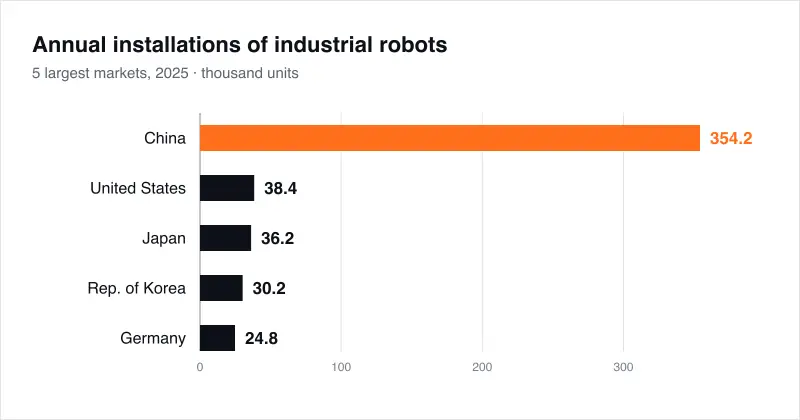
The demand is growing alongside the installed base of industrial robots. The source reports five million industrial robots operating worldwide by 2025. For humanoid robots and other systems designed for specific tasks, application-specific integrated circuits (ASICs) can be tailored to workloads, response times, power limits and operating conditions. That specialization comes with a development challenge: conventional chip design cycles may not match the speed at which AI models and software evolve.
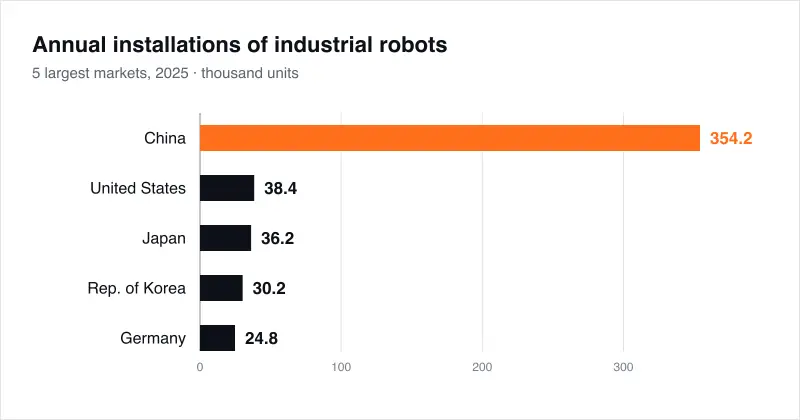
Fig. 1: Annual installations of industrial robots in the five largest markets, 2025. Source: International Federation of Robotics, World Robotics 2026. Chart redrawn by ChipAgents.
Design context has to persist across tools
An agent working on a chip needs more than a prompt describing the immediate task. It needs a shared representation of the design, the tools and methods in use, and the reasoning behind earlier decisions. ChipAgents calls this a design ontology: a structured view connecting RTL design, verification, error diagnosis and repair, synthesis, timing analysis and power, performance and area (PPA) optimization.
That context also needs to show where information came from, which design version it applies to and what depends on it. Without those links, an agent can mistake an old result for current evidence or act on an assumption that a later decision has replaced. Preserving organizational methods and prior engineering rationale could also help teams reuse what they learned instead of repeating investigations across similar design tasks.
The need becomes clearer in a 3D-IC, where logic, memory, die-to-die interfaces, packaging, power delivery and thermal behavior interact. A change to RTL may keep the same functional behavior while changing switching activity, placement or interconnect demand. Those physical effects can influence timing, power integrity and temperature once the design is implemented. An agent with a record of these dependencies could identify which analyses and verification results need to be revisited after a change, including effects that cross die and system boundaries.
Success means completing the whole workflow
Speeding up one design task has limited value if later verification or physical implementation stalls. Agents therefore need to carry an objective through a sequence of dependent steps, with progress measured against engineering outcomes: functional correctness, physical feasibility and the target PPA, all within schedule and compute budgets.
New architectures for physical AI can bring more configurations, interfaces and corner cases to check. Clear acceptance criteria give an agent a way to judge whether a step has produced useful evidence and whether the overall work is complete. The aim is not simply to generate design changes quickly; it is to reach an implementation that has passed the necessary checks.
That kind of workflow calls for choosing models, tools and compute according to the work at hand. Complex reasoning may call for a larger model, while repeatable operations may be better handled by deterministic procedures. Numerical analysis belongs in specialized engineering tools. CPU and GPU capacity, memory and parallel execution all affect the time and cost of getting to a validated result. ChipAgents frames that total cost and elapsed time as the useful measure of acceleration.
Verification evidence remains central
Robots operate in physical environments where a failure can create direct safety risks. Custom hardware also brings security requirements tied to its design and implementation. AI agents could assist by checking designs against stated requirements, identifying possible vulnerabilities and generating additional verification scenarios.
Automation alone does not establish that a chip is safe or secure. A credible workflow needs traceable decisions, repeatable tool runs, explicit assumptions and review and signoff by engineers. Each conclusion should be supported by evidence that can be examined, including the results of the relevant verification and implementation tools. That standard is especially important when an agent has made or recommended changes across several stages of a design flow.
ChipAgents’ stated target
ChipAgents says it is exploring how to make chip development 10× faster. Its approach combines an organizational design ontology, physics-aware models and large language model agents in IC-STAR, which the company describes as the neural engine powering its platform. The company says it is studying how models and multi-agent orchestration can reach verified outcomes faster while lowering inference cost.
Those are development goals, not reported results in the material provided. The practical test will be whether agents can reduce the time from design intent to verified implementation while preserving the engineering evidence needed for review. If they can, specialized silicon may become accessible to more teams building machines that sense, move and act. The key measure will be the completed, validated design—not the speed of any single automated step.