Formal Proof, Long-Run Linux Simulation and Emulation in CPU Design
- Published
- Author
- Paul Graykowski
- Reads
- 381
A small team combined formal checks, segmented Linux simulation and emulation to validate a multicore RISC-V CPU before silicon.
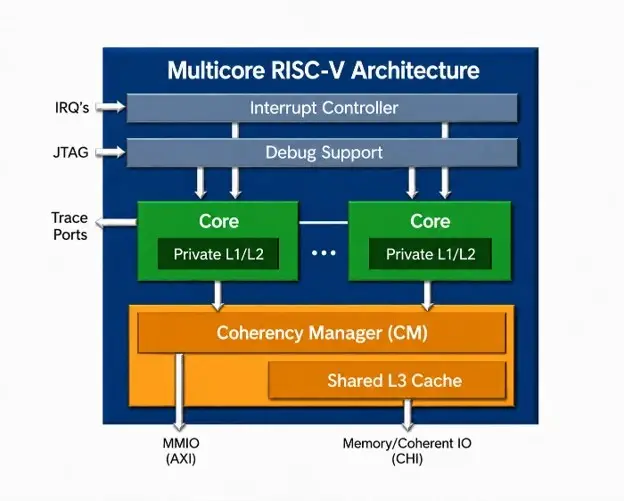
Validating a CPU design means more than checking that individual blocks behave as intended. Architectural rules, RTL choices, power and performance tradeoffs, and software all interact; faults in those interactions can surface only after a system has run at scale. A small team at an Austin, Texas, startup built its first CPU IP microarchitecture around RISC-V and used formal verification, long-running software simulation and emulation to move those checks earlier in development.
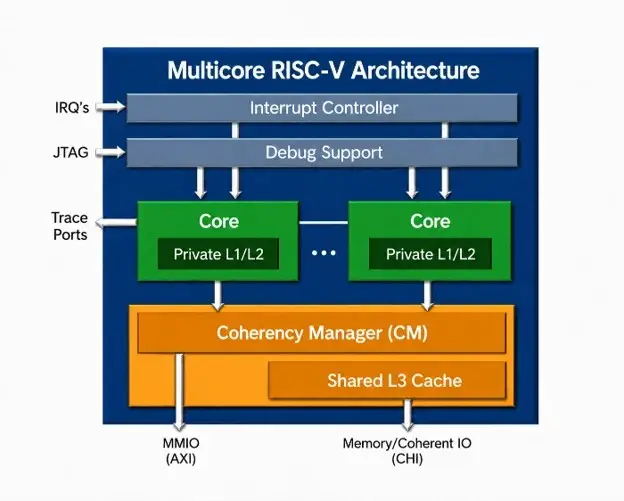
The work addressed a practical constraint for a lean engineering group: system-level verification can consume more compute capacity than a fixed setup can provide when workloads peak. The team’s approach linked formal analysis with software-driven simulation and full-system emulation, so it could check architectural intent early, investigate long instruction streams and bring up Linux on multicore configurations.
Proving architectural behavior early
The verification plan began with formal analysis of the processor pipeline. Cadence’s Jasper Formal Verification Platform was used to check properties across fetch, decode, execution and instruction flow. The aim was to establish key correctness conditions before committing to lengthy simulation and system bring-up.
Other Jasper tools addressed RTL and simulation risks at the same stage. Jasper Superlint flagged structural and coding issues that could otherwise carry into later verification. Jasper XPROP examined X-propagation concerns tied to initialization and reset behavior, reducing uncertainty in simulation results. With those checks in place, the team could direct longer runs toward areas with architectural sensitivity instead of relying only on larger regression volumes.
Formal checks could establish properties of the design, but full operating system behavior required long instruction sequences and interactions among components. Those conditions called for simulation and emulation as well. The team used each stage for a different scale of investigation: block and end-to-end intent in formal analysis, detailed signal-level debugging in simulation, and system operation during emulation.
Breaking long software runs into debug windows
Traditional simulation makes extended software execution expensive. The team’s Xcelium Logic Simulator flow addressed that challenge by dividing a long run into smaller snippets while preserving architectural state at each boundary. Engineers could then load a selected segment and inspect its signals without repeating the complete operating system boot sequence.
Linux ran as the main software workload on a QEMU-based virtual platform. The workload advanced in increments of one million cycles. At each checkpoint, the team captured the complete architectural state, producing a reusable snippet for a defined portion of execution. This gave engineers a way to reproduce and debug a particular region while retaining visibility into the design.
The flow produced approximately 120 snippets, covering instruction streams longer than 35 million cycles. Those extended runs exercised pipeline behavior and interrupt handling under software stress. Xcelium ran at approximately 100,000 cycles per second while maintaining full debug visibility. The team reported cutting turnaround for long software workloads from days to hours, making detailed investigation of complex interactions more practical.
Verisium Debug supported analysis across those runs by maintaining traceability through long instruction sequences and preserving context between simulation sessions. That continuity helped engineers examine failures found under software stress without giving up signal-level insight.
Tracking verification progress
Results from formal proof and simulation needed to feed into a common view of verification status. Verisium Manager provided a dashboard for test planning and coverage tracking against defined targets. The team could see which targets were met, identify remaining gaps and direct work toward the next priorities.
Verisium Debug complemented that tracking by linking results across simulation and emulation and retaining context during extended runs. Together, those tools connected verification stages that otherwise produce different kinds of evidence, from formal properties to observed system behavior.
Bringing up Linux on multiple cores
For full-system work, the team moved to the Cadence Palladium Enterprise Emulation Platform. It supported complete operating system boot sequences and multicore software workloads with hardware and software visibility. The team booted Linux on a single-core system in 50 minutes and on a dual-core system in 90 minutes, demonstrating system functionality across both configurations.
Emulation also let engineers check coherency and interrupt handling and identify performance hotspots in concurrent workloads. These checks reached beyond isolated pipeline behavior to examine how processors and subsystems interacted during system operation. The company reported that this work helped uncover complex interactions relevant to first-silicon success.
Cadence OnCloud supplied compute capacity that could scale with verification demand. The team said it could increase resources during peak periods without committing to fixed infrastructure at the start of the project. It also cited security aligned with ISO/IEC 27001 and ISO/IEC 27017 as a way to protect sensitive IP during the work.
What the flow changes for a small team
The team described available throughput as its main constraint: the amount of verification work it could run at a given time limited progress more than its methods or tools. Scalable compute capacity let engineers prioritize critical checks when demand rose instead of reducing verification to fit local infrastructure.
For future processor development, the project points to a broader use of pre-silicon system validation. At-speed prototypes can help teams evaluate multicore operation and hardware-software interactions before silicon is available. On-demand access to emulation and prototyping capacity can also let system integration begin earlier without requiring an in-house lab. The reported results make the central engineering lesson concrete: formal proof can narrow the search early, while long software runs and emulation expose interactions that only appear at system scale.