Turku Adds Three Powder Streams to Metal 3D Printing for Multi-Material Research
- Published
- Author
- Aura Moreno
- Reads
- 1,001
A new recoater lets Turku researchers place three metal powders in selected regions of a layer, opening studies of interfaces and plasma-facing parts.
Metal 3D printing can now place three different powders in selected regions of a single layer at the University of Turku. The university has integrated a Schaeffler Aerosint SPD2.1-B5 recoater with its Aconity MIDI+ printer, giving its researchers a way to investigate how dissimilar metals can be combined in one part—and what it takes for the boundaries between them to survive processing.

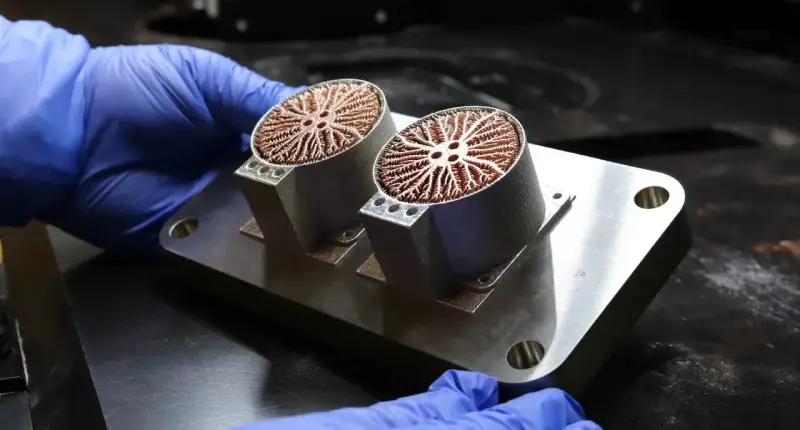
The immediate research interest is plasma generator hardware. Longer term, the equipment may help researchers examine parts that need different properties in different places: for example, a region that tolerates intense heat alongside one that conducts heat toward cooling channels. The university identifies future fusion energy and aerospace propulsion components as potential applications. These are research directions, not demonstrated performance claims for finished components.
Three powders, one build layer
In conventional laser powder bed fusion (LPBF), a recoater spreads a single powder over the build area. A laser selectively melts that material according to the part design, and the cycle repeats layer by layer. Turku’s Aerosint unit has three separate powder-delivery drums. It can distribute different powders in chosen areas before the laser processes the layer. Repeating that arrangement through the build lets material composition vary by location.
That change gives researchers control over where each powder goes, but it does not by itself make a sound multi-metal part. The powders must respond to the laser in ways that allow them to melt, solidify and bond together. Their arrangement and the processing conditions also affect whether the component can be made without cracking or other defects. The university’s work will examine those relationships, including laser-material interaction, solidification, interface bonding and local properties.
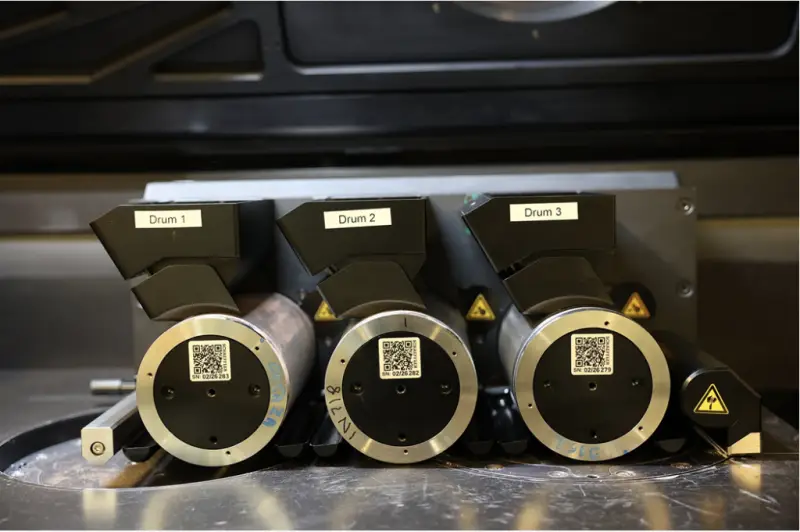
Associate Professor Ashish Ganvir, principal investigator of AM4Plasma, describes the research question as identifying which material belongs in each region and how the materials can work together. The project is developing new plasma generator hardware, and the printer will also be used to train researchers. Funding came through AM4Plasma, a EUREKA Network project coordinated by the University of Turku, with support in Finland through Business Finland’s CoInnovation program.
The interface is the harder part
Putting powders next to one another is only the first step. Metals can differ in how they absorb laser energy, melt and solidify, and those differences can complicate the boundary between them. Researchers need to establish which pairings can form reliable bonds, which process settings suit each combination, and how deposition choices affect defects and material mixing. The equipment therefore creates a platform for experiments; it does not settle the engineering questions that determine whether a part will perform as intended.
Work at the University of Nottingham’s Centre for Additive Manufacturing (CfAM) illustrates the kind of variables involved. Researchers studied interfaces between IN718 and GRCop-42, a copper alloy developed by NASA, using an Aconity MIDI+ printer paired with a Schaeffler Aerosint recoater. Their study found that deposition order and recoating direction affected defects and alloy mixing at the interface. The researchers said mechanical testing was still needed, so those observations do not by themselves establish how the resulting parts will hold up in service.
Another CfAM effort, DIADEM, examines ways to grade the transition between tungsten and copper for fusion plasma-facing components. Tungsten handles heat, while copper carries it away. Conventional joining can leave cracks, voids or residual stress, making the transition between the materials a central design challenge. The pairing reflects the same broad functional split described for Turku’s example component: one region faces severe thermal exposure, while another moves heat toward cooling.
A research tool with wider uses
AM4Plasma gives the Turku installation a first area of application, but Ganvir says the setup will also support later studies of material combinations, manufacturing processes and multifunctional component design. For engineering teams, that means the useful outcome to watch is evidence about which metal combinations and build conditions produce dependable interfaces. The three-drum recoater expands the range of material layouts researchers can investigate; the next step is establishing when those layouts can become manufacturable parts.