Star-Triangular Resin Lattices Reach 3.8 MPa in Compression Tests
- Published
- Author
- Aura Moreno
- Reads
- 674
VIT researchers found a star-triangular resin lattice carried higher peak loads than a re-entrant hexagon, though results varied across four samples per design.
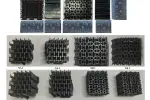
A change in lattice geometry produced a large difference in compression performance in resin 3D-printed samples tested by researchers at Vellore Institute of Technology (VIT) in Tamil Nadu, India. Their star-triangular design reached a peak force of about 2,700 N, compared with 660 N for the strongest re-entrant hexagon specimen. Energy absorption also favored the star-triangular design. The comparison kept resin, printer, post-processing and test conditions consistent, giving the team a way to examine cell shape as a performance variable.
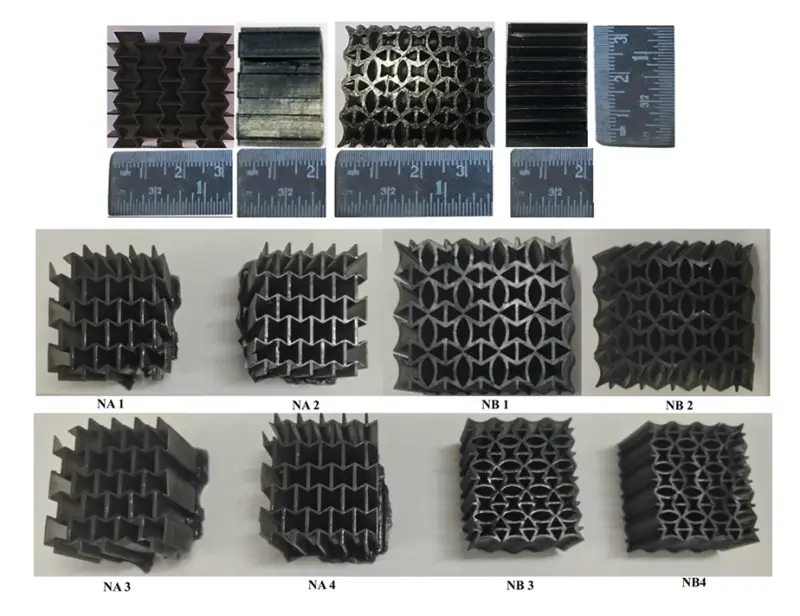
The work, by Pranjal Rukmangad, Benedict Thomas and Gunji Bala Murali, was published as an Article in Press in Scientific Reports. Its results suggest that cell geometry can substantially alter the compressive response of resin-printed auxetic structures. But the spread among individual specimens is wide, so the reported advantage needs confirmation in larger test batches.
Two geometries, one printing process
Auxetic structures have a negative Poisson’s ratio: when compressed, they narrow sideways; when stretched, they widen. That response comes from the structure’s geometry rather than a special property of the base material. VIT’s comparison focused on two unit-cell shapes: a re-entrant hexagon, labeled NA, and a star-triangular design, labeled NB.
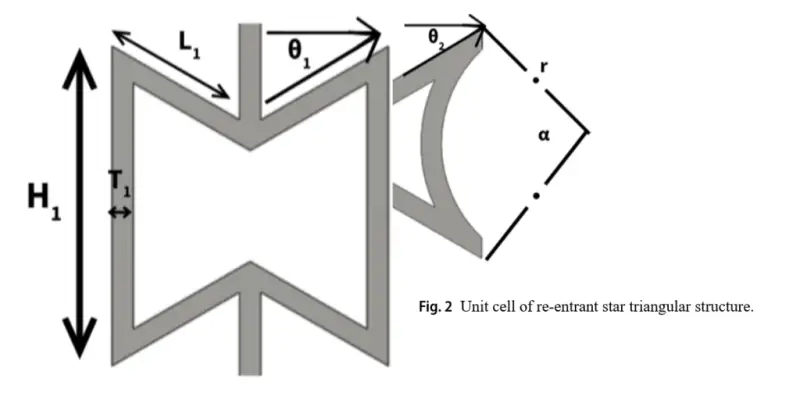
The team modeled both in Autodesk Fusion 360. Each unit cell was 10 mm tall, with 1 mm walls and members angled at 30 degrees. The NA cell uses two parallel struts and four struts angled inward. The NB cell combines four angled struts with curved members defined by a 6.25 mm radius.
Patterned into blocks 30 mm high and 20 mm deep, the designs differed in width and mass. The hexagon blocks were 32 mm wide and weighed 7 g; the star-triangular blocks were 35 mm wide and weighed 10 g.

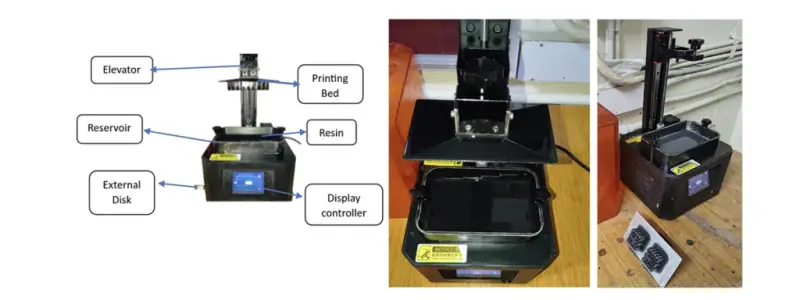
All eight specimens were printed in Anycubic Standard Photopolymer Resin on a Creality LD-002R resin printer. The printer cures each layer using UV light passed through an LCD screen. The team sliced the models in CHITUBOX at 0.05 mm layer thickness, with 6-second exposure per layer and 50-second exposure for the bottom layers. After printing, the blocks were soaked in isopropyl alcohol to clear uncured resin from the lattice cavities, then UV post-cured. Four specimens were made of each geometry.
Compression response and simulation
Compression tests used a Tinius Olsen H10KL universal testing machine with a 10 kN load cell. The researchers followed the loading setup, procedure and data collection methods of ASTM D695, adapting the specimen approach because the lattice blocks did not match the solid-sample dimensions specified by the standard. Tests ran at 2 mm/min until each block reached 40 percent of its height, at roughly 25°C and 50 to 60 percent relative humidity. The team estimated energy absorption from the area under each load curve.
The researchers also checked their finite element model in Abaqus from Dassault Systèmes. Before analyzing the resin structures, they reproduced a simulation of an ABS lattice from a 2021 study by Gohar and colleagues. The model’s maximum von Mises stress and maximum displacement were within 2.91 and 2.63 percent, respectively, of the published values. They then substituted the resin’s properties for the remaining analysis. Both lattice models showed stress concentrating at the re-entrant joints, followed by layer-by-layer collapse as cell walls folded inward.
Higher peaks, with substantial variation
NB1 delivered the strongest result: 3.8 MPa peak stress and about 2,700 N peak force at 1.6 to 1.8 mm displacement, followed by a sharp drop. It also absorbed the most energy among the tested specimens. NB2 reached 3.1 MPa and 2,200 N, with a more gradual post-peak response. The researchers link the star-triangular design’s higher performance to its greater number of connecting nodes and the load paths they create through the lattice.
The hexagon specimens carried lower loads and showed a more even collapse. NA3 recorded the group’s highest peak stress, 0.89 MPa, and peak force, 660 N; much of its load built late in the test as the cells compacted. NA4 had the highest initial stiffness and energy absorption in its group.
| Specimen | Peak stress (MPa) | Peak force (N) |
|---|---|---|
| NA1 | 0.45 | 280 |
| NA2 | 0.64 | 400 |
| NA3 | 0.89 | 660 |
| NA4 | 0.86 | 650 |
| NB1 | 3.8 | 2,700 |
| NB2 | 3.1 | 2,200 |
| NB3 | 0.6 | 500 |
| NB4 | 1.2 | 700 |
The authors suggest the re-entrant hexagon for cushioning, including biomedical implant devices, ergonomic products, shoe soles and soft padding. They propose the star-triangular structure for parts where higher strength and impact resistance are sought, such as sandwich panels, crash absorbers and protective gear. These are proposed application areas, not results from application-specific tests in this study.
What the comparison leaves open
Sample-to-sample variation limits how firmly the results can be generalized. Star-triangular peak stress ranged from 0.6 MPa to 3.8 MPa, and NB3 finished below three hexagon specimens. With only four samples of each geometry, the researchers could not calculate standard deviations, confidence intervals or error bars. They call for larger batches to establish whether the differences are statistically significant.
They also identify direct measurement of Poisson’s ratio, impact loading, fatigue behavior and application-driven optimization as next steps. Those tests would help show whether the compression advantage holds under repeated or faster loading and whether a particular geometry suits a specific part.
The geometry-first approach has a parallel in work from RMIT University, which compared an auxetic design inspired by the Venus’ flower basket sponge with a conventional re-entrant honeycomb. That team reported 13 times the stiffness and 10 percent more energy absorption than existing auxetic materials for its double-lattice design, printed in flexible TPU. The VIT study extends the geometry comparison to standard photopolymer resin. For designers considering resin-printed energy-absorbing parts, its central finding is that cell shape may strongly affect load capacity, while repeat testing will determine how reliably that gain can be achieved.