Siemens HyperLynx Toolkit Adds AI Agents to SI and PI Verification
- Published
- Author
- Akanksha Gaur
- Reads
- 871
Siemens combines specialized AI agents with physics simulation to analyze SI and PI, DDR5, PAM4 and 112G and 224G designs.
At 112G and 224G, electronic design verification involves large simulation workloads and many interacting signal and power integrity questions. Siemens’ HyperLynx Agentic Toolkit aims to reduce the manual effort in that work by coordinating specialized AI agents with physics based simulation. The software is designed to help engineers find and investigate design problems earlier in development.

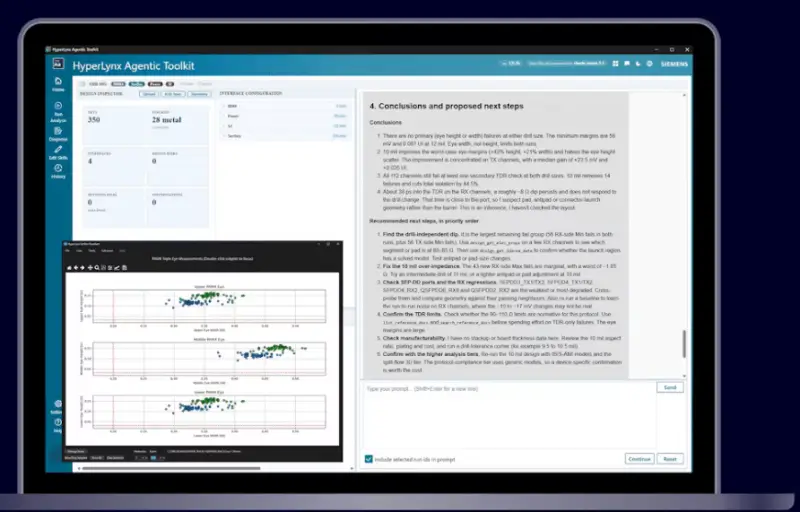
The toolkit, launched by Siemens, builds on the HyperLynx electronic design automation suite. An orchestration agent directs agents focused on Serializer/Deserializer (SerDes), Double Data Rate (DDR), signal integrity (SI) and power integrity (PI). Engineers can start verification tasks with natural language commands, rather than configuring every step manually.

Simulation remains the technical foundation
The distinction that matters for engineering teams is the toolkit’s use of established physics based simulation alongside AI. The agents can run simulations, derive electrical parameters, interpret results and assess performance against specified design margins. In practice, that makes the AI part of a workflow for selecting and examining simulation work; the reported findings are tied to engineering analysis rather than AI generated predictions alone.

That distinction is useful when a design issue needs more than a simple pass or fail. Simulation results can expose where behavior departs from an expected margin, while analysis can help engineers investigate possible causes and understand the likely effect on system performance. The toolkit is intended to support those diagnostic tasks, including trend spotting and technical specification research, as well as the investigation of failures.
The description does not specify how engineers supply design margins, which models or simulation settings are supported, or how agent findings are checked before they inform a design decision. Those details matter in practice: teams will need to understand how the software fits their existing verification methods and how its results relate to the assumptions in their models.

Features target memory and high speed interfaces
The toolkit’s stated capabilities include DDR5 simulation with compliance eye mask visualization and scatter plots for examining eye height against eye width. These views help engineers assess different dimensions of signal behavior together. The software also supports PAM4 signaling analysis, a relevant capability for high speed interfaces where interpretation of the simulated signal is part of verification.
Engineers can compare two electronic design alternatives and visualize large simulation datasets to identify areas that may need attention. Comparing alternatives within a verification flow can help teams see how a design choice affects the results under analysis. The visualization tools are also intended to make problem areas easier to locate when a simulation campaign produces substantial data.
- DDR5 simulation with compliance eye mask visualization
- Scatter plots for eye height versus eye width analysis
- Comparison of two electronic design alternatives
- PAM4 signaling analysis for high speed interfaces
- Visualization of large scale simulation datasets
These functions place the toolkit across several stages of board and interface verification: running simulations, examining signal measurements, comparing candidate designs and narrowing the investigation when results indicate a concern. The announcement names high speed electronic board design, memory interface verification, SerDes analysis, and complex SI and PI investigations as intended applications.
Computing capacity and workflow fit
Siemens says the software supports high performance computing (HPC) and graphics processing unit (GPU) accelerated simulations. Those options are intended to speed analysis and allow deeper exploration of the design space. The practical benefit will depend on the simulation workload and the computing resources available to a team; no speedup figures or hardware requirements are specified.
Natural language commands and orchestration may reduce the time spent setting up repetitive analysis, particularly when work spans multiple specialist domains. The agents can handle tasks such as running simulation processes and deriving electrical parameters, while the engineer remains responsible for interpreting the results in the context of the design and its margins. For teams already using HyperLynx, the central question will be how the new agent driven workflow integrates with existing simulation practices.
Siemens announced the toolkit on November 17, 2026. Its most concrete promise is to connect automated analysis to physics based verification across SI, PI, DDR and SerDes work. Engineers evaluating it will want to establish which tasks the agents can run in their own design flows, what computing resources those tasks require, and how clearly the resulting analysis supports review of high speed designs.