Clock Stability Helps Keep Patient Monitor Events in Sequence
- Published
- Author
- Semiconductor For You
- Reads
- 846
Local clock drift can complicate the alignment of monitor readings and alarms. Stable timing references help limit error while devices await network synchronization.
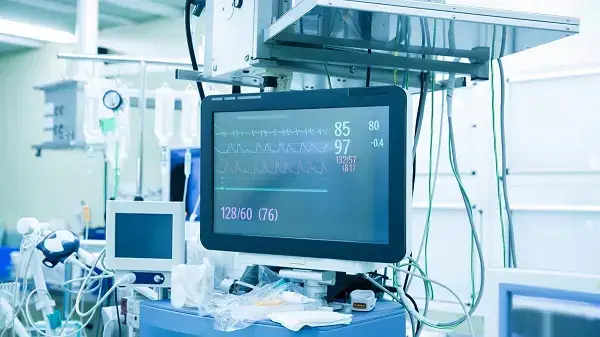
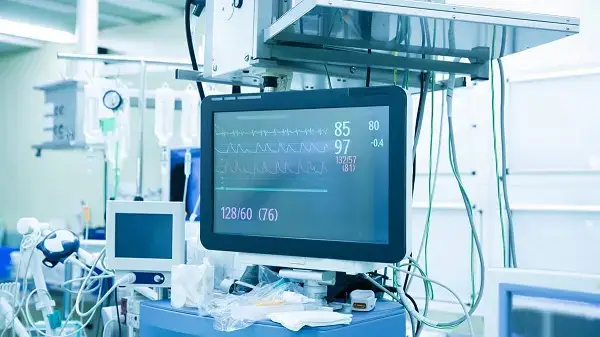
A patient monitor’s timestamps are only as useful as the clock behind them. In an intensive care unit, ECG, oxygen saturation (SpO2), blood pressure and other measurements may be recorded by bedside equipment and connected systems. When clinicians later compare a physiological change with an alarm or another device’s reading, differences between those systems’ clocks can blur the order of events.
That makes local timing a practical part of monitoring system design. Network synchronization can establish a shared time base, but each monitor still needs to keep time between updates, including periods when its network connection is unavailable or the equipment is in standby. The oscillator and clock circuitry inside the device determine how quickly its local time drifts during those intervals.
Synchronization leaves a holdover interval
Patient data can travel from monitoring equipment to central nursing stations, hospital networks and electronic health records (EHR). To make events from those endpoints easier to compare, the IHE Consistent Time Integration Profile (CT) specifies a median synchronization error of less than one second and uses Network Time Protocol (NTP) to establish a common time base.
That shared reference does not remove the need for accurate local clocks. Between synchronization updates, each device runs on its own timekeeping hardware. Any difference between the clock’s actual frequency and its nominal frequency accumulates as time error. The longer the interval before the next update, the more that accumulated error can affect the timestamp.
This independent interval is called holdover. It matters when a monitor temporarily loses network access, operates in an area with intermittent connectivity, or enters a low-power state. When communication resumes, the device can synchronize again, but events recorded during holdover still depend on how steadily its local clock ran. Timing quality is therefore a system concern: network synchronization sets the shared reference, while the hardware maintains it between updates.
For teams assessing event logs, the distinction helps explain why a network protocol alone cannot guarantee that every stored timestamp is equally precise. Synchronization frequency, network availability and local oscillator stability all affect how closely devices track the common time base. Accurate timestamps make it easier to compare records from separate endpoints, though they do not by themselves establish what caused a physiological change or alarm.
Frequency error becomes elapsed-time error
Temperature can shift the frequency of a timing reference. Patient monitors may be used across different thermal conditions, from cool clinical rooms to warmer bedside settings or equipment enclosures. A change in oscillator frequency means the device’s clock may gain or lose time relative to the shared reference.
The accumulated effect is easier to assess in seconds than in parts per million. For a 32.768 kHz temperature-compensated crystal oscillator (TCXO), a frequency error of ±20 ppm can produce drift of as much as 1.73 seconds over 24 hours. At ±5 ppm, the cited daily drift falls to 0.43 seconds. These figures illustrate how frequency stability affects the error that can build between synchronization updates; actual performance depends on the selected component and the conditions in which the device operates.
Mechanical and electrical conditions also shape component selection. Portable and cart-mounted monitors may experience vibration or mechanical stress during movement and repositioning. Nearby electronics can produce electromagnetic interference (EMI), adding demands on circuitry that handles signals. Designers have to account for these influences alongside timing accuracy, board space, power use and the monitor’s operating environment.
Low power and compact layouts add constraints
Battery-powered monitors must divide available energy among sensing, processing, display, wireless communication and other functions. Yet the real-time clock (RTC) still needs to maintain time in standby and other low-power states. A clock source suited to this role must combine stable timekeeping with low current draw, while the rest of the design determines how time, date and alarm functions are retained.
Board area is another constraint in compact equipment. Timing components occupy space that could otherwise support sensing, processing or communications. SiTime describes its Titan MEMS resonators as combining a small form factor with mechanical reliability. The practical value of a compact part depends on the device’s layout and design requirements; it can give engineers more room to fit other functions within a limited printed circuit board (PCB) area.
Timing components serve different roles
SiTime identifies several timing products for medical electronics. Its MHz MEMS oscillators, including SiT1602, SiT8008 and SiT8021, can provide reference frequencies for analog-to-digital conversion (ADC), microcontroller unit (MCU) or digital signal processor (DSP) functions, and communications interfaces, depending on application requirements. These parts support local clocking. Coordination of time across connected devices remains a system-level function.
For local timekeeping, SiTime points to the low-power 32.768 kHz TCXO SiT1552. It also lists the SiT95901 low-power RTC for maintaining time, date and alarm functions with battery-backup support. These components address distinct jobs: an oscillator supplies a frequency reference, while an RTC provides clock functions. Engineers still need to match the part’s stability, power draw, package and operating conditions to the monitor’s design.
As monitoring platforms connect more equipment, the number of clocks contributing to an event timeline grows. The useful design question is how much error can accumulate during each device’s expected holdover period, and whether that error fits the needs of the records being compared. Network synchronization provides a shared reference; stable local timing helps devices retain it until the next update.