304 or 316L Stainless Steel Enclosures: Matching Material to the Environment
- Published
- Author
- Casey Porter
- Reads
- 596
304 suits many indoor installations; 316L adds molybdenum for better resistance to chloride exposure and localised corrosion.
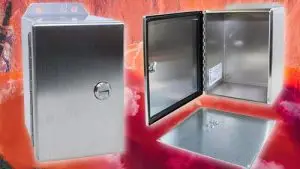
Choosing between 304 and 316L stainless steel is an environmental decision with a direct cost consequence. Hammond says an equivalent 316L enclosure typically costs 15–20 per cent more than one made from 304. That extra expense is useful where exposure calls for greater corrosion resistance, particularly around chlorides; for many indoor installations, 304 is normally adequate.
What changes between 304 and 316L
Both grades are used for enclosures that need mechanical strength, impact resistance and resistance to corrosion and chemicals. The key difference described here is molybdenum: 316L contains approximately 2–3 per cent, and Hammond says its material contains up to 3 per cent. This addition generally improves resistance to localised corrosion, especially pitting and corrosion in crevices when chlorides are present.
That distinction matters in settings such as seawater exposure and chemical processing, where chloride-rich conditions can attack a surface locally. Hammond rates 316L more favorably than 304 for salt water exposure, general chemical corrosion and pitting. Its comparison describes 304 as susceptible to chloride corrosion and 316L as resistant. For atmospheric and fresh water corrosion, the table rates 304 “Very good” and 316L “Excellent.” These are broad comparative ratings, not a substitute for checking the actual chemicals and conditions at an installation.
For an enclosure specified only by its material grade, the practical question is what the outside surface will encounter over time. Internal use is usually a straightforward case for 304, according to Hammond. A site exposed to salt water, chloride-bearing substances or industrial chemicals may justify considering 316L. The decision should reflect the exposure, rather than assuming that the higher grade is always necessary.
Wall mounted enclosures for general applications
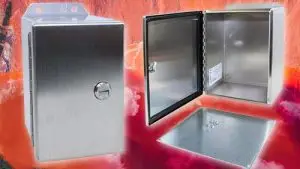
Hammond’s Eclipse Junior wall mounting family is offered in both 304 and 316L. The range has 22 standard sizes, from 102 x 102 x 76mm to 406 x 356 x 254mm. That spread gives specifiers several enclosure footprints while keeping the choice of stainless grade separate from the listed size options.
The body and cover are formed from 1.6mm material. Smooth, continuously welded seams are used, and the enclosures have no knockouts, cutouts or holes. A formed lip is intended to help keep flowing liquids and contaminants out. The continuously hinged cover opens through 180°, giving access to equipment inside the enclosure.
Tool operated door latches help restrict access and increase vandal resistance. A seamless poured-in-place gasket provides the environmental seal. Hammond lists the family as sealed to IP66 and NEMA Types 3R, 4, 4X, 12 and 13, and UL Listed. These enclosure ratings describe a separate part of the selection: the material grade addresses corrosion resistance, while the enclosure design and sealing address protection against external conditions.
Washdown requirements and the HYJ family
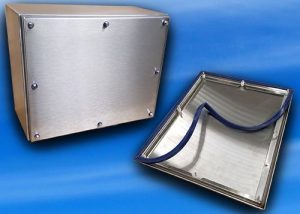
For applications with regular high pressure, high temperature washdown, Hammond’s UL Listed HYJ family is specified for IP69 sealing. It is made from 304 as standard, with 316L available on special order. Hammond describes the family as optimized for food and pharmaceutical environments where routine cleaning uses 15 l/m at up to 80°C, with the spray applied from 150 to 200mm.
The HYJ range comes in five sizes, from 202mm x 124mm x 102mm to 416mm x 338mm x 203mm. Its symmetric rectangular shape allows vertical or horizontal mounting. Sloped sides and smooth surfaces are designed to help water drain after spray cleaning, reducing places where wash water can remain on the exterior.
Six crevice-free hex head bolts, each fitted with a silicone washer, secure the cover to the body. The blue silicone gasket sits beyond the door edges, a layout intended to avoid crevices where dirt can collect. The gasket can be removed for cleaning or replacement. Hammond also offers versions with pre-punched holes for pushbuttons.
The HYJ product family therefore addresses washdown and enclosure sealing through its geometry, fasteners and gasket, while the option of 316L addresses material resistance when the installation environment calls for it. These are related but distinct specification decisions.
Specify for the exposure
A practical selection starts with the conditions at the enclosure: indoor or outdoor placement, fresh or salt water exposure, contact with chemicals, and whether cleaning involves high pressure or heat. The available comparison points toward 304 for many ordinary internal applications and 316L where chloride exposure or chemical conditions make its added corrosion resistance relevant. Since the stated price premium is typically 15–20 per cent for 316L, matching the grade to the actual environment can avoid paying for material properties the installation does not require.
Hammond provides product dimensions and design details for both families, along with downloadable product files including PDF, AutoCAD .dxf and 3D Solid Model .igs and .stp formats. Those details can help teams check enclosure fit and mounting arrangement alongside the material and sealing requirements.