Smart Maintenance Market Growth Depends on Closing the Alert-to-Repair Loop
- Published
- Author
- Zeynep Kaman
- Reads
- 894
The market is forecast to reach $20.4 billion by 2032, but better maintenance depends on linking fault alerts to repairs and feeding results back into models.
Industrial maintenance software is starting to connect the steps between a machine fault and a completed repair. That shift matters because an alert by itself doesn’t prevent downtime: someone must diagnose it, plan the work, carry it out and record what they found. The final record can then improve future alerts. Today, those steps often sit in separate systems and depend on experienced technicians to bridge the gaps.
IoT Analytics estimates that the global smart maintenance market reached $8.1 billion in 2025 and will grow at a 14% compound annual growth rate (CAGR) to $20.4 billion by 2032. The market remains fragmented: Baker Hughes, IBM and Emerson lead, but no vendor holds more than 6%. Vendors are trying to connect their separate products through software integrations, partnerships and acquisitions, with AI agents beginning to coordinate more of the work.
Why the repair has to complete the loop
Smart maintenance connects monitoring, diagnosis, maintenance action and reliability improvement. The practical sequence starts when a sensor detects an abnormal condition. Analytics identifies a likely fault and may recommend a response; asset performance management (APM) helps rank the issue; and a computerized maintenance management system (CMMS) plans and records the work. The loop closes when technicians document what they found and that information returns to the system that generated the alert.
That last handoff is often missing. Alerts may arrive by email or phone, while maintenance planners manage work in a separate CMMS. After a repair, technicians may enter hurried free-text notes—or leave the record empty. A “no fault found” result is seldom captured. Without reliable closeout data, the software can’t distinguish a correctly identified failure from a false alarm, or learn which repairs resolved a particular condition.
For years, experienced technicians supplied this missing context themselves. They interpreted alerts, recognized familiar failure patterns, fixed the equipment and remembered the result. That knowledge is becoming harder to retain. In an IoT Analytics survey of 120 digital decision-makers in machine building in 2025, 43% identified workforce skill gaps and lack of expertise as a critical or significant barrier to AI adoption. MaintainX co-founder Nick Haase has estimated that half of maintenance and reliability professionals will reach retirement age within about five years.
The economic case is substantial, though any one repair is difficult to tie directly to a prevented failure. IoT Analytics estimates that unplanned downtime costs industry between $0.5 trillion and $1.0 trillion annually, with about 87% of that cost indirect, including lost revenue and missed orders. A prevented outage leaves no direct line on a profit and loss statement; plants therefore need evidence in operating results.
One example comes from Gousto, a UK meal-kit company. It connected factory equipment—including older machines fitted with vibration sensors—to a shared data platform. Its CMMS converts anomalies into work orders and sends them to engineers through an app. Over 18 months, Gousto’s mechanical availability rose from 70% to 98.5%, while mean time to repair (MTTR) fell from one hour to 15 minutes.
The cost of a prolonged outage can also be large. LyondellBasell’s propylene oxide/TBA asset in Bayport, Texas, experienced an unplanned outage beginning in March 2026 that lasted about 13 weeks. Management estimated a $25 million weekly EBITDA impact, or about $150,000 per hour. The estimated effect was about $40 million in the first quarter and $250 million in the second.
Six segments, with vendors reaching across the gaps
The market spans six categories: wireless, wired and portable sensing, plus standalone maintenance analytics, APM and CMMS. Sensing detects changing machine conditions. Analytics diagnoses and recommends; APM prioritizes; and CMMS software organizes, executes and documents work. Each category addresses a different part of the process, but vendors are increasingly reaching into adjacent steps with bundled products and integrations.
Wireless sensing is growing fastest. IoT Analytics forecasts that it will expand from $1.1 billion in 2025 at a 24% CAGR to $5.1 billion by 2032, making it the largest segment by then. Wireless specialists such as I-care, AssetWatch and Tractian are gaining share, while several automation incumbents are losing share in this segment. The report also estimates that 4.1 million sensors shipped in 2025, with shipments expected to grow 16% annually through 2032.
Wireless vendors once tended to stop at the alert. Many now bundle sensors, software and expert diagnosis in a subscription, then pass findings to a customer’s work order system—or provide a CMMS of their own. Nanoprecise, Waites, KCF Technologies and Augury each integrated with MaintainX between October 2025 and March 2026. In the Waites integration, technician updates flow back to analysts, connecting the repair record to the monitoring process.
A sales engineer at a wireless vibration monitoring specialist described the operating model: “When our AI sensors detect a specific failure mode, such as pump cavitation, our platform opens a work order in the connected CMMS (e.g., MaintainX, SAP) or in our own CMMS.” The useful distinction is between generating a ticket and learning from the repair. The first can speed dispatch; the second can improve later diagnosis.
Wired sensing is forecast to grow more slowly, from $1.4 billion in 2025 at a 6% CAGR to $2.1 billion by 2032. Its vendors are also moving toward execution. Ifm electronic’s moneo Asset Health identifies a likely fault cause and creates a maintenance ticket with a repair recommendation. For critical machines, SKF links condition monitoring with lubrication, alignment, bearing replacement and on-site maintenance support. It also takes responsibility for reliability outcomes through performance-based contracts.
Standalone analytics is projected to grow from $1.1 billion in 2025 at a 22% CAGR to $4.2 billion by 2032. The product shift is from prediction alone toward a diagnosis and suggested repair. Siemens Senseye, Augury and Treon presented features in 2025 and 2026 that add a likely root cause and recommended action to an alert. In July 2026, Augury partnered with Rockwell Automation to have its alerts create work orders automatically in Rockwell’s Fiix CMMS.
CMMS software occupies the point where work is planned, performed and closed, so it can hold the feedback needed for model improvement. Vendors are moving upstream into machine data and triggering. MaintainX demonstrated a pressure-threshold trigger that opens a work order at IMTS 2026. Rockwell connects machine data from its control systems to Fiix. The CMMS segment is forecast to rise from $1.9 billion in 2025 at a 13% CAGR to $4.6 billion by 2032, faster than its 12% annual growth rate over 2022–2025.
Integration is common; feedback remains scarce
The broader vendor roster includes SAP, Siemens, ABB, SKF and GE Vernova, alongside specialists such as I-care, Augury and Tractian. Yet breadth across the whole process is unusual. Of 597 vendors classified in the Smart Maintenance Vendor Database 2026, 76% offer only one of the six solution categories; only 7% offer three or more. Most companies cover one or two steps and depend on other suppliers for the rest.
That specialization explains why integrations are multiplying. In some plants, staff still transfer alerts into the CMMS manually. Elsewhere, a connection may create a work request automatically or send work order status back to the analytics platform. These links automate useful sections, but they often stop short of returning a technician’s findings to the model. Notes such as “bearing replaced, outer race damage confirmed” or “no fault found” are the labels that can tell a system whether its diagnosis was useful.
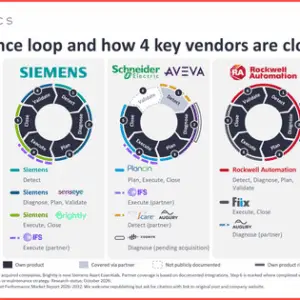
Four companies illustrate different ways to assemble the process. Siemens covers steps one through five with products spanning condition monitoring hardware, Senseye analytics and Brightly CMMS, which it acquired in 2022. Industrial Copilots and AI agents across Senseye and Brightly are intended to translate alerts into diagnoses, repair instructions and work orders. In June 2026, Siemens also partnered with IFS to connect its digital twin and production intelligence with IFS’s EAM and field service management software.
Schneider Electric covers the software portion, steps two through five, with AVEVA for analytics and APM, and Planon for CMMS. It doesn’t offer dedicated monitoring hardware within the market scope described here, so it works with sensing providers including I-care and Augury. Schneider agreed in 2026 to acquire Cognite for $3.1 billion; the deal would add an industrial data and AI layer alongside AVEVA’s APM software.
Rockwell Automation combines its sensing and analytics products with Fiix, the CMMS it acquired in 2020. On July 14, 2026, it introduced Fiix MAX, an AI maintenance assistant embedded in the CMMS workflow that surfaces asset history, parts context and work instructions. Later that month, Rockwell partnered with Augury to connect its Reliability Agent with Fiix MAX. Validated machine health issues can then generate prioritized work orders containing a diagnosis and suggested repair steps.
MaintainX starts with the CMMS, covering work planning through closeout, and depends on other companies for detection and diagnosis. Its integrations with Augury, KCF Technologies, Nanoprecise and Waites were made between October 2025 and March 2026. In the KCF and Waites integrations, technician feedback returns to the sensing vendor. Since May 2026, Autodesk has owned MaintainX, creating a possible connection between field maintenance records and product design.
The examples show several routes to broader coverage: build the missing product functions, connect to specialist vendors, form partnerships or acquire adjacent capabilities. They also show why the CMMS is central. A monitoring company can identify a fault, but the CMMS is where a repair is assigned, carried out and recorded. Without that link, the alert’s path to a completed job is difficult to demonstrate.
AI agents need reliable plant data
AI in maintenance has often meant identifying anomalies. Vendors are now describing agents that can act on an alert and coordinate the next steps, including work requests, technician assignments and spare parts. IBM’s Maximo Condition Insight analyzes asset data, work orders and failure modes. SAP’s agents convert asset health signals into pre-filled maintenance requests. Bosch’s Smart Maintenance Agent allocates technicians and spare parts. Siemens and Rockwell have embedded AI assistants in their CMMS products.
These capabilities don’t remove the need for sound maintenance records. Sensors, work orders, parts systems and technician knowledge may all contain relevant information, but many plants keep those sources disconnected. Asset records may also be incomplete or out of date. An agent working from poor data can produce the wrong work order or reinforce a mistaken diagnosis. IoT Analytics ranks poor maintenance data among the five most pressing challenges for adopters, alongside the shortage of skilled workers.
The prerequisite is operational: connect relevant systems, maintain usable asset records, and ensure that work orders are properly completed and closed. The technician’s finding must be captured in a form that can inform future diagnosis. Only then can an AI system learn from repair outcomes rather than simply produce more alerts.
How much authority to give AI remains unsettled. Tractian positions its system toward AI-led diagnosis without a human analyst reviewing every alert. Waites and AssetWatch emphasize expert review before an alert reaches the customer. Either approach has to earn trust: a false alarm can make plant staff less willing to act on later alerts. Greater autonomy will depend on evidence that diagnoses are accurate and that recommended work gets completed. Vendors are placing their products on a five-level scale from human-only to AI-only, but adoption will depend on performance in actual maintenance operations.
Adoption is still early. IoT Analytics reports that only one in five process plants in its survey uses AI to predict failures. Agentic AI gives vendors new ways to coordinate maintenance steps, but the report expects closed-loop systems to take years to become mainstream across most of the areas it tracks. Manufacturers tend to adopt cautiously, and software capability alone doesn’t connect disconnected equipment records or improve incomplete closeout notes.
The market estimates and vendor comparisons come from IoT Analytics’ Smart Maintenance & Asset Performance Market Report 2026–2032, published in November 2026. Its research included interviews with more than 75 experts, two end-user surveys of 120 respondents each, and visits to four trade fairs, including Hannover Messe and IMTS 2026. The market definition covers connected digital solutions and directly related services supporting industrial asset maintenance. It includes sensing with bundled software and services, standalone analytics, APM and CMMS; standalone managed monitoring and reliability consulting, as well as EAM, ERP and MES, sit outside that core scope.
The outlook is clear even if the path differs by plant: smart maintenance is expanding, and vendors are working to connect detection with action. The test is whether a system can carry an alert through a completed repair and return a trustworthy result to the next diagnosis. Until that feedback becomes routine, AI may speed parts of the workflow, but experienced staff and disconnected records will continue to shape what the system can do.