Smart Home Adoption in Europe and North America Could Reach 200.7 Million Households by 2030
- Published
- Author
- IoT.Business.News
- Reads
- 988
Berg Insight forecasts 200.7 million connected households by 2030, with growth increasingly tied to integration, services and useful automation.
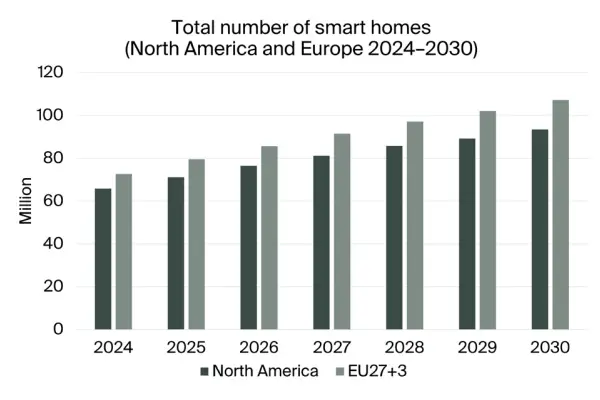
Smart home growth is moving into a phase where making devices work together may matter as much as adding new connected households. Berg Insight estimates that 150.6 million households in Europe and North America had at least one smart home system at the end of 2025. It forecasts 200.7 million by 2030, an increase of about 50 million households in five years.
That forecast describes adoption, not the total number of devices or systems in use. Many homes run several separate smart home solutions, from lighting controls to security equipment. This distinction helps explain why the installed base is already far larger than the household count—and why integrating existing systems is a significant part of the market’s next phase.
Europe has more connected homes; North America has higher penetration
North America had 71.1 million smart homes at the end of 2025, equal to 47.2 percent of households in the region. Berg Insight projects the count will reach 93.5 million by 2030, with a compound annual growth rate (CAGR) of 5.6 percent.
Europe, defined in the research as the EU27+3 countries, had 79.5 million connected households in 2025. That was 33.3 percent of households. The forecast puts the installed base at 107.2 million in 2030, a 6.2 percent CAGR.
The regional differences also reflect different routes into home automation. In North America, interactive home security services have helped introduce consumers to connected devices. ADT, Vivint, SimpliSafe, Comcast and Telus are among the providers combining monitoring with connected home functions.
In Europe, traditional automation platforms and do-it-yourself products have a more prominent role. Providers named by Berg Insight include Shelly, eQ-3, Somfy, Loxone and Verisure. For manufacturers and integrators, these established routes shape what customers expect from a system, including how it is installed, managed and extended.
More than 567 million systems are already in use
At the end of 2025, North America had 314.6 million smart home systems in use. Berg Insight divides that total into 243.7 million single-purpose solutions and 70.9 million multifunction or whole-home systems. Europe had 253.2 million systems: 202.2 million point solutions and 51.0 million whole-home systems. Together, the regions accounted for approximately 567.8 million installed systems.
A household with a connected thermostat, camera system and lighting controls might have several distinct solutions, even if its occupants consider them part of one smart home. The figures therefore capture two different measures: how many households have adopted smart home technology, and how many systems those households use.
That gap points to work beyond acquiring first-time customers. Device makers and platform providers can seek to bring separate functions into a more coordinated experience. Integration can make it easier for users to control equipment across applications, but it also raises practical questions about compatibility, software support and how devices from different vendors exchange information.
Revenue growth outpaces household growth
Berg Insight estimates North American smart home revenue at US$57.4 billion (€50.8 billion) in 2025. Its forecast reaches US$88.0 billion (€77.9 billion) in 2030, an 8.9 percent CAGR. For Europe, it projects revenue growth from €44.5 billion in 2025 to €75.9 billion in 2030, equivalent to an 11.3 percent CAGR.
Across both regions, annual revenue from home automation system shipments and service fees is forecast to rise from €85.6 billion in 2025 to €153.7 billion in 2030. Since this projected increase is faster than household adoption, revenue growth appears set to depend increasingly on what systems do, how many functions they support and the services attached to them.
Those figures combine equipment shipments and service fees, so they cover more than the sale of connected devices. The split also matters in practice: recurring services can form part of a provider’s offer, while hardware has to fit into the customer’s existing mix of products and platforms. Berg Insight’s forecast indicates expansion in both regions, with Europe growing faster on the reported revenue measure.
Compatibility will shape the next generation of products
Smart homes still span multiple communication technologies, including Wi-Fi, Bluetooth, Zigbee, Z-Wave and Thread. Matter is one interoperability initiative intended to simplify connections among products from different vendors. Berg Insight also identifies embedded hub functions and artificial intelligence as developments to watch through 2030, alongside energy efficiency, product discontinuations and consumer trust.
For product teams, connectivity alone doesn’t guarantee a useful system. Customers may expect a device to work with platforms they already use, and that expectation makes compatibility and continued software support part of the product decision. Integrators face a related challenge: combining equipment across brands requires dependable interactions, especially when several home functions are meant to respond together.
AI could coordinate security, heating, lighting and other connected functions more automatically. That depends on systems being able to access the needed data and communicate consistently across products. When that foundation is missing, adding another layer of automation may not resolve the underlying integration problem.
Security, climate control and service robotics stand out because users can readily connect them with monitoring, energy use or household tasks. Smart thermostats and energy management products, for example, are aimed at helping households manage consumption and costs; the forecast doesn’t quantify savings for users. The practical test for the market will be whether connected functions provide dependable value together, rather than merely increasing the number of devices in each home.
Berg Insight’s report brochure, Smart Homes and Home Automation, provides further information on the research.