EOS HELIOR Adds Large Build Volume and Three Lasers for Polymer Production
- Published
- Author
- Laura Griffiths
- Reads
- 762
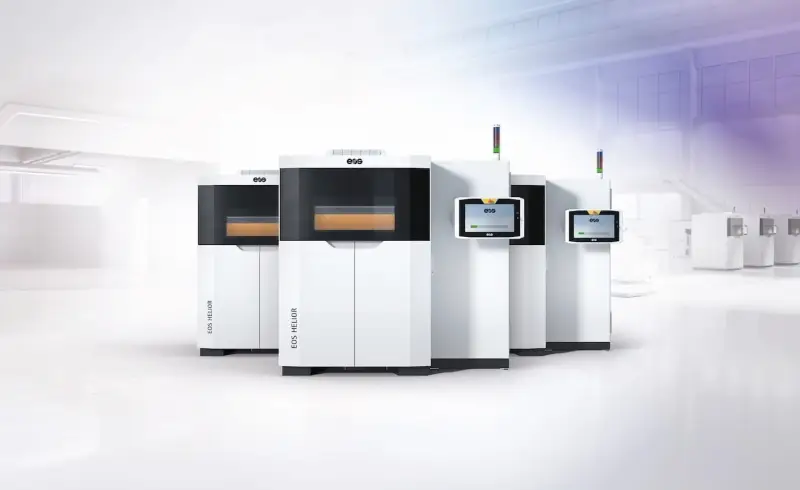
EOS HELIOR combines a 700 x 380 x 580 mm build volume with three 70W lasers, targeting high-volume polymer production and reduced finishing work.
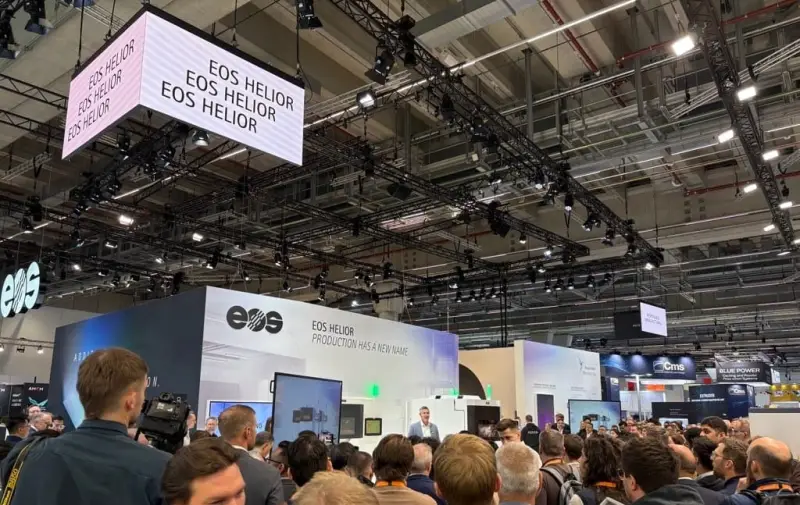
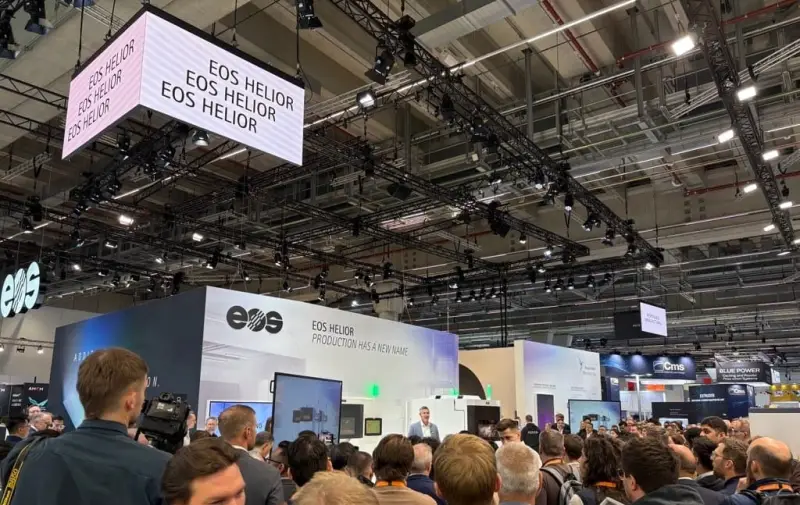
EOS is positioning HELIOR around production economics: a larger polymer build chamber, three 70W lasers and process features intended to increase output while cutting finishing work. The system’s 700 x 380 x 580 mm build volume is aimed at manufacturers running substantial part volumes, including contract manufacturers and service providers. EOS says HELIOR will be commercially available from December.
More build capacity per production cycle
EOS claims up to 80% higher throughput, citing a 24-hour build cycle that produces 154 liters of parts at 10% packing density. That figure describes a particular packing condition and build duration; it should be read as a stated production example, not a universal output rate. Actual results will depend on the part mix, arrangement, material and process settings used in a job.
The system uses three 70W lasers, which EOS says are fully utilized through dynamic load balancing. In practical terms, that approach is intended to distribute work across the available laser capacity as the build proceeds. The stated aim is to raise machine output across a large build area. For production teams, the relevant question will be how well that capacity translates to their own geometries and job schedules.
EOS says HELIOR is designed to support a full week of build jobs and more than 1,000 liters of production before maintenance operations. Those figures frame the machine as equipment for sustained use, rather than occasional builds. They also make maintenance planning and job sequencing part of the value proposition: longer production runs can help keep capacity in use, provided the work queue and material workflow match the machine’s scale.
Finishing work and process control
EOS claims up to an 80% reduction in post-processing effort. The features it identifies include an independently adjustable roller recoater and geometry-aware advanced exposure parameters. The recoater’s independent adjustment gives operators a way to configure powder spreading, while the exposure parameters are intended to account for part geometry during processing. EOS presents these capabilities as a means of reducing work after the build; the actual reduction will depend on the parts and finishing requirements involved.
EOS also points to 3D EOSAME for part homogeneity across the build chamber and Smart Scaling for Z-direction accuracy. It describes advanced process parameters as enabling one-click build optimization. Together, these features address consistency and setup within the production workflow. They matter most when a machine is expected to make many parts across a large chamber, where repeatability and the effort required to prepare builds affect day-to-day throughput.
Designed around high-utilization users
Rüdiger Herfrid, EOS senior product manager for software, described HELIOR as the company’s biggest polymer system. He said EOS expects contract manufacturers and service providers to be an important audience because of the machine’s high volume and suitability for large parts. Original equipment manufacturers are also potential users, he said, but EOS sees contract manufacturers as the majority of its customers for this kind of capacity. Herfrid characterized the intended operating pattern as close to continuous use, describing it as “twenty-four/seven or twenty-four/six.”
EOS chief technology officer Joachim Zettler said the system was developed around production concerns including throughput, flexibility and reliability. He pointed to integrated monitoring, open data access and reduced maintenance alongside lower post-processing and labor demands. Those are manufacturer-stated benefits; for a buyer, the practical assessment will depend on how HELIOR’s workflow fits existing production planning, labor allocation and quality requirements.
EOS says five pilot customers helped develop and validate the system: FKM Additive Manufacturing, Prototal Group, Materialise, Shapeways and Formrise. Their involvement provides a set of industrial users in the development process, though no customer-specific performance results are provided here.
Materials and production integration
At launch, HELIOR has validated material process parameters for PA 2200 and PA 2220 HighReuse. EOS says additional materials will be qualified in response to customer requests. That qualification path matters for manufacturers whose production work depends on a particular polymer: the two launch materials define the stated starting point, while broader material choice depends on later qualification.
The machine is designed to connect with EOS software, materials and production solutions. EOS also identifies powder feeding and automated unpacking among the peripheral technologies available through a partnership with AM Solutions. These systems can support material handling around the build process, a significant consideration when a large machine is expected to run at high utilization. The next measure of HELIOR’s production case will be how its claimed output and reduced finishing effort hold up across customers’ parts, materials and operating schedules.