RIG-TARS Desk Robot Combines ESP32-S3 Control, Serial Servos and Voice Interaction
- Published
- Author
- Ananthu Ashok
- Reads
- 817
LuwuDynamics’ $99 RIG-TARS kit pairs an ESP32-S3 with three UART servos, an IMU, display and networked voice features; the enclosure is 3D printed separately.
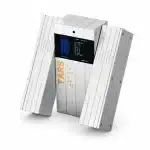
RIG-TARS puts articulated movement, onboard sensing and voice interaction into a desktop robot built around an ESP32-S3. LuwuDynamics’ $99 kit includes the electronics and components, while builders supply a 3D-printed enclosure. Its design makes the project a compact platform for experimenting with motion control and connected robot interfaces.

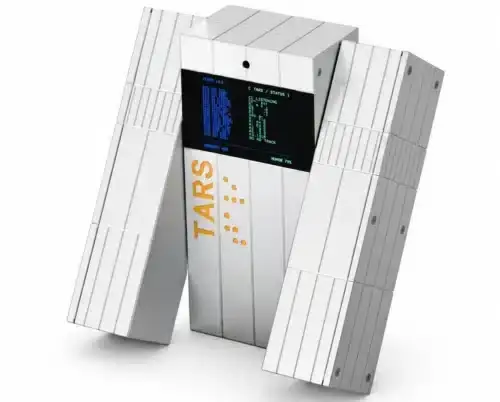
Three actuators define the motion system
Rather than using wheels, RIG-TARS moves and changes posture through a three-column articulated body. Three serial servos receive commands over UART, giving the firmware control of the robot’s pose. The arrangement is intended to support several body configurations, with the same platform configurable as TARS, Puppy, Hover or ARM.

A six-axis QMI8658C inertial measurement unit (IMU) tracks the robot’s motion and orientation. That sensor data gives the controller information about how the body is positioned as the servos move it. The combination of commanded actuation and inertial sensing is useful for interactive desktop robotics, where posture and movement are central parts of the interface. The available details don’t specify the servo models, joint ranges, movement speed or any balance performance, so those capabilities will depend on the mechanical design and firmware implementation.

Display and audio connect the user to the controller
A 2.4-inch TFT display, driven by an ST7789V2 controller, provides a 320×240-pixel interface. It can show system information such as battery voltage, module orientation, tasks and process logs. This gives users a way to inspect the robot’s state locally, alongside its audio interface.

The robot has a microphone and speaker, with audio processing handled over I2S. The ESP32-S3 supplies Wi-Fi and Bluetooth Low Energy connectivity. Firmware supports optional GC0308 or OV2640 cameras, although the camera is not described as part of the standard kit contents. The source specifications don’t state the battery capacity, runtime, display brightness, audio performance or camera resolution; these details matter to anyone planning extended operation or a specific vision application.
Voice features rely on a network connection
RIG-TARS runs RIG-Omni, a C++ firmware platform. Its voice interface combines on-device wake-word detection with speech recognition and generation over a network connection. That split places wake-word handling on the robot while enabling interaction with large language models hosted on cloud servers.

The firmware also supports Model Context Protocol (MCP), which is used to expose voice commands for functions such as movement, calibration and status checks. In practical terms, a spoken request can connect the user-facing audio path to robot actions and system information. The network dependency is part of that design: the described speech recognition and generation use remote services, so connectivity and the chosen service will shape the interaction. No supported service list, latency figures or offline speech-recognition capability is specified.

Kit scope and project files
At US$99, the kit includes the components but excludes the enclosure, which builders must 3D print. That makes the printed body a key part of assembly: its geometry has to accommodate the three-column mechanism and electronics. LuwuDynamics provides the RIG-Omni firmware, mechanical design files and documentation through its GitHub project, giving builders material to inspect before adapting the robot.
The project README identifies Apache License 2.0, but the actual license file should be checked before using or modifying the files for commercial work. That distinction matters for anyone planning to distribute a derivative design or incorporate project code into a product.
RIG-TARS’ appeal lies in bringing servo control, inertial sensing, a small status display and networked voice interaction together in a buildable desktop form. For engineers and makers, the next practical questions are how the supplied mechanical files handle actuator mounting, how the firmware maps commands to each configuration, and what the optional camera and cloud speech paths require in a finished build.