Satellite IoT in Europe: 868 MHz Limits and NB-NTN Options
- Published
- Author
- Harald Naumann
- Reads
- 426
Europe’s 868 MHz satellite rules cover only six countries and limit downlink use. NB-NTN offers two-way links, with country-by-country spectrum rights still required.
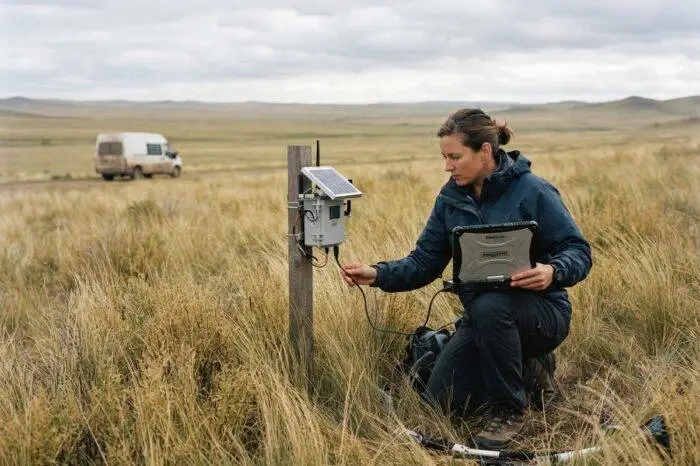
Choosing a satellite radio for an IoT product determines more than its coverage. It shapes which markets the device can enter, what it can send back to the network, and whether it can receive substantial data such as firmware updates. In Europe, satellite links using the 868 MHz band suit a narrower set of devices and countries than a global product may need. NB-NTN supports two-way communication under a global technical standard, but still depends on spectrum rights in each market.

868 MHz access is limited by country
The 862 to 870 MHz band is designated in Europe for short-range devices, including sensors, wireless switches and LoRaWAN nodes. It has no general allocation for satellite services. To create a route for low-power devices to communicate with satellites, the European Conference of Postal and Telecommunications Administrations (CEPT) adopted Decision ECC/DEC/(25)02 on June 27, 2025. The decision sets technical conditions for those links.
Adoption is a country-by-country matter. As of November 2026, six countries had implemented the decision: Belgium, Denmark, Germany, Lithuania, Slovakia and Spain. Eleven more planned to implement it, including France and the Netherlands; sixteen were still examining it. Poland, Serbia and the United Kingdom had not implemented it.
The decision’s annex listed two satellite systems: LS-4 from Lacuna Space, notified by Germany, and Plan-S from Connecta IoT, notified by Türkiye. An implementation in one country does not grant access across ITU Region 1, which includes Europe, Africa and the Middle East. A manufacturer needs to check both whether each target country has implemented the decision and whether the satellite operator has permission to provide service there. In Germany, each satellite network needs individual authorization from the Bundesnetzagentur.
Equipment also needs CE marking under the European Radio Equipment Directive. In the simplest case, the manufacturer can self-declare conformity. That product-level step does not establish that satellite service is available in every country where the device might be sold.

LoRaWAN’s downlink is the main application constraint
LoRaWAN can move small sensor readings over long distances with low device power, but its satellite use brings both access and link-budget constraints. Classic LoRaWAN typically uses eight channels, each 125 kHz wide. Its ALOHA access method lets devices transmit without first checking whether a channel is clear, so collisions and lost packets are part of the system’s behavior.
That trade-off becomes more pronounced when a satellite is moving overhead. Visibility windows are short, and the satellite’s motion introduces Doppler shift: a change in the received signal frequency. Either factor can make an already uncertain transmission less reliable. For asset tracking, agriculture or infrastructure monitoring, missing data may have a direct operational cost.
Semtech’s LR-FHSS method reduces spectrum use through narrowband frequency hopping. It does not change LoRaWAN’s ALOHA access method, so it does not remove the possibility of collisions. The more consequential limit in Europe is the satellite-to-device link. ECC/DEC/(25)02 describes satellite downlinks as multicast messages for functions such as wake-up calls and device control, rather than targeted messages to individual devices. It also places strict limits on transmit power reaching the ground.
That combination makes over-the-air firmware updates impractical under the described 868 MHz arrangement. A sensor that sends occasional readings may still fit the model. Products that need substantial downlink data or dependable exchanges in both directions need a different connectivity plan.
NB-NTN provides a two-way satellite path
NB-IoT is a cellular standard designed for low-power IoT devices. In Release 17, 3GPP extended NB-IoT to non-terrestrial networks, including satellites. The satellite form is called NB-NTN. Devices use satellite navigation (GNSS) positioning to help compensate for timing and frequency offsets, addressing the long signal delays and Doppler effects associated with satellite links.
NB-NTN is sometimes grouped under the broader label 5G NTN, but the standards distinguish it from NR-NTN, the satellite form of 5G NR. Since Release 19, NR-NTN also supports RedCap and eRedCap devices: simplified 5G equipment intended for IoT applications with higher data needs than NB-IoT sensors.

Unlike ALOHA-based access, the network assigns transmission times to devices. Communication runs in both directions and uses satellite bands intended for the service. For example, Skylo operates in L-band (n255) and S-band (n256) through satellite partners including Viasat and EchoStar; it does not operate its own satellites.
The ecosystem includes chipsets, modules, certification programs and network services. Pixel 9 users have been able to contact emergency services by satellite through Skylo since August 2024, and the service has also extended to the Pixel 10 series. For IoT, Deutsche Telekom, o2 Telefónica and Vodafone IoT offer NB-NTN through Skylo.
Service availability and spectrum rights still matter
A standard that supports satellite communication does not guarantee coverage or service in every market. NB-NTN operators need rights to use their frequencies in each country, and providers are at different stages of deployment. Deutsche Telekom has Skylo in live operation with geostationary satellites; its connection with OQ Technology’s low Earth orbit satellites has been validated.
Geostationary satellites remain above a fixed point on Earth, while low Earth orbit satellites circle the planet at altitudes of a few hundred kilometers. The two orbits create different link conditions, but neither removes the need to design the radio and antenna around the intended network.
A separate satellite LoRaWAN route uses licensed S-band spectrum rather than the 868 MHz arrangement. EchoStar Mobile offers satellite LoRaWAN mainly in that band, where European rights are held by EchoStar and Viasat. Those rights expire in May 2027. A proposed transition would keep them in place for two more years, while preventing their holders from transferring or leasing them. Product plans that rely on this route therefore need to account for the stated expiry and transition period.
Antenna design remains a system-level problem
For a geostationary link, the satellite is around 36,000 kilometers away. At that distance, small antenna design errors can prevent a device from connecting. Low Earth orbit satellites are closer, but pass quickly across the sky, so signal delay and Doppler shift change rapidly. Both cases leave little room to treat the antenna as an afterthought, especially when it must fit inside a compact product enclosure.
OpenFlare is one example of a development platform addressing those constraints. Antennity and Embever are developing it for the European Space Agency as an open-source connected warning light intended to replace a roadside warning triangle. It is also a reference design for battery-powered IoT devices that need accurate positioning. OpenFlare uses NB-IoT and LTE-M, switches to NB-NTN where terrestrial coverage is absent, and uses GNSS to determine position. Its development material includes schematics, antenna concepts and RF measurements.
Commercial hardware offers another example. Spanish livestock-tracking company Digitanimal uses a collar certified by Skylo for its network. The collar sends data via NB-NTN and uses a PrimeLoop antenna instead of a conventional chip antenna. Antennity developed the hardware, while Digitanimal developed the firmware.
Match the radio to the product’s markets and data flow
For a low-data sensor sold in a country that has implemented ECC/DEC/(25)02, 868 MHz satellite LoRaWAN may be suitable. Its downlink conditions make it a poor fit for products that require firmware updates or regular two-way communication. NB-NTN offers a broader technical path for those uses, and its components and network services are available, though the market remains small and service depends on national spectrum rights.
The practical design decision is to map target countries, operator permissions, required downlink volume and antenna constraints before committing to a radio platform. Global reach depends on the combination of device, network and country approvals; a band name or standard alone cannot establish it.