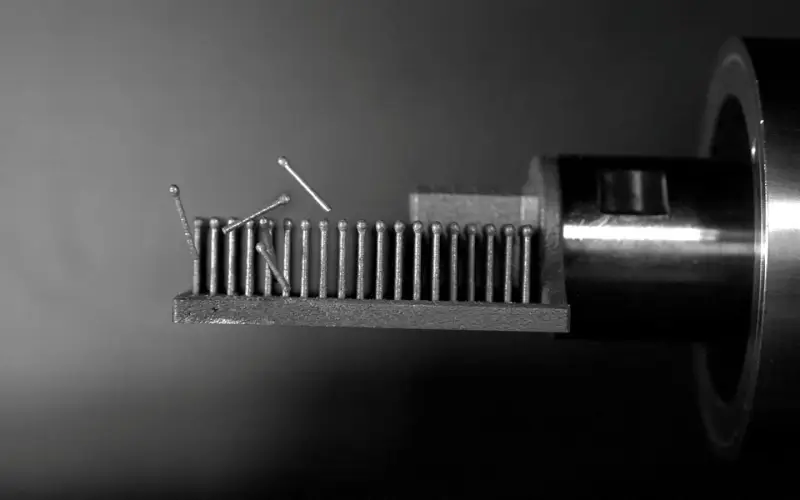
German applied research institute Fraunhofer IAPT has developed an automated process that uses ultrasound to remove support structures from 3D printed metal parts. According to the institute, the supports come away cleanly within a few minutes and without manual work. The institution exhibited the method publicly for the first time at Formnext 2026, and it has already filed a patent application for the process.
The process applies high-frequency mechanical vibrations in the ultrasonic range to a printed component. Fraunhofer IAPT says the method saves time and money, improves workplace safety, and makes support removal more stable and repeatable, with consistent quality from part to part.
Tackling a costly bottleneck
Support removal is one of the most labor-intensive steps in post-processing additively manufactured parts, and delicate features or internal structures make it harder still. Done by hand, it takes up staff time, gives results that vary from part to part, and can expose workers to health and safety risks such as fine metal powder particles released into the air.
Fraunhofer IAPT’s method replaces that manual work with ultrasound. A strong coupling between the component and an ultrasonic system carries high-frequency vibrations into the part, and especially into its supports. The institute pairs vibration settings tailored to each component with specially adapted support structure designs. Together, they set up resonance in the supports and concentrate stress where the supports attach to the part, so the supports break away cleanly.
According to Fraunhofer IAPT, the process uses low-cost equipment, greatly speeds up support removal and is designed as an automated step that can be built into production lines.
From dental labs to wider industry
The method came out of the Sonodent research project. In May 2026, the project received funding from the Fraunhofer High-Performance Center IAMHH.
Dental technology is the first application, but Fraunhofer IAPT says the process can be used in other industries and adapted to any 3D printing process that relies on support structures. The institute presents the method as a step toward wider industrial adoption of additive manufacturing, because it automates a step that has so far depended heavily on manual work.
Taking the hands out of support removal
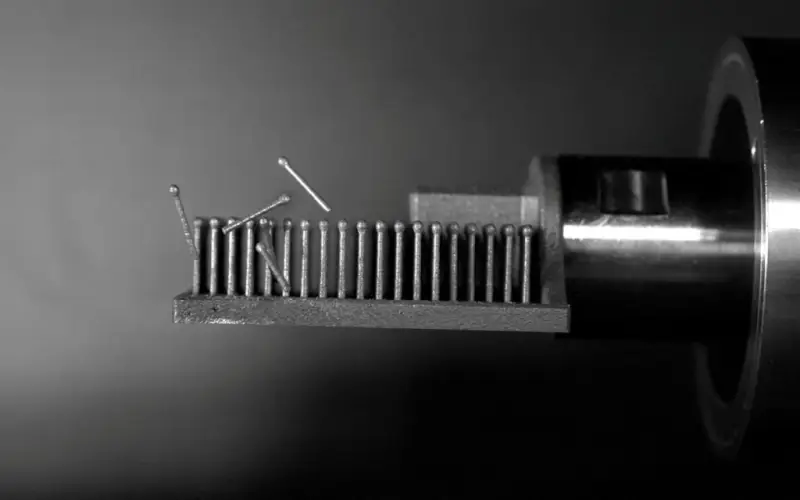
Fraunhofer IAPT is targeting one of the most manual steps left in metal additive manufacturing. Its approach does two things at once. It designs supports specifically to fail under ultrasonic vibration, and it automates the removal so the step can run inside a production line rather than at a technician’s bench.
Robotics is another route to that goal. UK-based Rivelin Robotics developed Netshape Robots, which use its Netshape software to enable automated support removal and surface finishing of metal parts. According to Rivelin, its technology enables a 90% reduction in defects, a 10-fold reduction in operating costs, and eliminates the potential for human risk and variability. Through the UK government-funded CAMPFIRE project, the company worked with partners including GKN Aerospace to apply the system to aerospace parts, orthopaedic implants and gas turbine components.
Other companies are changing the supports themselves, which is also part of Fraunhofer IAPT’s method. For its upcoming SnowPod compact metal printer, SnowX has designed a breakaway support structure that can be removed from a part gradually. The company compares its behavior to a zipper and says it is meant to simplify support removal after printing.
From robots to redesigned supports, the industry is trying to make support removal fast and repeatable enough to keep pace with printing.
Voting is open for 2026 3D Printing Industry Awards. Have your say now!
To stay up to date with the latest 3D printing news, don’t forget to subscribe to the 3D Printing Industry newsletter or follow us on LinkedIn.
Explore the full Future of 3D Printing and Executive Survey series from 3D Printing Industry, featuring perspectives from CEOs, engineers, and industry leaders on the industrialization of additive manufacturing, 3D printing industry trends 2026, qualification, supply chains, and additive manufacturing industry analysis.
Featured image shows Support removal using ultrasound. Photo via Fraunhofer IAPT.